How to Prove Social Media ROI to Investors
Learn to prove social media ROI to investors by converting marketing metrics into investor-grade KPIs. Understand CAC, LTV, and retention for scalable growth.

How to Prove Social Media ROI to Investors
When you are attempting to understand how to prove social media ROI to investors, you are entering a completely different arena from that with which most marketing teams are familiar. Investors don’t invest in likes, reach, or even really cool engagement graphs. They invest in repeatable, scalable unit economics. They want to see social represented in the same vocabulary as the rest of the business: CAC, LTV, payback period, pipeline quality, close rates, retention, and margin. And they will challenge every assertion until the math either holds up or falls apart. If you’re building a system for consistent outputs, see weekly social media system for a related approach.
This is the transition you need to make: from tracking the activity on the channel to demonstrating the business value of social. This means that you will attach an attributable outcome to every valuable social action, differentiate social sourced and social influenced, and calculate the actual cost so your ROI can stand up to scrutiny. I have learned this the hard way, building social growth platforms that look awesome, but are only truly valuable when driving revenue and retention. If you’re tightening measurement and consistency at the same time, inconsistent social media posting is also relevant.
In this post, I will walk you through a hands-on, investor-friendly model that you can use even with a small team and a small amount of data. I’ll walk you through how to tie social to CAC, LTV, payback, pipeline quality and retention. And how to answer the only two questions that investors will ask you in every meeting and every data room: Is it real and Can it scale.
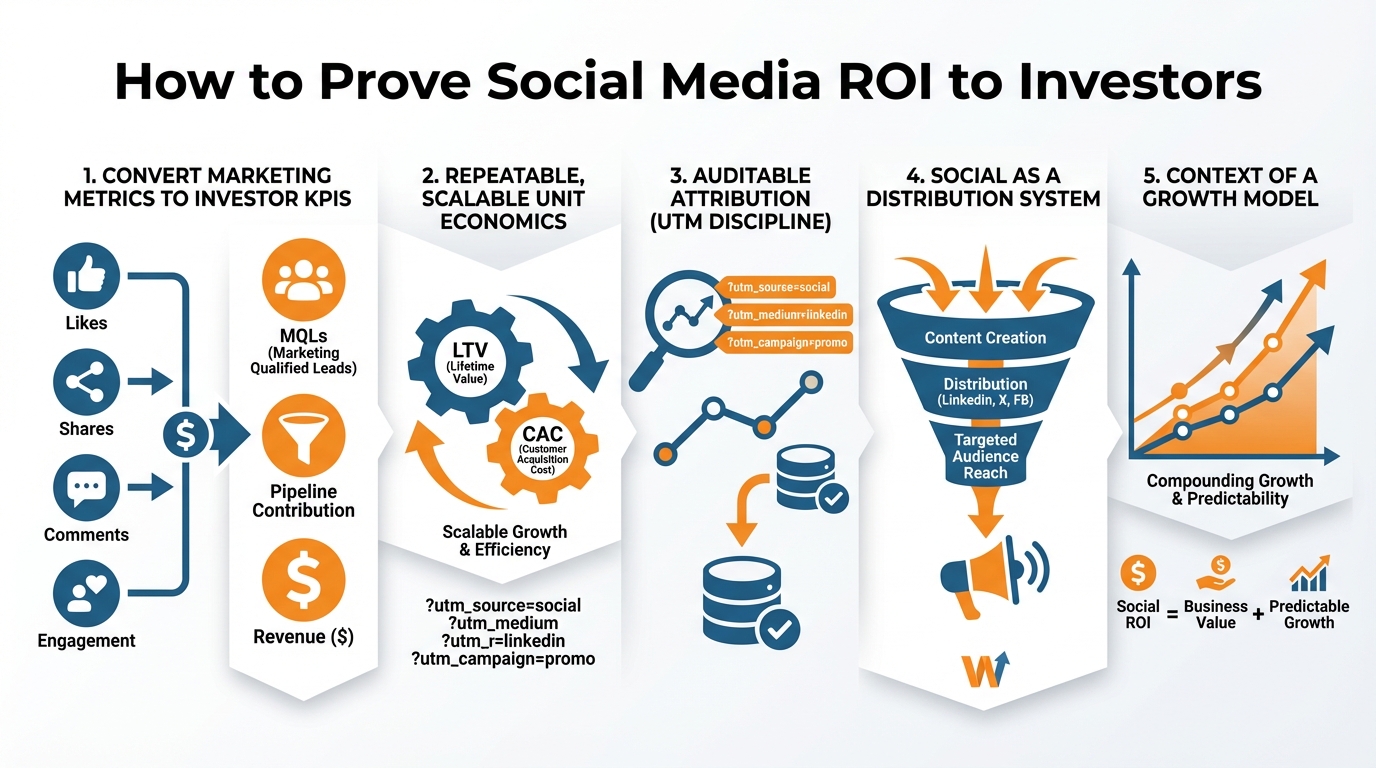
Measuring Social Media Success: Converting Marketing Metrics into Investor-Grade KPIs
The trick to How to prove social media ROI to investors is to frame it in a way that equates to how investors measure growth. If you’re building a repeatable operating system, a social media content calendar can help make those inputs week-over-week consistent.
Take a minute to jot down what the word return really means for your business model: if you’re in ecommerce, it’s contribution margin, not revenue; if you’re in B2B, it’s pipeline value and closed-won revenue; if you’re in subscription-based, it’s retention and expansion; if you’re a service business, it can be cost-to-serve reduction via fewer support tickets or shorter sales cycles.
Investors do not care how busy social was, they care how social affected one of these specific outcomes.
I’ve watched small businesses gain investor confidence very quickly simply by shifting the conversation from engagement to margin, payback, and repeatable revenue.
Second, convert social to unit economics so it can sit alongside the rest of your acquisition channels with no special social handling.
To do that you will need to figure out your blended and marginal CAC - the former is a key indicator of your growth machine’s overall health, the latter tells you whether you are acquiring efficient new customers on social or just picking up cheap credit for demand you were going to get anyway.
You will then also want to hook those customers to LTV and payback period, not just first purchase - if your average order is 80 and your gross margin is 55%, your gross profit per first order is 44, but if you are getting customers on social who buy 2.2x in the first 90 days, your gross profit just got to 97, and your allowable CAC and payback story just changed in a way that investors really understand.
Next, define everything before you calculate a single metric.
Your investors will ask about attribution, so segment out social-sourced versus social-influenced and define your terms before you begin:
- Social-sourced: First touch or last non-direct touch on a tracked social media link that results in a sign-up, lead or purchase within a predetermined amount of time.
- Social-influenced: Social was a part of the journey, but not the eventual conversion, as evidenced by assisted conversions, view-through (if possible) or A/B testing.
I often see the two get conflated into revenue generated by social, which makes for some nice charts, but also raises a ton of red flags in a diligence call.
Lastly, find leading metrics that investors will buy because they mathematically relate to lagging financial metrics.
Measure qualified traffic, not overall traffic (time on site, product page depth, pricing page views), activation (from account created to first meaningful action), sales accepted leads (and their close rate downstream), repeat rate, cohort retention. If you’re benchmarking results, an engagement calculator can help quantify performance cleanly.
Your job is to show the through-line: social will increase qualified traffic by X, which in turn will improve activation by Y, which will generate SQLs by Z, which converts at a known close rate into revenue, while holding margin and improving payback.
When you can demonstrate that chain with week-over-week consistent inputs and clean definitions, social ceases to be a branding expense and becomes an investor-grade growth vehicle.
How to demonstrate your social media return on investment (ROI) to investors in a way that will stand up to diligence
Want to learn about How to prove social media ROI to investors?
You’ll want measurement design that passes a 3rd grade test, not dashboards on steroids.
instrumentation to make attribution auditable (enforce strict UTM discipline, lock a channel taxonomy so social is always labeled the same way across ads, organic, influencers, and partners, keep your CRM clean enough that lead source never becomes a free-text mess…), ability to click into any closed deal and show the exact social touchpoints, landing pages, and timestamps that created or influenced it, and if you have offline steps like calls, consults, or in-store visits, ability to stitch them back with a consistent identifier such as email or phone so social does not mysteriously disappear right before revenue shows up. For clean, consistent tracking, a UTM generator helps enforce that strict UTM discipline. Also, only 38% of global marketers evaluate holistic ROI by measuring traditional and digital marketing efforts together in Nielsen’s 2024 marketing report on maximizing ROI, which is exactly why investors press for definitions and auditability.
Next, make ROI unavoidable by calculating total costs.
People will tolerate low growth assumptions, but they will penalize you for puffing up costs when you inevitably discover the labor later.
You should create a fully-loaded cost model that accounts for your time and your team’s time, production time for creative, contractors or agency fees, time managing partners and influencers, software, and a basic overhead allocation.
I generally convert all the labor to a blended hourly rate, and attach it to every action (e.g., content creation, community responses, outreach to influencers, reporting), so you can report the ROI both with and without overhead.
That one shift in approach changes social ROI from marketing exaggeration to unit economics that tie to your P&L.
Second, stop reporting one-time campaign results and move to cohorts to demonstrate ROI and lifetime value.
You need a cohort by acquisition month and a cohort by channel, e.g., Paid Social, Organic Social, Influencer, and Partner Social.
You also need contribution margin and repeat rates over time.
Then you can answer the questions investors care about.
Do social-acquired customers come back 1.3x times in 60 days? Is churn lower?
How many days does it take to recoup CAC?
I’ve seen small companies immediately gain trust by demonstrating that customers acquired from social return their investment in, for example, 45 days instead of 75 days from another channel when first-purchase dollars are similar.
Last, be transparent and don’t over-claim.
Use last-touch for decisions that are under your immediate control (e.g., testing landing pages, offers, or creatives that directly lead to conversions).
Use multi-touch to see how social is helping pipeline and accelerating conversions for longer sales cycles.
Also, be clear about what you can’t prove as real ROI, like untracked DMs, dark social sharing, or view-through impact without a solid model.
In diligence, the most important phrase is not social drove all of this but here is exactly what I can prove, here is what I consider to be influenced, and here is the unclaimed gap that I am leaving to keep the metrics investor-ready.
I've been thinking a lot about how to prove social media ROI to investors, and I wanted to share a few thoughts.
The key to demonstrating social media ROI is to show that it's incremental, which means proving causality rather than just correlation.
In other words, you need to show that your social media activities directly caused an increase in sales, engagement, or whatever metric you're trying to move.
One way to do this is to run experiments, where you withhold social media advertising from a control group and compare the results to a treatment group that receives the ads.
You can also use statistical techniques like propensity scoring to match users in the treatment and control groups based on their likelihood of converting.
Finally, make sure you're measuring the right outcomes.
Instead of looking at vanity metrics like likes and shares, focus on metrics that tie directly to your business goals.
For example, you might measure the number of conversions generated from social media, or the revenue per user compared to other channels.
By following these steps, you should be able to prove the incrementality of social media and demonstrate its value to investors. This connects with how creator campaigns are judged too: IAB reports that 40% of buyers rank overall ROI as the top KPI for creator campaigns in its 2025 creator economy ad spend report.
This is the point at which most ROI analyses will gingerly fade to black, while leaving investors still far from convinced: we now demonstrate what social caused and not merely what it was near.
The secret to show social media ROI to investors is a simple incrementality test that works at your scale, not a comprehensive attribution model.
If you are small, start with a time-boxed spend cut: run your normal social for 2 weeks, then cut paid social spend to near-zero for 7 to 10 days while keeping everything else the same, then turn it back on.
You are not trying to create a lab experiment; you are trying to measure a directional lift that passes muster.
Observe the changes in new customer volume, qualified leads, conversion rate, and pipeline velocity, and then compare to a baseline week and to a control signal like direct traffic or existing-customer orders that should be less impacted.
Second, distinguish demand capture from demand creation, in order to show that you’re not claiming credit for people who were already going to buy anyway.
Folks know search and retargeting capture intent that already exists; social has to demonstrate that it creates new intent or pushes something that was going to happen in 6 months into happening now.

You show that by looking at things that happen before branded search and lower-funnel conversions; when social pressure goes up, do you see increases in non-branded search volume, direct traffic, first-time visitors to your site, signups for email newsletters, demo requests, or new-to-file customers?
I prefer to show it as a simple chain: when I increased social reach into a cold audience, non-branded clicks and first-time site visitors went up first, followed by qualified conversions with some lag.
That lag is the fingerprint of demand creation, and is something capture channels cannot normally deliver on their own.
The only investor-grade behavior is measuring the counterfactual, which means answering what would have happened if social hadn’t existed.
This can be done without a whiz-bang attribution stack if you create a basic holdout.
If you have a local or regional business, find two geographies that look the same. Continue spending in one, and stop in the other. Look at the delta in performance pre- and post-test.
If you’re a national business, cut out a clean holdout group (e.g., 10% to 20% of your target audience) from paid social for a given time period. Compare the trailing conversions and revenue generated per impacted user.
Don’t give me just revenue. Give me incrementality: incremental conversions, incremental gross profit, and incremental CAC.
If you ran the holdout, and would have otherwise had 100 orders, but the social exposed group had 120 at the same average margin, then social didn’t just drive 120 orders, it drove 20 incremental orders.
Your ROI starts with that 20. This focus on business impact aligns with Nielsen’s findings that median brand recall was over 70% among consumers who saw certain ads in its analysis of new media impact on brand awareness and ROI, but recall still has to be translated into incrementality.
Lastly, address those concerns before they come up by testing for repeatability.
Seasonality and launch issues are a thing, so you run the same test over several periods or cohorts and demonstrate the lift holds within a band and isn’t a one-off blip.
Influencer spikes and one-off virality are a thing, so you carve them out: tag those dates, exclude them from the underlying lift calculation, and then repeat the experiment under normal conditions.
If social is indeed a scalable channel then you should be able to show that when you remove social influence, leading indicators and new customer growth go down, and when you turn it back on they come back up in a predictable way.
That signature over 2-3 cycles is as close as you’ll get to being able to hand an investor proof of causality absent a million-dollar measurement stack. And it matters because social signals can move markets: an event study using 114 million tweets found an ESG-risk event defined from social-media spikes is associated with an average -0.29% abnormal return in this arXiv paper on ESG reputation risk.
The quickest way to justify a social media budget to investors is to explain it within the context of a growth model with which they’re already familiar.
Let me explain.
To master How to prove social media ROI to investors, you have to stop pitching social as more posting and start pitching it as a distribution system with compounding mechanics.
Investors can underwrite systems, not hustle.
So you show how your reach expands through partnership networks, influencer ecosystems, and community flywheels where each node brings the next one.
Your job is to map the engine in a way they can model: number of partners activated per month, average audience overlap, click-through to a tracked landing page, conversion rate to lead or purchase, and downstream gross profit.
When you present it this way, social becomes an acquisition surface area that grows because the network grows, not because your team works harder. If you want a broader framing, social media automation is closely related to building that system.
Second, you need to show leverage so that growth doesn’t mean hiring in a straight line.
You show leverage by explaining how one piece of content becomes multiple assets across channels, segments, and funnel stages - and also by establishing replicable community processes that turn questions into content and content into sales enablement.
I show investors a simple capacity metric they can validate: content units output per labor hour, community response coverage per 100 members, and then show that ratio changing over time.
For instance, if you’re currently producing 12 usable content units per 10 labor hours and you get it to 18 per 10 through reuse and more streamlined process, you just created 50 percent more output without hiring and that’s real leverage that will show up in a lower CAC on the same spend.
Then you can make that scalability story investable by modeling the marginal economics, so you create that table that shows for every 10 or 20 percent of spend that you shift out of this channel and into social, what does your marginal CAC look like?
What does your marginal payback look like?
What is the point of diminishing returns?
Most small businesses can gain credibility here quickly because you are not purporting to be infinity, you are showing the curve.
I would often model this as a saturation threshold that the first dollars of social might be 30 to 60 days, but after frequency and conversion rates, marginal CACs get worse and paybacks get worse, so we need to put a cap on this and push that money into the partner or new content channels rather than trying to force scale.
That’s a story that investors love.
Lastly, you articulate risk mitigation strategies like an operator, not a salesperson.
You actively mitigate platform concentration risk by highlighting platform distribution goals and what performance looks like if one platform drops 30 percent.
You mitigate partner concentration risk by broadening the types of deals you do with partners and cultivating new partners to mitigate against single partner failure.
You mitigate creative fatigue risk by quantifying the half-life of a creative - or the number of days/impressions until performance drops 20 - and planning for a refresh before the drop hits CAC.
When you can demonstrate the ability to scale and maintain performance through diversification, refresh rates, and a simple stop-loss program, you will begin to allow investors to accurately predict your upside and your downside which is the crux of demonstrating and validating ROI. This emphasis on community and durable strategy matches HubSpot’s finding that 86% of social media marketers say building an active online community is critical to a successful social media strategy in 2024 in its 2024 social media state report.
The End
It is simple to demonstrate social media ROI for investors.
You measure it like a business function.
You use the investor language (incremental CAC, payback period, LTV lift, pipeline quality, contribution margin), you have a definition of what social-sourced and social-influenced mean, so there is no fudge factor in the math.
And you can take them down from a post to a tracked session to a lead or order to a line on your P&L that says contribution margin.
Then there is no more debate.
You have a business function, not an opinion.
Then you make your measurement auditable so it passes diligence.
You maintain a unified channel taxonomy, and you ensure clean tracking links, and you can reach back to the time-stamped and time-contexted basis for each lead and each deal without needing to spin a narrative.
I’ve noticed that there’s a huge credibility increase for a small company when you can respond to two follow-on questions from investors immediately: give me three deals you closed and their full path to closure, and give me the fully-loaded cost of generating those deals (including labor).
Finally, you prove incrementality, because investors aren’t paying you for correlation.
You do a simple holdout, or time-boxed spend reduction test, you find the incremental conversions and the incremental gross profit, and then you find the incremental CAC.
If your test generated 20 incremental orders, your ROI story is based on 20 orders, not on 120 orders that happened to occur while social ran; that one simple trick is the difference between a marketing report and investor-grade proof.
Lastly, you put the social channel in a box with defined unit economics and downside protection.
You show the law of diminishing returns as you increase spend, the leverage you are creating such that output grows faster than the team, and the stop loss mechanisms that prevent CAC disasters if creative wears off or a platform underperforms.
If you nail those 4 items then social ceases to be a marketing channel and transforms into an investable growth driver that folks can safely underwrite into your valuation.
Related reads
4/27/2026
B2B SaaS social media benchmarks: Set the right targets.
B2B SaaS social media benchmarks: Set the right targets. The trouble with defining B2B SaaS social media benchmarks is that it's an inherently impe...
4/25/2026
Building a personal brand as a technical founder (without becoming a creator)
Building a personal brand as a technical founder (without becoming a creator) Creating a personal brand as a tech founder should feel less about ma...
4/20/2026
Creative Post Ideas for Sustainable Brands (That Don’t Sound Greenwashy)
Creative Post Ideas for Sustainable Brands (That Don’t Sound Greenwashy) That’s not what creative post ideas for sustainable brands should look lik...