Agile Social Media Marketing for SMBs: A Weekly Growth Loop
Agile social media marketing is a weekly operating system for SMBs. Set objectives, produce content, measure impact, and adjust for growth.
Agile social media marketing for small to medium-sized businesses (SMBs)
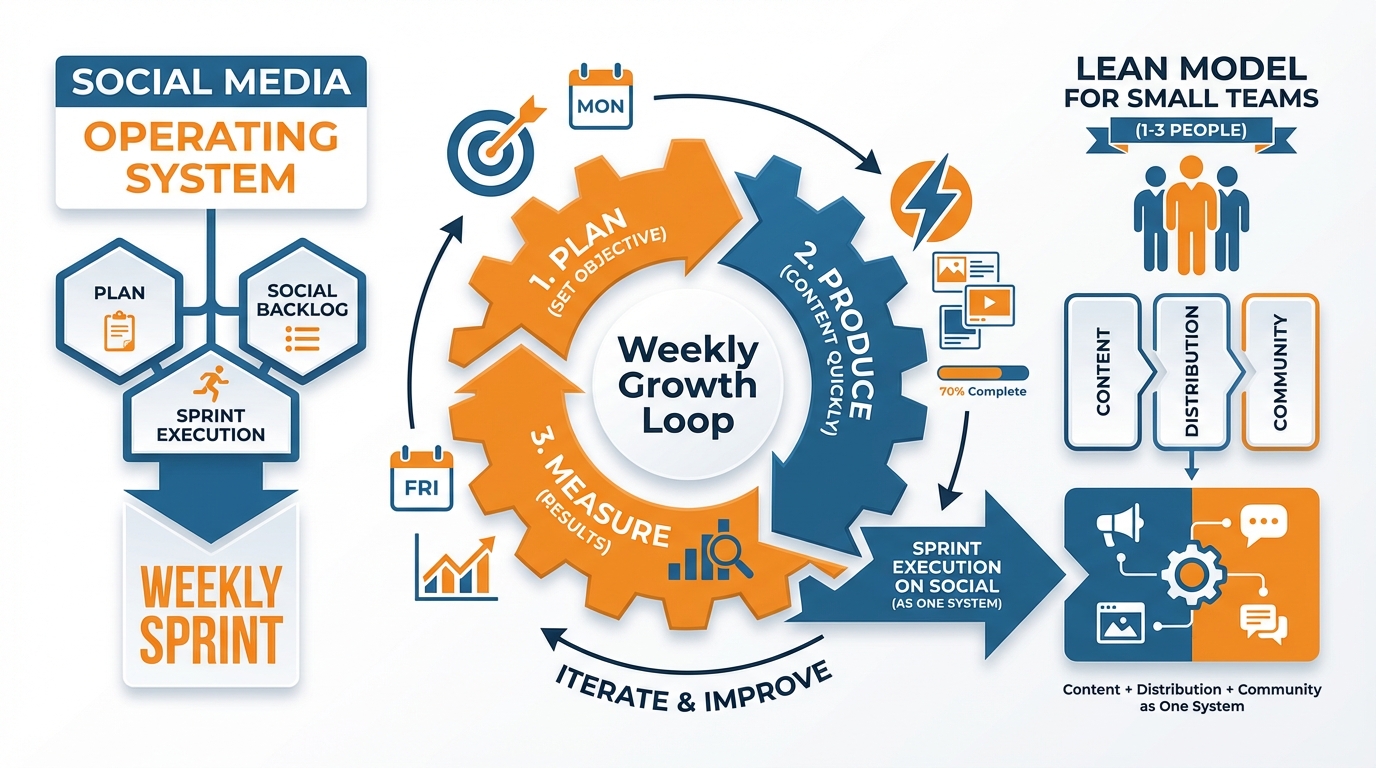
So what is agile social media marketing for small to medium-sized businesses (SMBs)? Well, it’s not a content calendar or a list of post ideas. It’s a social media operating system that’s run every week: We set one objective for the business. We produce a small batch of social content as quickly as possible. We measure the impact of the content on leads or reservations. We adjust the following week based on these data points. In essence, we shift from viewing social as a monthly campaign to a weekly growth loop.
I’ve Googled this before, and if you’ve done the same, you know what I mean. When you search for ‘agile’ as a keyword in the context of small business social media, half of the search results will be about Agile as a tool. You get one search result that talks about Agile as if it’s a thing you can purchase, one that talks about agile in the context of Scrum and its ceremonies, and a whole lot of generic advice in between that doesn’t tell you how to actually implement it on a week-to-week basis. That’s also why a lot of small business owners find themselves consistently posting on their social media platforms, yet still struggling to achieve their goals. If this sounds familiar, see inconsistent social media posting.
This is especially true for SMEs. You have the smallest team, which means you can’t afford long approval chains. You have the least time, which means you can’t afford to spend weeks creating content that isn’t converting. And you have the smallest budget, which means you can’t afford anything less than immediate feedback loops that translate social activity into business outcomes (quote requests, demo calls, table bookings, store visits, sales, etc.), not just more engagement. I have seen that a weekly cycle with clear decision rules will beat a ‘perfect’ plan that never learns. Over this guide, we will create that cycle, so that every week of social activity pays for itself. For context on adoption and channels, the Verizon’s 2025 small business survey findings reported that 82% of SMBs use Facebook to promote products and connect with customers, 58% of SMBs are on TikTok, and 28% of SMBs are using AI for marketing and social media.
Agile social media marketing for small and medium enterprises (SMEs): a lean model for smaller teams
Agile social media marketing for a small business has to acknowledge your constraints: 1 to 3 people, frequent distractions, and no patience for unnecessary bureaucracy.
My minimal essential system is built from three ceremonies.
- You plan at the start of the week to figure out what is worth your time.
- You hold a mid-sprint for 10 minutes to check you’re not going off track.
- And you hold a retrospective to figure out what to do differently next week to make it all worthwhile.
Time box your planning to half an hour: you decide what content to publish, what content to engage with, and what to experiment with, then you move on.
Time box your mid-sprint check-in to 10 minutes: did we hit our desired outcome?
If not, what do we need to change this week to fix that?
Time box your retrospective to 20 minutes, and that’s where the real magic happens as you’re forced to hold a funeral for those darlings and simply repeat more of what worked. If you want a deeper view of systematizing week-to-week execution, read weekly social media system.
Roles are straightforward, too, because in small teams roles are not job descriptions, they’re hats.
You need a content owner to create and ship assets, a community owner to convert eyeballs into conversations, and a growth/ad owner to turn winning assets into scalable demand.
In a solo team, you’re all three, but the thinking can be separated: content is about hooks and clarity, community is about response time and trust, growth is about amplification and insights.
I use this framework because it shines light on bottlenecks: if you’re clogged with comments and DMs, the solution is not to post less, it’s to fix your community plumbing.
And if your reach is good but your leads suck, the issue is not your content, it’s your offer or call to action.
Between Kanban and short sprints, pick based on your business model.
If your business is reactive, for example, if you are a local service, hospitality, or anything where demand varies based on weather, events, or last-minute availability, Kanban works best because you will want flow.
You can set WIP (work-in-progress) limits to avoid drowning: say, 2 pieces of content in production and 1 timeboxed for community per day.
If your business is campaign driven, like most B2B, SaaS, or a product launch model, short sprints of say 7-10 days work better because you will want constrained production, distribution, and measurement.
I have seen small teams make significant gains here simply by reducing cycle time: if you go from monthly planning to weekly decisions, I would bet that a ton of content waste is eliminated because you will stop building posts that sounded great in a plan but got no attention or results. This kind of focus also aligns with what the 2025 key findings on Agile marketing show: 96% of marketers applying Agile ways of working report a positive experience, and 66% of Agile marketers reported lower stress levels.
The guard rail against process for the sake of process is: each sprint has one business outcome and one learning goal.
The business outcome is a metric that matters for the business, 15 quote requests, 8 demo calls, 30 table bookings, not engagement.
The learning goal is a single hypothesis that you want to test, like problem-first hook outperforms feature-first hook, short founder videos outperform carousels, responding to within 60 minutes increases DM-to-lead.
I use sprints for that reason, they give you decision rules: if you hit the outcome, you keep the pattern and scale, if you miss but you learn something, you tweak the next sprint, if you miss and don’t learn anything, you simplify and change the test.
That is agile at SME speed: ship small, measure fast, learn on purpose.
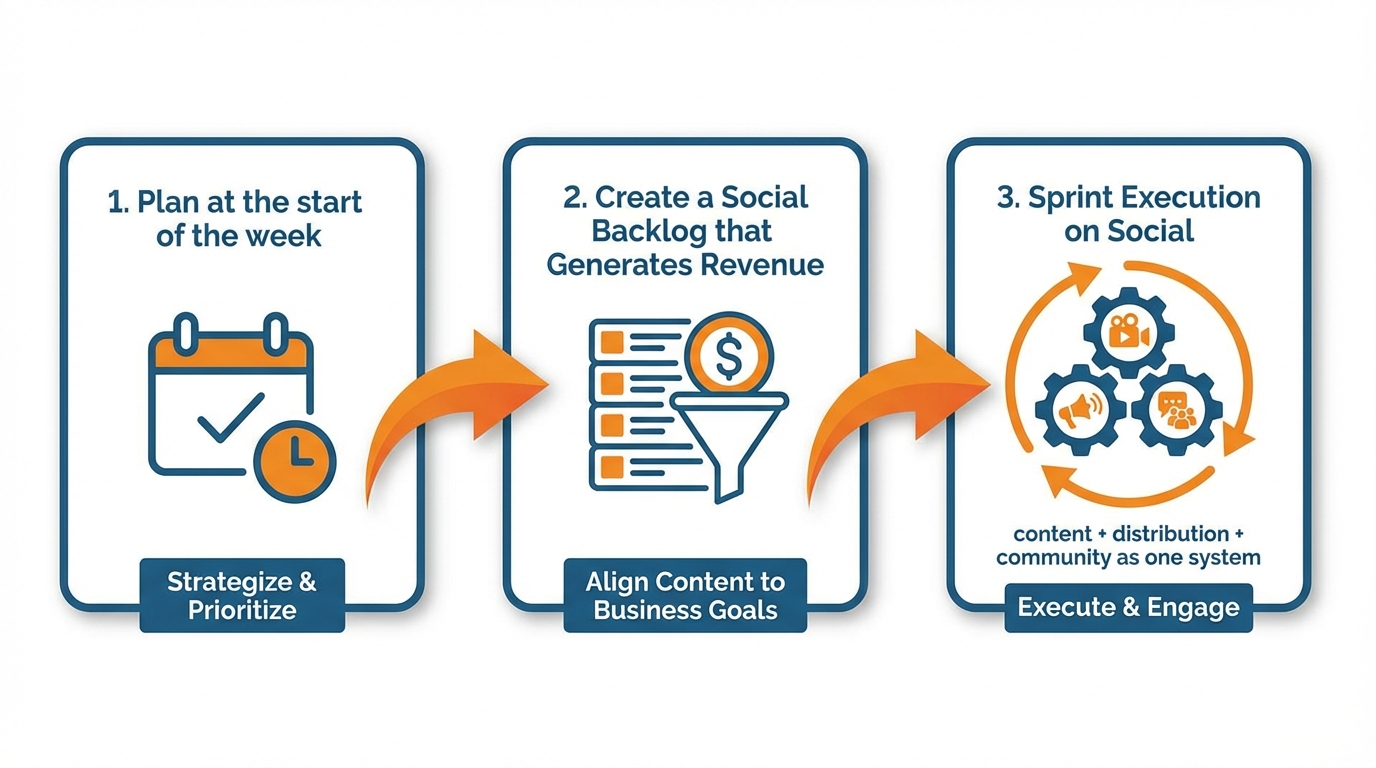
Agile Social Media Marketing for SMBs - Creating a Social Backlog that Generates Revenue (rather than just random posting)
This is how you do agile marketing on social media if you are a small business.
This is how you move from treating your ideas like inventory - which, if you don’t control, will mean you ship whatever is closest to the deadline, not whatever gets you paid.
You need a social media backlog, and you need to be able to scan that backlog in 60 seconds and understand why each item is there.
I organize my backlog into four buckets - problem aware, solution aware, proof, and conversion, which map to different customer intents and different funnel stages.
If I’m trying to tackle my conversion bottleneck for the week, then I only plan content that falls into the conversion bucket.
That’s how you avoid random acts of content.
Next, rewrite backlog items as outcomes rather than tasks.
Instead of having a backlog item that says ‘post about my service,’ write it as moving a specific audience to a specific action like ‘generate 5 qualified DMs from local homeowners about emergency repairs’ or ‘drive 20% more clicks to the pricing page from Instagram week over week’.
This forces you to identify the hook and offer before you start designing, which is where most of the SME time is wasted.
I do this because outcome language makes prioritization merciless: if you can’t measure the movement, it’s not ready for the week.
For context, most organic social drives single-digit CTRs and often less than 1% on most platforms, so you win by running lots of small clear experiments connected to buying intent, not by polishing one perfect post. This fits well with broader evidence too: the Sustainability (2023) bibliometric review on SMEs and social media analyzed 293 Scopus-indexed journal articles published between 2007 and 2022, summarized on this research page about leveraging social media for SMEs.
This is why your definition of done is the key to balance between speed and quality.
For every item on your backlog, you should be able to check the box on the following: the creative is adapted for the channel, the hook is clear in the first second or first line, the ask is a single ask, measurement is enabled so that you can connect the dots to impact, distribution is determined before hitting publish, and a follow-up plan is in place for engagement and DMs within a defined SLA.
If you cannot check all of these boxes, then the content is not done, it is just posted.
I’m strict about this because social is not content, it’s content + conversion, and subject matter experts don’t have the bandwidth to invest in content that gets impressions, but does not connect to the bottom line.
Prioritization is where the rubber meets the road for SMEs to be agile: you want to deliver quick wins and build compounding assets concurrently, but you cannot allow interrupts to take over the week.
The trick is to allocate most of your bandwidth to compounding assets (e.g. case studies, FAQs, objection handling scripts, founder vision statements) that can be leveraged and shared multiple times, and a minority fixed allocation to quick wins (e.g. limited-time supply, timely promotion, location-based opportunities).
For interrupt tasks (e.g. reacting to news, solving customer problems) you want to allocate a fixed maximum bandwidth in the week, and approach it as a triage queue that meets one of three conditions: must preserve trust, must capture demand in the moment, or must teach us something we can leverage again.
Once you hit that bandwidth limit, all other interrupt tasks get pushed to the backlog with an intent flag, so you are still seen as responsive, but you have preserved the scheduled tasks that are actually delivering a scalable revenue funnel.
Agile social media marketing for SMEs: sprint execution on social (content + distribution + community as one system)
Here’s the plan for agile social media marketing that can actually be used by small to medium businesses… It’s simple really.
I do a planning session on Monday to commit to a minimal sprint goal, lock the top three outcomes, and decide how the content will be distributed and socialized… All before we create anything.
I also have strict WIP (work in progress) limits, so we don’t end up starting five things and not finishing anything… At most, there are only 1 to 2 pieces of content in progress at any given time.
And the next piece of content can only be started once the prior piece of content is completed with a metric to measure success and a plan for responding.
This is how we get speed without chaos… We shorten the cycle time… The one sustainable competitive advantage a small team has over a large team. If you want another angle on this, see smart social media automation.
Outside of meetings, you can maintain velocity by running a simple daily async cadence: 3 numbers, 1 decision.
You review did we generate demand signals yesterday (replies, saves, link clicks, qualified DMs), is there anything stuck in production, and is community under SLA.
If yes, either you deprioritize or just kill it quick, because sunk-cost posting is how SMEs lose weeks.
I do this because organic performance is lumpy and most posts will never be top performers, so your role is to provide enough quality shots on goal and learn fast, not to protect a single baby.
CM needs to be a first-class sprint activity, or it’ll consume your whole week.
You define triage rules, so you reply immediately to buying intent, within a couple of hours to trust-risk issues, and within 24 hours to everything else, and you set a max on how much community can take.
In practice, you reserve a fixed daily amount of time for comments and DMs, and you treat any time outside that as intake: tag it, classify it, and decide whether to turn it into a backlog item.
If you do this well, you can make community a conversion channel: I’ve seen that faster response times can double the number of DM conversations that move to a next step, because intent decays really quickly and social users move on.
The third leg is distribution.
It can’t be post and pray.
You have a repeating amplification channel for each piece of content, something that you can repeat every week: a partner share, a micro-influencer re-post, a customer shoutout, a cross-promotion.
You can’t start from scratch every week, or even every month.
You have a small network of partners (it can be as few as 10 to 30) that you do a regular content swap with.
You promote them, they promote you.
You try to keep it all to one problem area so the algorithm and other humans both know what it’s about.
I try to do this as a process.
Every sprint has a certain number of outreach emails, a certain number of co-creations, a certain number of re-mentions.
SMEs don’t succeed at distribution through shotgun blasts, they succeed through routine and other people.
Becoming agile as a small and medium-sized enterprise (SME) on social media: metrics, testing, and decision rules to optimize on a weekly basis
Another thing - agile marketing for SMBs only works if you’re running a tight feedback loop, not a monthly review.
I monitor every day, to gauge whether content is being viewed, and whether it’s being shared, and whether it’s starting conversations.
That means video retention, or hold on the first line of text, saves and shares per 1,000 impressions, link CTR, and DM reply rate. If you want a practical structure for measurement and proof, see prove social media ROI to investors.
Every week, I do business truth: lead quality from DMs, and forms, bookings or calls scheduled, and the earliest CAC indicators, cost per qualified click, or cost per meaningful conversation.
The idea is that the quicker you identify a problem, the faster you can address it.
If you’re not retaining people, it’s a hook problem.
If you’re retaining people, but CTR is a bust, it’s a CTA, or offer problem.
If CTR is healthy, but leads are a bust, it’s targeting or promise.
To make the metrics useful, you need a sprint learning agenda, otherwise you are just collecting trivia.
Each week, you pick one thing you are trying to learn about hooks, formats, offers, or audiences, and you design the sprint around it.
For example, you can test problem-first hooks versus authority-first hooks, or founder face-to-camera versus product demo, or a specific offer like free estimate within 24 hours versus fixed-price package.
Keep the learning goal narrow enough that you can attribute cause and effect in one week, and tie it to where your funnel is leaking.
When you do this consistently, your content stops being a creative exercise and becomes a weekly science experiment that compounds.
Experiments don’t require a lot of budget, they require a framework and a bridge from organic to paid.
I use organic as the speed filter and paid as the zoom lens: publish 2-4 variations of a piece of content that vary just one thing, see which one gets the best early signals in the first 2-6 hours, and then put a little bit of paid behind that winner to validate with a bigger crowd.
You’re not paying for reach for reach’s sake, you’re paying for data to make a decision faster.
A real-world working pattern for subject matter experts is to only amplify winners and only to the segment of people you actually serve, because paying to test a bad hook is the fastest way to waste budget and ruin confidence. This is especially relevant given what the Intuit SMB MediaLabs advertising trends report found: 92% of respondents said they’ll maintain (41%) or increase (51%) their advertising spending into the first quarter of 2026 (8% predicting cuts), and 75% said social media was an effective advertising channel for them.
Decision rules are how activity gets converted to improvement.
Establish keep, kill, or scale criteria prior to posting: keep if it exceeds your minimum retention threshold and saves/shares per impression is increasing; kill it if retention tanked and it attracted some of the wrong signals; scale if you see both the leading indicators and some of the downstream metrics such as qualified DMs, bookings, or clean sales conversations.
Then close the loop with a weekly retro that yields specific backlog changes not nebulous learnings: invest in double down on the hook, cull the losing format for a month, revise the offer, tighten up the target audience.
If your retro is not changing your backlog for the coming week, you’re not doing agile, you’re just doing analytics.
O Fim
Agile social media marketing for small to medium sized businesses isn’t about more content, or more platforms, or more hustle.
It’s about creating a repeatable weekly cycle that turns social media into a growth engine, that gets better, smarter, more profitable with every passing week.
By running the same cycle every 7 days, you quit playing a guessing game, and start playing a compounding game: your hooks get better, your offers get better, your response times get better, and your team wastes less time on content that looks great, but never generates any bookings, calls, or sales.
Make it a simple sequence: operating model to ensure we know how to make decisions and flow work, a backlog tied to revenue to ensure we are only building things that can impact the business, sprints with WIP limits to ensure we actually deliver, and measurement plus a retro that enforces action.
This is how small teams can outperform large teams. Reduce cycle time.
If a monthly cycle yields 12 business decisions a year, a weekly cycle yields 52, and this disparity alone can lead to a significant performance differential due to 4.3x more opportunities to adjust. In many markets, social remains a primary lever for SMEs; for example, the GeoPoll Africa MSME Pulse Survey report page notes the report is based on CATI (Computer-Assisted Telephone Interviewing) survey methodology and covers 4 countries in 2023: Kenya, Nigeria, South Africa, and (newly added) Ethiopia.
Here’s what you do next: you select a 7-day sprint objective based on revenue, not eyeballs.
You select something you can measure at the end of the week, such as 10 qualified DMs, or 6 quote requests, or 12 booking clicks, or 3 sales calls booked.
And you select 1 learning question that you can answer in 7 days, such as: does a problem-first hook outperform a feature-first hook for my top buyer persona?
Or does a tighter reply deadline improve DM to next step conversion?
I have watched teams start moving the needle just by tightening the focus of the week to one outcome and one question, because clarity crushes content overwhelm.
Run the first sprint with strict WIP limits and guard the finish line: don’t start the next asset until the last one is finished with measurement and a response in place.
At the end of the week run a retro that demands a decision, not a discussion: keep, kill, or scale, and show the result of the decision in next week’s backlog.
When the output of your retro determines what you work on on Monday, you’re no longer posting; you’re doing Agile social media marketing for SMEs as a system that learns and returns dividends every week.
Related reads
4/27/2026
B2B SaaS social media benchmarks: Set the right targets.
B2B SaaS social media benchmarks: Set the right targets. The trouble with defining B2B SaaS social media benchmarks is that it's an inherently impe...
4/25/2026
Building a personal brand as a technical founder (without becoming a creator)
Building a personal brand as a technical founder (without becoming a creator) Creating a personal brand as a tech founder should feel less about ma...
4/20/2026
Creative Post Ideas for Sustainable Brands (That Don’t Sound Greenwashy)
Creative Post Ideas for Sustainable Brands (That Don’t Sound Greenwashy) That’s not what creative post ideas for sustainable brands should look lik...