Should E-commerce Startups Bother With Pinterest?
For e-commerce startups, is Pinterest a worthwhile investment? This guide helps you decide by outlining how to test, measure ROI, and avoid vanity metrics.
Should e-commerce startups bother with Pinterest?
I don’t view this as a Pinterest 101 question. I view this as a classic startup resource allocation question: if you devote your limited time, creative capital and money to this, what other things don’t you do and what signal can you receive quickly enough to make the investment worthwhile.
For a small business, worth it is not impressions, followers, or saves. Worth it means three things you can actually control: runway, time-to-signal, and measurable contribution to revenue. Runway is how many weeks you can keep testing before you need the channel to pay you back. Time-to-signal is how quickly you can see leading indicators that are predictive of future sales, such as qualified clicks to product or collection pages, email signups from Pinterest traffic, and assisted conversions in analytics. Measurable contribution to revenue is whether Pinterest is driving first-touch purchases or increasing your blended numbers, not whether a pin went semi-viral.
When you’re done with this guide you’ll be able to:
- Make a simple go or no-go decision
- Choose the minimum viable test to prove or disprove your idea
- Measure that test without lying to yourself
I’ll also walk you through 1) What to test first 2) Which metrics to pay attention to 3) How to distinguish between real traction and “vanity” metrics so you can confidently commit or abandon early.
A practical add-on: if you need help organizing the workflow side of this, a social media content calendar can make the ongoing cadence less chaotic.
What about Pinterest?
If you’re an e-commerce startup, does it make sense for you to invest time there?
For your product?
For your target customer?
For your profit margins?
TL;DR: I mentally just think of Pinterest as more search and discovery than social content, so you need to match intent and be discoverable instead of entertaining every day.
For you that means the difference between whether or not Pinterest is worth doing for an e-commerce startup is whether someone can look at your product for 1s, read one line of text to get the value, and think I’ll save this for later.
I see a lot of smaller brands get outsized returns here when their product falls within an intended use case like outfit planning, room decor, party planning, skin care routines, gift shopping, and before/after tutorials, because that pin can function as a “purchase later” button instead of competing to be an entertainment success on a daily basis.
Pinterest’s search intent is also massive: a report on Pinterest search ads becoming self-serve cited over 2 billion searches per month, and 97% of those searches being unbranded.
Before we dive into more on the tactics of how to make sure you fit and how to succeed if you do, there are 4 initial qualifiers we can quickly check to see if you fit, and if it’s worth you going down the rabbit hole:
-
is your category aspirational (driven by visual discovery) rather than commodity (where the image is just about the product), or replenishment (where the image is not a factor at all)?
-
do you have a story where the problem and solution can be explained with a single image and headline? (i.e., is it simple enough that a user can grasp in one second or less)
-
do you have an average order value and gross margin that can support paid media if you need it? (this is because Pinterest is a long-term play, and you may need to supplement your results upfront)
-
do you have the bandwidth and budget to support ongoing content creation? (because the algorithm loves variety, and you’ll need to test a lot of different concepts to optimize).
Pinterest generally isn't for you if you have almost no surface area to play with -- one SKU with a single use case, no bundling, no styling, no comparisons, no outcome to depict.
It generally isn't for you if you have very low margin and need to hit profitability on last click ROAS, since attribution from Pinterest generally spans a longer consideration period and more assisted conversions than instant checkout.
And if your product needs tons of education but isn't easy to show in a save-worthy pin, you are going to have a tough time getting distribution; if it takes five paragraphs to explain, you are fighting the way the platform is used.
One rough and ready heuristic is that if you can't think of at least 20 different genuinely different pin concepts based on your existing product offering in one hour of brainstorming, you are likely to exhaust the potential before finding a winning formula.
The mental category people get wrong about Pinterest
What I think people get wrong about Pinterest is the mental category it goes in.
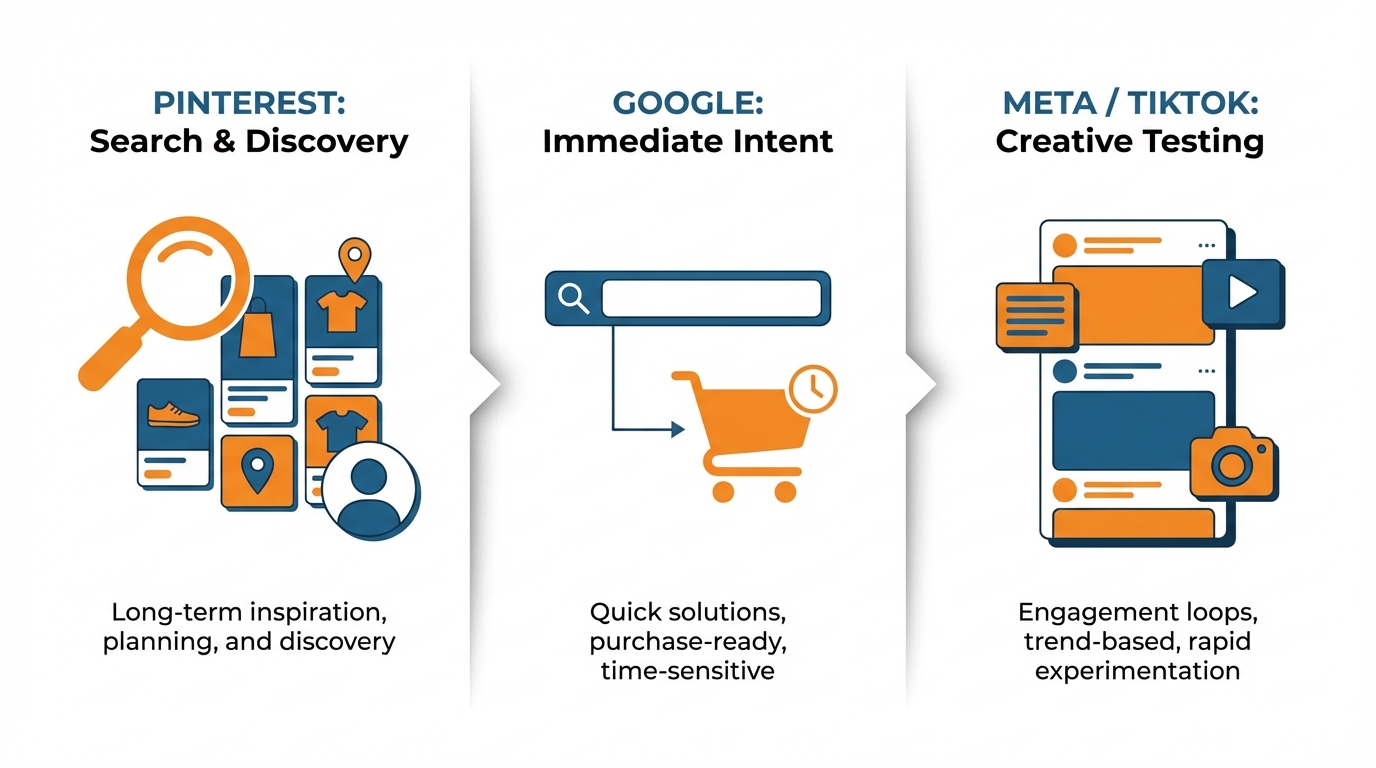
Google is 'I want this thing right now and am searching for it, and I'm willing to pay to appear right now' - and that's the box we put Pinterest in.
Meta and TikTok are 'I'm not sure what I want, so give me this creative testing engine and I'll figure it out, and then I'll retarget everyone later to make sure they buy' - Pinterest is the discovery channel for those people, but with a catalog feed, where the best product wins every time, and your work (your images) has longer legs because people can discover them weeks later and click on them and buy.
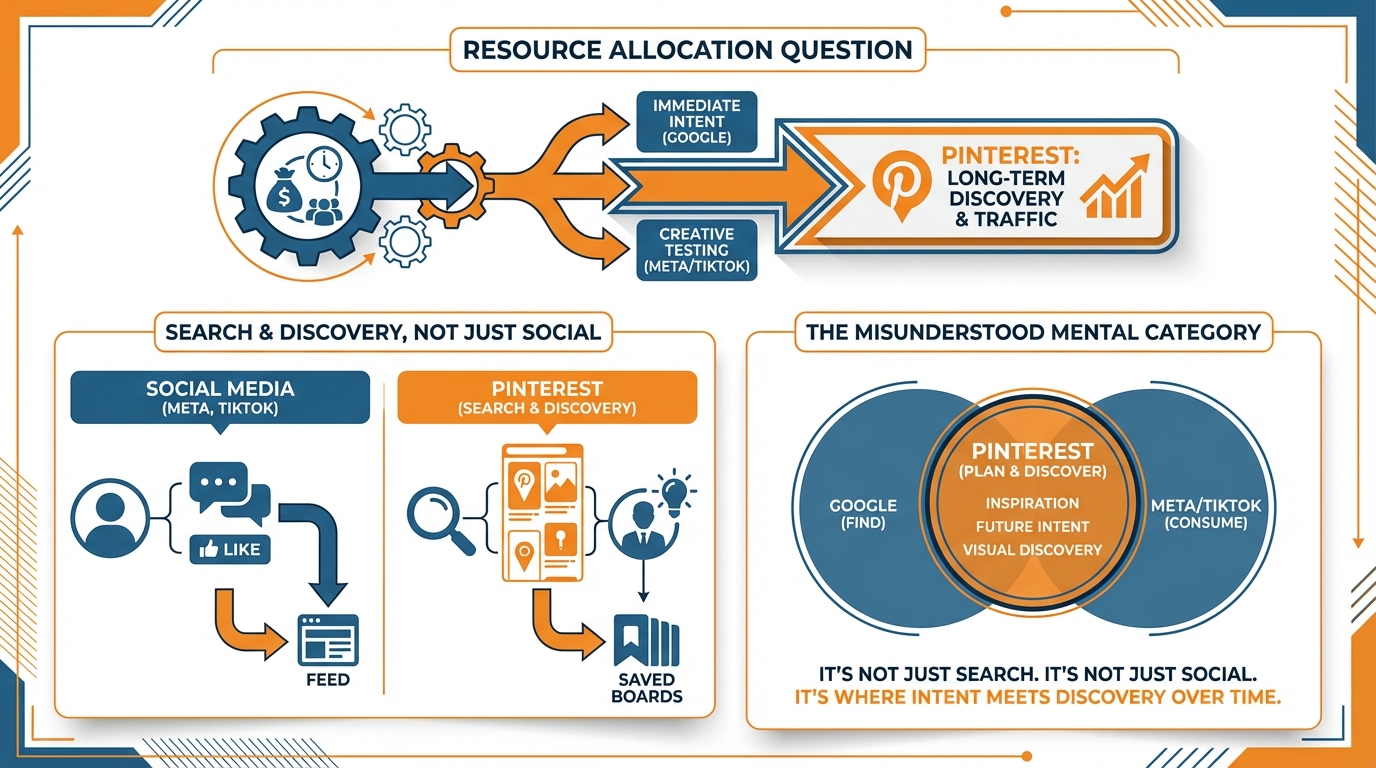
So the 'I tried it and it didn't work' is really just a product of being in the wrong mental box - and not being prepared for it to not work like Google Shopping works, but instead like the compound interest of a discovery channel works.
As context for why it’s become so meaningful as a channel, Pinterest has sustained user and revenue growth: the investor update on Pinterest Q2 2025 results reported $998 million revenue (+17% YoY) and 578 million global MAUs (+11% YoY).
Should You Use Pinterest For Your E-Commerce Start-Up?
When you Can’t Afford to Wait 6 Months… (What to Expect)
If your question to us as e-commerce startups is: Is it worth it? Then the answer is: It depends on your runway and patience level.
I’m providing this roadmap so you don’t freak out too soon or too late.
Week 0-2: Setup. Business account. Pinterest tag. Clean product catalog/product feed. A couple of well-structured boards. First batch of creatives covering different use cases and search terms.
If you do not do this and just start pinning, you’ll still see some traffic, but you won’t understand what’s driving it, you won’t be able to retarget later, and you will (falsely) conclude that the channel is shit.
Weeks 3-6, you are not trying to prove out profitability, you are trying to prove out signal. You should see impressions first, then saves, then outbound clicks - if your pixel tracking is set up correctly you should see add-to-carts begin to appear.
Important note: saves and outbound clicks are leading indicators on Pinterest, and revenue generally lags because it’s more of a planning engine than a checkout engine.
You should take rising save rate as a sign that your creative is working, and you should take outbound clicks to product or collection pages as a sign that your promise is matching up to your landing page.
If you are looking only at purchases inside of a 7-day window, you’ll often kill Pinterest just as it’s beginning to work.
Between month 2 and 4, you may hit a compounding period where you see older Pins re-circulate and previous winners continue to drive traffic with no maintenance.
A Pin may sit dormant for weeks and then pick up again because distribution on Pinterest is largely search and discovery driven, not just recency; the more it’s saved, the more opportunities it has to appear in more contexts.
I’ve watched products go from one or two clicks a day to steady traffic every day because a few Pins finally got matched to the right keyword cluster and started ranking, and once that happens you start feeling it in your blended metrics: more assisted conversions, more later branded search, and less dependence on having to pay to continue to be visible.
Which brings us to the real question to ask yourself on the runway: do you need sales this month, or can you afford to invest in an asset that compounds.
If you need sales this month, Pinterest isn’t your core channel (though you can still use it as a secondary channel): you’re probably heavier in faster-intent channels.
If you have 30-60 days for proof-of-signal, Pinterest is a great investment, as long as measurement is in place for you to take decisions off saves, outbound clicks, add-to-carts, and assisted conversions, rather than waiting for last-click revenue which might not even show up in the first few weeks.
Pinterest for e-commerce startups: Is it worth it without ads?
(Organic vs paid and the real cost: creative operations)
The real Pinterest tax isn’t posting. It’s creation.
Because to make Pinterest work, you need to give it a lot of different ways to talk about your catalog: different shots, different uses, different keywords, different times of year, different people.
So if you think of it as a single photo shoot that results in 10 Pins, then yeah, Pinterest probably isn’t worth it for an ecommerce startup.
Your minimum viable creative funnel should be this: new Pins per week for constant learning, enough variations per product to let the algorithm try and match you against different search queries, and enough repurposing that every product photo becomes multiple ideas.
I love getting one core set of assets and then spinning it into hero product shot, in use demo, before after, comparison, bundle, gift angle, size/fit clarifier, and a simple how it works sequence, because that takes one shoot and makes it last for weeks of tests, rather than just one spike.
Sure, organic can work but it’s not fire-and-forget, it’s inputs plus optimization.
The big benefit to small brands is that Pinterest is one of the last platforms where unbranded discovery exists: people are typing in solutions and topics, not your brand name, which gives unknown stores a fair shot.
The second benefit is shelf life: a Pin can rack up clicks weeks or months later, which you almost never see on a feed-first site.
But you’ll only reap that compounding if you keep putting more material into the pipeline and keep optimizing the Pins that are already getting saves and clickthroughs.
Your role is to treat Pins like mini search results: refine the promise the viewer gets in the first second, get the text overlay to match the search terms people use, then watch which concepts are driving saves per impression and clicks per impression and produce more of those concepts.
If you’re trying to systematize creative inputs, a weekly social media system can help you stay consistent without turning Pinterest into daily busywork.
The key to not having Pinterest eat into your product and fulfillment time is to think in batches, not in daily tasks, and in modules, not in final outcomes.
Try to get into a rhythm where you create one batch of source content, then transform that into a repository of modules with different formatting and messaging.
When I’m doing this effectively, a single photo shoot or UGC-style recording session can result in dozens of Pins because I’m thinking about modularity: the same photo might have different copy hooks, different use cases, different keyword copy, and different destinations (a product page versus a collection, for example).
That’s the true ROI: not on ad spend, but whether you can keep up with the content demands without breaking your team.
If you can’t consistently generate enough modules to keep iterating, you’ll experience Pinterest as slow, even if it’s a channel fit for you.
I use Paid when I need to accelerate: if I need to collapse the feedback loop, if I want to continue to pile onto creatives that have already shown they can drive saves and clicks, or if I’m trying to retarget planning mind states on our website that need to come back for a second visit.
I don’t approach Pinterest advertising the way I approach Meta advertising - the intent and creative treatments differ.
Search is more analogous to Pinterest than social: the creative has to feel like a resource to the pinner, not an ad.
The times I don’t find Pinterest investment worth it is an operational decision rather than a strategic one: dirty catalog hygiene and feed issues bleed reach due to incorrectly titled pins, variant errors, or items not being in stock, and also landers that don’t match the promise of the Pin (slow load time on mobile, thin assortment, no clear call to action). Apps like Syncerize can help keep that inventory across shops up-to-date, reducing errors on your Pinterest pages too.
If you address those two areas of your business, you should see a lift in both paid and unpaid results - you aren’t bleeding equity you already have coming from discovery.
The Pinterest problem for e-commerce startups: If you can’t measure it, should you still do it?
(Attribution, tracking and risk)
Should e-commerce startups use Pinterest? Absolutely.
As long as you don’t let it be a mystery channel.
You have to have a normal, boring standard for measurement: implement the Pinterest Tag, ensure clean UTMs on every URL you can control, and then do a basic sanity test in GA4 to ensure Pinterest isn’t bleeding into Direct or Referral. If you need a simple way to keep this consistent, use a UTM builder tool so every URL you can control stays clean.
I also do a quick reality check by comparing 3 different numbers weekly: GA4 sessions from Pinterest, Pinterest outbound clicks, and LP views for the exact URLs with the Pinterest UTMs.
The three metrics will never match, but if they’re wildly divergent, your analysis is fantasy.
In the majority of small shops I look at, fixing UTMs and channel grouping alone shifts Pinterest performance by 10 to 30 percent since it is no longer misattributed.
With the foundation in place, the way you measure success from here is everything that happens after the last click.
You should think of Pinterest as a planning engine, so measure it on assist behavior: assisted conversions in GA4, new-to-brand signals like higher first session bounce but better second session conversion rate, and your email/SMS capture rate from Pinterest landers.
The rough metric I like to use as a benchmark when I’m testing is this: Pinterest traffic can look worse on purchase rate, but within 30-45 days it needs to beat your site average on one of these three: product or collection page views per session, add-to-cart rate, or opt-in rate.
If you don’t see one of those lift, you’re not building demand, you’re buying curiosity.
If the platform can take all or none of the credit for incrementality, you can do a clean read simply by performing a quick controlled pressure test.
Pick a subset of products or collections, lean into Pinterest for 2 weeks, stop for a week, and look at what happens to blended metrics that Pinterest can’t take credit for: brand search lift, direct traffic to the pinned collection URLs, and opt-ins attached to a Pinterest UTM.
You aren’t trying to solve attribution; you are trying to see if Pinterest makes a measurable wave that breaks elsewhere in your funnel.
The healthiest Pinterest systems I have seen fill the top and mid funnel and allow email/SMS and retargeting to close later, which is why on-site engagement signals like scroll depth, collection views, and add-to-cart are more relevant than sessions.
Finally, if you're considering going big, you should also factor in platform risk as a founder, not a marketer.
Because setup and support overhead is real: tagging problems, catalogue rejection, variant mismatches, app failures.
That can take a week of an SMB owner or employee’s time, and every down feed is unlogged non-delivery.
Moreover, in some categories, junky content also dilutes CTR and renders your brand near undesired visual adjacencies, so if this is a concern you should keep an eye on your surrounding pins, if you even care where you get pinned.
In any case, this is my mantra for treating any growth channels.
You can use Pinterest for growth.
But you can't have it be your sole plan for growth.
Because if your tracking goes down or your reach does, your revenue should dip, not drop.
Also, this channel is not small: the investor update on Pinterest Q3 2024 results reported $898 million revenue (+18% YoY) and 537 million global MAUs (+11% YoY), and a Statista snapshot of Pinterest’s 2024 annual revenue puts it at $3.65 billion (+19%).
My tl;dr on Pinterest for e-commerce startups: Does it work?
My tl;dr on Pinterest for e-commerce startups: Does it work? Yes, if you have visual product/market fit, can produce a constant flow of new content, and have the patience to let compounding take effect and can measure it effectively.
On Pinterest, a pin on Pinterest is more like a search result than a post, which is why the potential reward is high: a single idea can generate qualified traffic for weeks without adding any extra effort to your daily routine.
The most basic rule is a very functional one: if you can afford to do enough creative plus clean tracking to get to the point where you have significant data, try it.
Give yourself enough volume to figure some things out, generate it long enough for saves and clicks to turn into return visits, and track it enough to tell curiosity-driven traffic from buyers.
If you are so in need of fully-attributable last click sales this month to stay in business that you don’t have the ability to experiment, do search and paid social because they do the most to compress the cycle, and they’ll show up better in attribution windows.
This becomes actionable if you pick a swim lane today: go, no-go, or not yet.
Go if your product can be digested in a second, your margins can handle a few beats longer, and your organization can generate enough asset diversity to feed the ad variations.
No-go if your product is a commodity where the visual differences don’t really matter, your margins demand last-click ROAS purism, or you can’t generate the asset diversity the machine needs to discover your best paths.
Not yet if your measurement data is still broken or your catalog and landing page experiences are not yet in good shape because they will just screw up both ad and organic outcomes.
Next, fit Pinterest to the channel mix that your runway and margins support.
Treat it as a compounding discovery layer that drives your site, your email or SMS capture, and your retargeting, rather than needing it to support your full revenue plan.
Every time I see small businesses have success on Pinterest, it’s almost never as a result of a single viral pin - it’s because steady effort plus transparent attribution result in it becoming a reliable source of high-intent sessions, which reduces the need to pay for attention everywhere else.
And if you want a real-world reminder of how “planning” translates into buying behavior, an older analysis of Pinterest’s influence on purchases cited a survey where 52% said Pinterest helps them find items they want to buy, and 30% said they bought something online after viewing Pinterest content.
If you’re struggling with consistency while testing any channel, this pairs well with reading about inconsistent social media posting so you don’t confuse operational drift with channel fit.
Related reads
4/27/2026
B2B SaaS social media benchmarks: Set the right targets.
B2B SaaS social media benchmarks: Set the right targets. The trouble with defining B2B SaaS social media benchmarks is that it's an inherently impe...
4/25/2026
Building a personal brand as a technical founder (without becoming a creator)
Building a personal brand as a technical founder (without becoming a creator) Creating a personal brand as a tech founder should feel less about ma...
4/20/2026
Creative Post Ideas for Sustainable Brands (That Don’t Sound Greenwashy)
Creative Post Ideas for Sustainable Brands (That Don’t Sound Greenwashy) That’s not what creative post ideas for sustainable brands should look lik...