LinkedIn content strategy for HR tech startups
Uncover a tactical LinkedIn content plan for HR tech startups. Learn to reduce risk, drive conversations, and build pipeline despite limited resources and case studies.
LinkedIn content strategy for HR tech startups
More posting is not a content strategy for HR tech startups. It is just more noise and HR buyers are trained to ignore noise because the downside of choosing the wrong tool is real. When a People leader buys software, they are not buying a nice-to-have app. They are signing up for trust and risk: employee data sensitivity, compliance exposure, security reviews, messy integrations, and the hardest part of all, change management across managers and employees. One misstep can create payroll mistakes, broken onboarding, adoption failure, or a hit to culture. That is why HR deals move slowly, involve multiple stakeholders, and punish vague claims like AI-powered or easy to implement.
That’s why you need a LinkedIn content strategy for your HR tech startup. It’s not about racking up views. It’s about getting enough respect from the right HR buyer that they reach out to you, or reply to your comment, or doesn’t immediately shut down a DM from you because you sound like someone who’s walked through the swill behind the palace. You need content that reduces perceived risk, answers the security and adoption questions, and makes your product feel like a foregone conclusion for their existing stack - even if you’re a small team with limited proof. For a repeatable system, see this guide on a social media content calendar.
In this post, I’ll outline a tactical LinkedIn content plan for HR tech startups that will help you convert eyeballs to conversations and pipeline despite the reality of most HR tech startups: one marketer, a busy founder, and not enough case studies yet.
You will see how to generate owned distribution that you control, develop repeatable processes you can apply every week, and track meaningful results like qualified DMs, sales meetings, and pipeline influenced, not trend commentary or vanity metrics.
If you act on what I will write, you will stop praying for an algorithmic miracle and start treating LinkedIn like a reliable go-to-market machine. Below, we’ll outline a winning LinkedIn content strategy for HR tech startups.
to help position you favourably for HR buying committees.
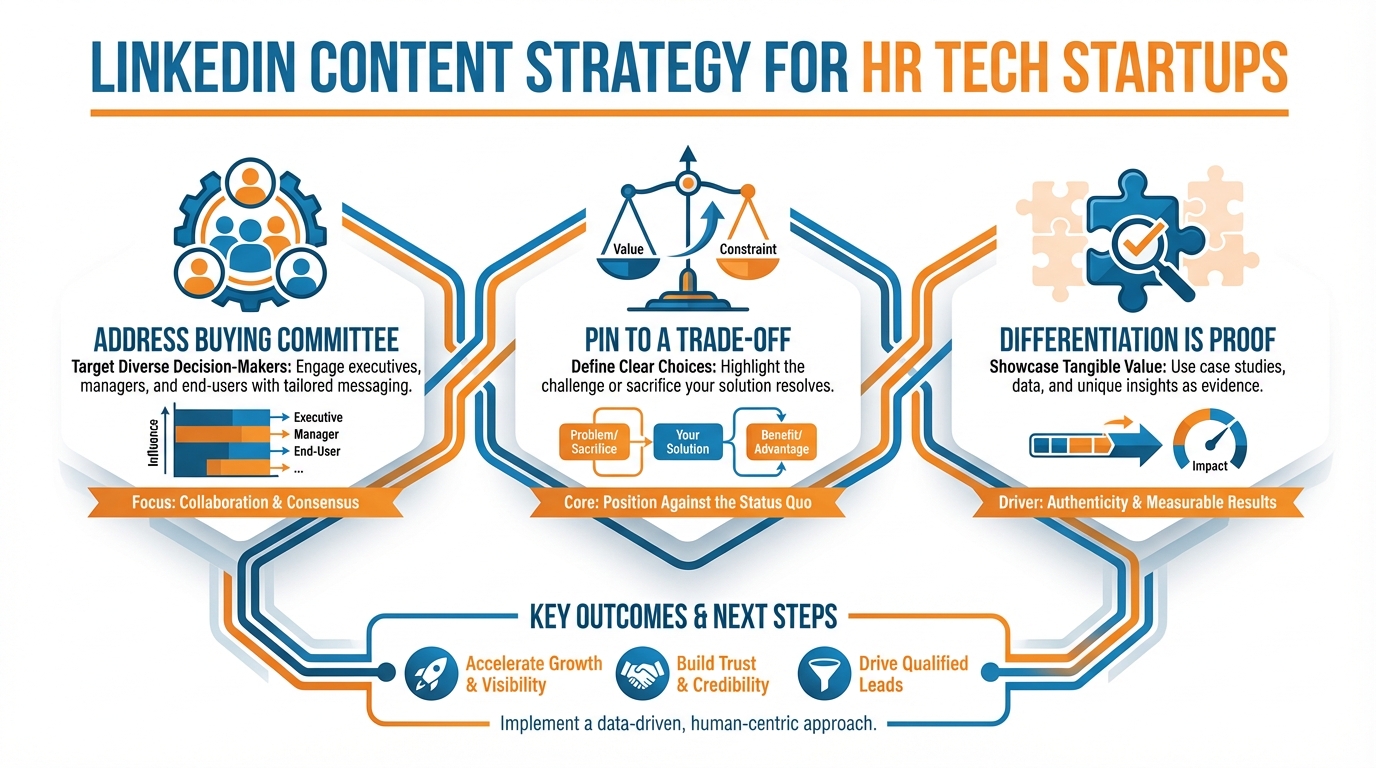
Write for the HR buying committee (not just HR)
Sure, HR is the one that you’re trying to reach on LinkedIn.
But your buyers don’t sit in a vacuum and they’re not all HR.
They’re a committee with conflicting priorities and you need to address all of them in the same post.
Write your post for the CHRO or VP People - because she’s the one who will be fired if it doesn’t go well - but understand that you need to include HR Ops or TA - because he’s the one who will have to deal with it every day - as well as Finance - because he’s the one who wants to know how soon he’ll get his money back - and IT or Security - because she’s the one who doesn’t want to allow another vendor to access our employee data - and then even payroll, legal, works councils, or the HRBP that’s going to sink the whole thing by just posting “-1” on your internal thread.
HR is the one reading your posts, but if you’re not writing for everyone else, you’re going to get a lot of likes, but you’re going to keep losing deals.
Here are the steps to successfully selling to HR committees: Outline your solution according to the real HR tech purchase journey, not the one that you hope it is.
Be sure to indicate that you expect them to be highly doubtful of AI functionalities, will likely be fearful of tool fatigue, and to assume the implementation is going to be a nightmare.
You should also explain integration points early on since HR is assuming the cost and time to integrate will be more than the demo.
You should discuss adoption risk, manager behavioral changes, and what will happen after the first two weeks of novelty has worn off.
Finally, don’t shy away from privacy and security; include it in your story and assure IT that you will reduce their work, not increase it.
By voicing concerns before your prospect does, you build trust faster than any feature on your product. For the “buyers are out of market” reality behind this, the Edelman x LinkedIn report notes the “95:5 rule” that 95% of a B2B company’s customers are out of market at any given time.
Pin yourself to a trade-off, then quantify the cost of not adopting
On LinkedIn, you have to pin yourself to something if you want to stand out.
It has to be a trade-off within a category, rather than some broader thought on HR.
Are you a best-of-breed play vs. a suite?
Are you a replacement for spreadsheets vs. a system of record?
Are you automation vs. control?
Then you then have to consistently lay out the cost of not adopting: a seat left unfilled for an extra week, a recruiter who has to do a status check-in rather than make a hire, a compliance issue that can arise from having non-standard documentation, an internal mobility effort that won’t move the needle because we can’t standardize skill profiles.
When you talk about outcomes, any solution has to be tied to metrics the buyer committee cares about, such as time to hire, retention, internal fill rate, audit preparedness, the number of help desk tickets from hiring managers, etc.
I’ve seen tiny firms defeat larger firms in a content battle simply by making things tangible and quantifiable rather than just another think piece on the Future of Work.
Differentiation is proof engineered to feel low-risk
The best HR differentiation is proof, that has just been constructed so that the evaluation is perceived as low risk.
That means evidence mechanisms that mitigate risk; that means examples that benchmark the good state; that means process flows that indicate hours rather than “rocks in your backpack”, that means implementation timelines that describe the impact to HR/managers/employees on a weekly basis.
That means highlighting risk-mitigating aspects such as permissioning/data storage/upcoming SOC2/edge cases first, since that is what derails.
Finally, it means choosing the right persona:
- founder persona for vision, for credibility of category creation
- practitioner/operator persona for bringing that vision to life day to day
- customer-adjacent persona when you don’t have logos, to share learnings from implementations, from pilots, from what a low-risk evaluation looks like, from the customer perspective
And that is how you turn your LinkedIn posts into positioning, not posting. If you need a consistent system to avoid gaps, this pairs well with weekly social media system.
Build content pillars that map to objections (not generic thought leadership)
When it comes to HR tech startups, a key part of an effective LinkedIn content strategy is to focus on content pillars that illustrate how the product value proposition translates to tangible results in HR.
This can include pieces on best practices, trends and news, thought leadership interviews, and educational articles and guides that speak to the value of the product.
The easiest way to bore HR buyers on LinkedIn is to create pillars around generic thought leadership.
In a real LinkedIn content strategy for HR tech startups, your pillars should tie to intent and objections that derail deals.
You need five lanes you can post in every week: operational pain that shows where time and compliance are bleeding in the day-to-day HR workflow, change management to tackle adoption and manager behavior, implementation reality that includes integrations and sticky edge cases, data and privacy to speak the language of IT and Security, and ROI logic that Finance can cross-check.
If your pillar can’t answer an objection like this will create more admin work or we can’t risk employee data, it is not a pillar, it is fluff.
Turn features into workflow stories (Monday-morning reality)
Next, you need to turn your product into workflow stories rather than feature lists.
Each post should tell the story of what HR teams will find different on Monday morning: what process steps go away, what new information do they get to see, what new controls do they get to see.
You make that believable by calling out a tangible artifact that improves, like fewer email threads, fewer status meetings, fewer reconciliations of spreadsheets, fewer nagging of managers, fewer exceptions that hit payroll, fewer gaps in audit trail.
I often tell this story as a before-and-after, with a tangible change in one of those variables that small businesses can relate to, like a 7-14 day reduction in time-to-hire because of reduction in approval latency, or a 2-5 hour per week reduction in HR admin time because of reduction in double data entry across systems.
The goal is not the absolute number, it is the logical walk to the number that makes the number seem earned.
Manufacture proof without NDAs (patterns, teardowns, negative learnings)
In nascent HR tech markets, the proof is scarce, and your content has to manufacture it without violating NDA.
You can do that by extracting anonymized patterns from sales conversations, support requests, beta programs, and postmortems on deployment and publishing that pattern as a teardown.
You list ten conversations and report on what typically trips up an evaluation, what the common questions are from someone who’s going to buy, and what the early warning signs are of a customer that’s going to churn in month two.
You can even share negative learnings like where automation falls down, where the permission model has to be more nuanced, or where integration assumptions will drive unforeseen costs, because that sounds like you’ve lived it.
HR execs trust vendors that speak to their limitations and can say this won’t work if you have a different process in each part of the organization. This aligns with findings that 33% show relatively low confidence in the quality of thought leadership their organization publishes.
Demonstrate problem-solving without turning every post into a pitch
Last, demonstrate your product without turning every single post into a sales pitch by making your posts about problem solving.
You don’t declare a capability, you do a scenario, discuss common pitfalls, and how you would evaluate products in this space if you were the customer, including what you’d expect from Security and what you’d expect from implementation.
Consistency is the trust builder: keep your use cases small, your terminology regulatory, and your assertions verifiable.
If you post regularly and sound like an ops guy who has had to deal with HR headaches, you aren’t seen as a scary vendor anymore.
You start to be seen as the safe choice, even if you are a small startup.
Distribution and Partnerships: How to Amplify Your Content Reach Without Spending a Single Dollar
To ensure your HR tech startup reaches the right audience on LinkedIn, it’s crucial to expand your distribution channels and leverage partnerships. Here are some strategies to increase your content’s reach without incurring advertising costs.
- Collaborate with HR Influencers: Partner with HR influencers in your niche to broaden your audience. For example, @BryanChaney is a popular HR influencer you can consider.
- Employee Takeovers: Invite employees to take over your HR tech startup’s LinkedIn account and share their stories. This approach has been successfully adopted by companies like HubSpot, LinkedIn, and Glassdoor.
- Repost and Share: Share relevant posts from other accounts on your LinkedIn feed. You can also request other accounts to repost your content.
- Employee Advocacy: Encourage your team members to share your HR tech startup’s content with their networks. This will not only increase your reach but also add a personal touch to your content.
- Guest Blogging: Write guest posts for other websites and share them on your LinkedIn feed.
- Engage with Other Content: Like and comment on other people’s posts to increase engagement.
- Share User-Generated Content: Share content created by your users, such as testimonials or success stories, on your LinkedIn feed.
- Product Updates: Share updates about your HR tech product with your audience.
- Participate in LinkedIn Groups: Join relevant LinkedIn groups where your target audience is active and share your content with the group members.
- Optimize for SEO: Ensure your HR tech startup’s LinkedIn content is optimized for search to improve visibility and reach.
By implementing these distribution and partnership strategies, you can significantly enhance your HR tech startup’s content reach on LinkedIn without spending money on advertising.

If you’re still using a company page to push the whole LinkedIn boulder, you’re missing a huge chunk of potential impact.
I see the most rapid, organic traction for a small HR tech firm coming from a quadruple-play: founder, GTM, customer success, and product, each with their own spin on the same underlying message.
You define the throughline monthly, and each one of you owns a channel: the founder speaks to category choices and the breaking status quo, GTM to decision-maker value and trade-offs, CS to on-the-ground usage and what actually endures past the second week, and product to the technical and data architecture that minimizes danger.
It works in the wild because LinkedIn amplifies people more than pages, and four teammates each posting weekly will often beat a company page that posts daily. If you want to reduce inconsistency, this is complementary to inconsistent social media posting.
Then you hack distribution intentionally rather than relying on luck.
Your first hour after posting is important, because initial activity is one of the most powerful inputs LinkedIn uses in determining whether to expand distribution.
Comments are typically worth more than likes, because they suggest dwell time.
I recommend consistently commenting on 10 to 15 HR practitioners’ and leaders’ posts per day, who are people your customer is already paying attention to.
Leave detailed, domain-level insights: a counterpoint, a list of tips, a common obstacle that you have seen trip up projects, a key KPI to monitor.
I also suggest using team-based amplification: when someone from your organization posts something, the rest of the team chimes in with meaningful thoughts that add depth to the piece, not generic praise for it.
I’ve seen small teams increase their median impression count 100 percent just by weaponizing the comment section as a distribution mechanism, because you are piggybacking on somebody else’s distribution. This aligns with how decision-makers actually consume thought leadership: 52% of decision-makers and 54% of C-suite executives spend an hour or more each week reading thought leadership content.
The second thing you need to do is build a partner network that’s focused on shared stories, rather than one-off mentions.
HR buyers look to other practitioners, fractional HR leaders, HR communities, implementation partners, and other SaaS tools in the ecosystem, because those folks understand what happens once you’ve walked away.
You need to develop content relationships where you share your processes, benchmarking, and lessons learned, and your partner brings their perspective, authority, and content fit.
For instance, I’m currently collaborating with an implementation partner to develop a weekly lesson learned about where HR technology deployments go wrong, and we post it from both perspectives on our blogs and they share my blog because it makes them sound smart to their audience.
And this is particularly impactful in HR tech, because it’s about fear, and the most impactful content is going to be lessons learned that help you avoid a problem.
For long-term flywheel gains, it’s important to have a minimum viable influence map (of ~30-50 influencers) and then actually spin loops instead of doing 1-off asks.
An influence map is when you name the people that are discussing and writing about your category and are running community calls, creating templates, and getting interesting HR feedback.
I like to categorize each by role, target audience, and the strength of our relationship.
If you’re reaching out to them, it’s best to not have an ask for at least 2-4 weeks.
Then when you do have a request, it’s best if it’s easy to execute and makes them proud to share.
For example, you both do a blog post on “2 lessons learned,” or you do an event summary of “5 things you can use at work on Monday.”
You could do a joint update on, “Here’s what we are seeing in the wild across projects, security reviews, or implementations.”
I feel these loops can be sustained because you’re not paying for ads to reach people, you’re building a network of trusted voices willing to share your content.
5. How to use LinkedIn for HR tech startups: Process, automation, and measurement to tie content to pipeline
Your LinkedIn content strategy as an HR tech startup has to endure the 3 bitter truths of a startup: we don’t have much time, we don’t have much data, and the team is already maxed out.
So you make it work by creating a capture mechanism that converts your daily activities into content: every demo, every webinar, every onboarding call, every objection is a prompt to capture 1 thing you didn’t anticipate, 1 thing that was hard, and 1 thing the customer measured.
Then you do your content creation in timeboxed chunks because context switching is the enemy of regularity.
You write once and publish many by transforming: a demo becomes a workflow teardown post, the teardown becomes a comment on an influencer’s post, and the comment becomes another post with an even stronger point of view.
You aim for rapid content cycles, not perfect content, because the winners on LinkedIn are the teams that learn in public, evolve each week, and last long enough in the arena to get seen by the people who count.
AI is your steel girder, not your brand voice.
You can automate the tedious stuff like extracting the key learnings from conversations and storing them in one place, converting repeat questions into a collection of standardized prompts, and reminding yourself to check in with community members who have fallen off your weekly radar. Tools like the AI LinkedIn post generator can support the workflow, but they don’t replace it.
You can automate all of this, but leave the judgment, including the hook, the judgment, and the tone in the commentary and DMs, up to you.
If you read as if you’ve been templatized, HR buyers will assume your product is templatized, which is a no-go in a market where everyone has exceptions, stakeholders, and compliance considerations.
The core of this rule is easy: automate the things you should, but don’t automate your judgment.
Never publish anything you wouldn’t be able to say organically on a call. For measurement discipline, note that LinkedIn introduced a 365-day lookback window in the Revenue Attribution Report, which supports longer deal cycles.
So what does ‘work’ mean if not views?
Views are a reach metric, not a revenue metric.
You should be measuring a funnel you can control: profile views from the right titles and locations, then qualified DMs that are discussing a specific process or vulnerability, then meetings set, then pipeline impacted.
So here are some leading indicators that could tell you someone is interested before they’re ready to talk: saves, high-intent comments (that reference roll out or security, for instance), and repeat engagers from target accounts over a few weeks.
My own experience has been that saves often outperform likes as an early signal for purchases because saves are typically content that will be shared in a group decision. This also fits with how teams evaluate impact: 51% determine effectiveness by looking for increased website and social media traffic.
When you’re looking at this on a weekly basis, don’t look at which content went viral, look at which content got repeat engagement from accounts you’d actually sell to.
To tie content to the conversion funnel, you need a seamless bridge from engagement to conversation without coming across as sales-y.
You accomplish this by commenting in public first, then sliding into their DMs with a brief question only if they show intent.
If someone says, “Do you know how hard it is to implement this?” you leave a public comment with a tangible next step they can take inside their organization, then DM them a quick question about the problem they’re trying to solve that has nothing to do with your schedule.
If they DM you back with details, you invite them to the next logical step: a hosted event if they are still in the discovery phase and “browsing,” a consultative risk call if they are more in the “evaluating” phase and are risk averse, a pilot if they need to see the solution in action, or a demo if they already have urgency and are at the shortlist stage.
You can enhance this system by running a weekly input cycle with the sales, customer success, and product teams: you debrief calls and extract objections, dig into the win-loss analysis, and produce content that removes sales obstacles as a regular responsibility, so each piece of content makes the next sales conversation easier, less stressful, and more likely to result in a “yes.” For keeping the cadence consistent, consider social media calendar automation.
Últimos pensamentos
Trend posting with a nicer hook is not a content strategy for HR tech startups on LinkedIn.
Positioning + believable outcomes + targeted distribution + production cadence is.
If you stack those four things together, you can stop begging the algorithm for table scraps and instead stack up trust with a buying committee that has been hard wired to respond with a ‘no’.
The reward isn’t more reach, it’s more risk reduction, quicker consensus, and more conversations that begin with ‘we already share your view’…
Here’s what I would do if I was joining this week.
I’d bring your messaging into alignment with that buying committee, and not just HR.
I’d have each post subtly address the four risk questions: will this break, will this get used, will this integrate, will this pay back.
I’d then choose outcome-based pillars that you can justify with data and logic, not fluff: time-to-hire reduction, approval turnaround time, payroll discrepancy reduction, manager request reduction, audit prep.
You should be able to say here’s an observable starting point that your buyer can independently verify within the company, e.g. the number of handoffs, the hours HR Ops spends on redundant data entry, the days an offer sits in approval, and then illustrate how the workflow change we propose will impact that metric.
Second, approach distribution from your partners like a product capability, not a marketing bolt-on.
You’ll get more mileage having an ecosystem of 30-50 people and brands that your customers already trust than aiming for mass.
I’ve seen small teams double their average views simply by treating comments as distribution, and by having regular co-post loops with implementation partners, fractional HR leaders, and adjacent tools, because that’s where the credibility HR buyers look for is: rooted in reality.
Highlight what didn’t work in the pilot, what security wanted to know on the first call, what adoption looked like after two weeks, and what you’d try to measure in the first 30 days to prove value. On the product side, even LinkedIn’s own systems show measurable impact; one deployed approach reported a 0.62% improvement in click-through rate (CTR).
Content calendar isn't your competitive advantage.
Insight about your audience, the web of relationships you have with them, and a feedback loop that connects content and conversations is.
Measure the KPIs that indicate you're engaging a committee: Saves from the titles you're targeting, sustained engagement from the same accounts across multiple weeks, and DMs about implementation, security, or deployment.
If you can establish a flywheel where every post helps you understand their objections, every interaction makes a relationship stronger, and every week gives you more leverage into the next, you'll be able to outmaneuver larger companies long before you have their resources.
Related reads
4/27/2026
B2B SaaS social media benchmarks: Set the right targets.
B2B SaaS social media benchmarks: Set the right targets. The trouble with defining B2B SaaS social media benchmarks is that it's an inherently impe...
4/25/2026
Building a personal brand as a technical founder (without becoming a creator)
Building a personal brand as a technical founder (without becoming a creator) Creating a personal brand as a tech founder should feel less about ma...
4/20/2026
Creative Post Ideas for Sustainable Brands (That Don’t Sound Greenwashy)
Creative Post Ideas for Sustainable Brands (That Don’t Sound Greenwashy) That’s not what creative post ideas for sustainable brands should look lik...