How to Fix Inconsistent Posting on Social Media (Without Guilt)
Struggling with inconsistent social media posting? Discover why it's a systems issue, not a discipline problem. Learn to diagnose your content pipeline and build a repeatable consistency strategy.
How to Fix Inconsistent Posting on Social Media (Without Guilt)
If you’re trying to solve the problem of inconsistent posting on social media, the first thing to do is let go of the guilt. Inconsistent posting is almost never a discipline problem. It is almost always a systems problem, and small businesses feel it first because you’re doing sales, and delivery, and admin, and hiring all on the same calendar.
The way to get on a more consistent track isn’t to apply even more pressure with a tighter schedule. It’s to diagnose what’s really clogging your content pipeline. I find that it’s just one of these six culprits: idea generation, time, approval cycles, perfectionism, positioning that is too fuzzy to write confidently, or a “be everywhere” approach. Once you see the true source of the blockage, you can apply a solution to the correct pressure point.
If I am going to fix this for myself, I don’t begin with a calendar. I begin with a basic publishing pipeline that persists even in my most hectic weeks. You will leave with a concrete way to identify your constraint, a frictionless method you can execute again and again, and a consistency strategy that will work in the actual week, not the theoretical week.
If you’re also building a repeatable weekly system, you may find this useful: weekly social media system.
Identify the root cause of your inconsistency (a simple diagnosis that alters the solution)
Want to know how to fix your inconsistent posting on social media?
Well first you have to stop thinking of inconsistency as one thing.
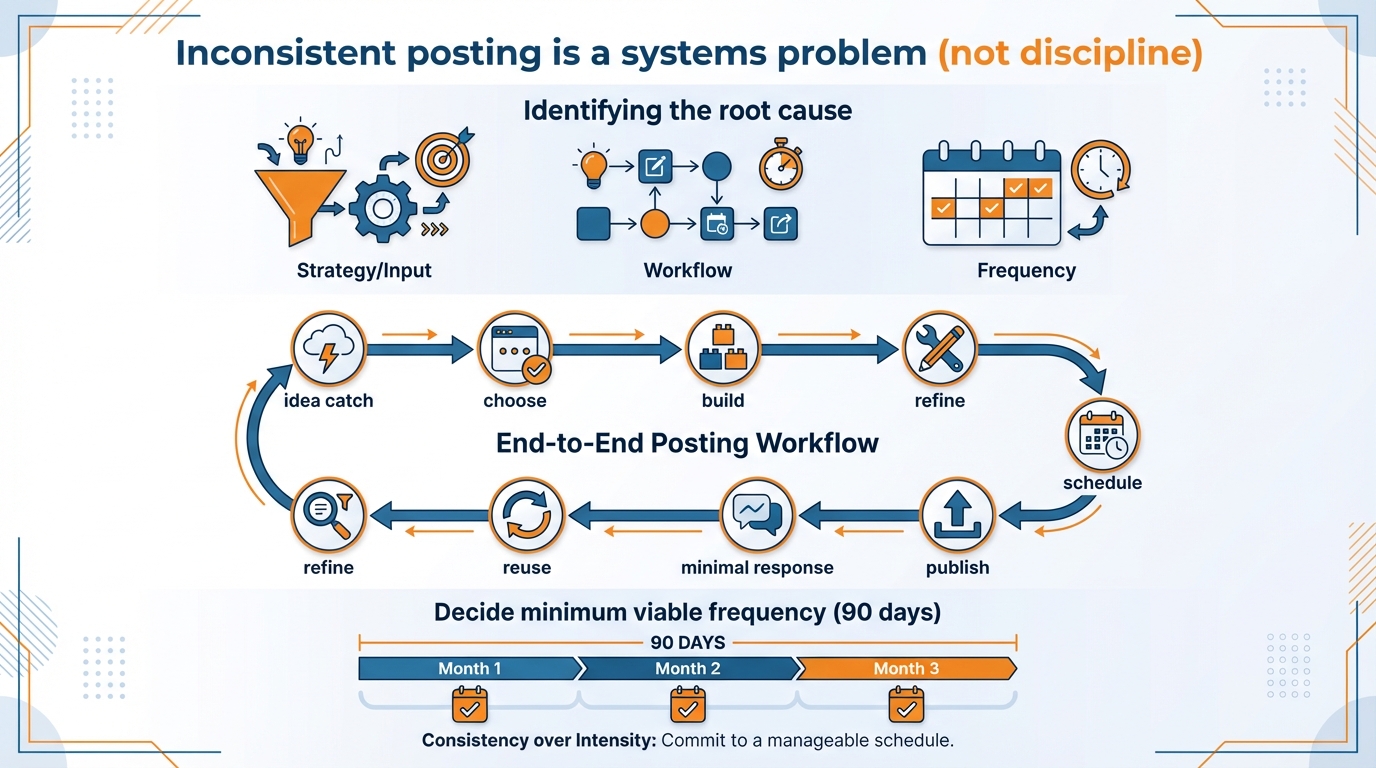
It is most likely one core issue that has 3 different guises.
Guise number 1 is a strategy or input issue: you’re not posting because you don’t know what to post, so you wait for inspiration and you disappear when business gets busy.
You can identify it when you only post when inspired, you keep asking what should I post today, or you hop trends without a clear angle tied to what you sell.
Mask two is a capacity or process issue.
You know what to write, you just can’t seem to consistently execute.
You have to start again every Monday.
You post every day for 10 days and then stop.
You can only create when you’ve got a free afternoon.
The metric I look for here is throughput, not motivation.
If you can’t generate 2-3 decent posts in an hour of focused effort, your process is too intensive for a small business week and you will always fail on consistency when faced with a normal week of client work.
Mask three is friction or workflow perfectionism: content is created, but never published.
What you see is drafts sitting in your note app, captions partially written, photos still needing to be edited once more, or a tendency to write the same post five times over.
The second big friction mask is when you’re spread too thin across five platforms and every single one requires a different content style, so nothing gets published.
I’m guilty of this too: I’d create content, but because every single post had to be perfectly branded and perfectly suited for each and every platform, publishing became the friction point, not creating.
Here’s a fast diagnosis that can prescribe the fix: track your last 14 days, and for each missed post, attribute it to just one cause, either ideas, time, or shipping.
Then tackle the thing that comes up most often first, since fixing your biggest bottleneck will clear up everything else.
If it’s ideas, you need a repeatable way to come up with on-brand topics fast, not more discipline; if it’s time, you need lower-weight formats you can create on a busy day; if it’s shipping, you need a simpler definition of done and a 1-click publishing flow.
Tools can be useful once you identify the bottleneck, and something like WoopSocial is most useful if your main problem is ideas, or converting ideas into content ready to post that still reflects your brand. If you want faster ideation, an AI social media content generator can help you move from idea generation to draft output more quickly.
Cadence is also common to misjudge; according to HubSpot’s findings, 19.7% of marketers post multiple times per day and 64% post less than daily, which is a useful reminder that inconsistency is often a systems mismatch, not a character flaw.
Create a basic end-to-end posting workflow
So that consistency ceases to be dependent on motivation.
Want to figure out how to repair your erratic social media posting?
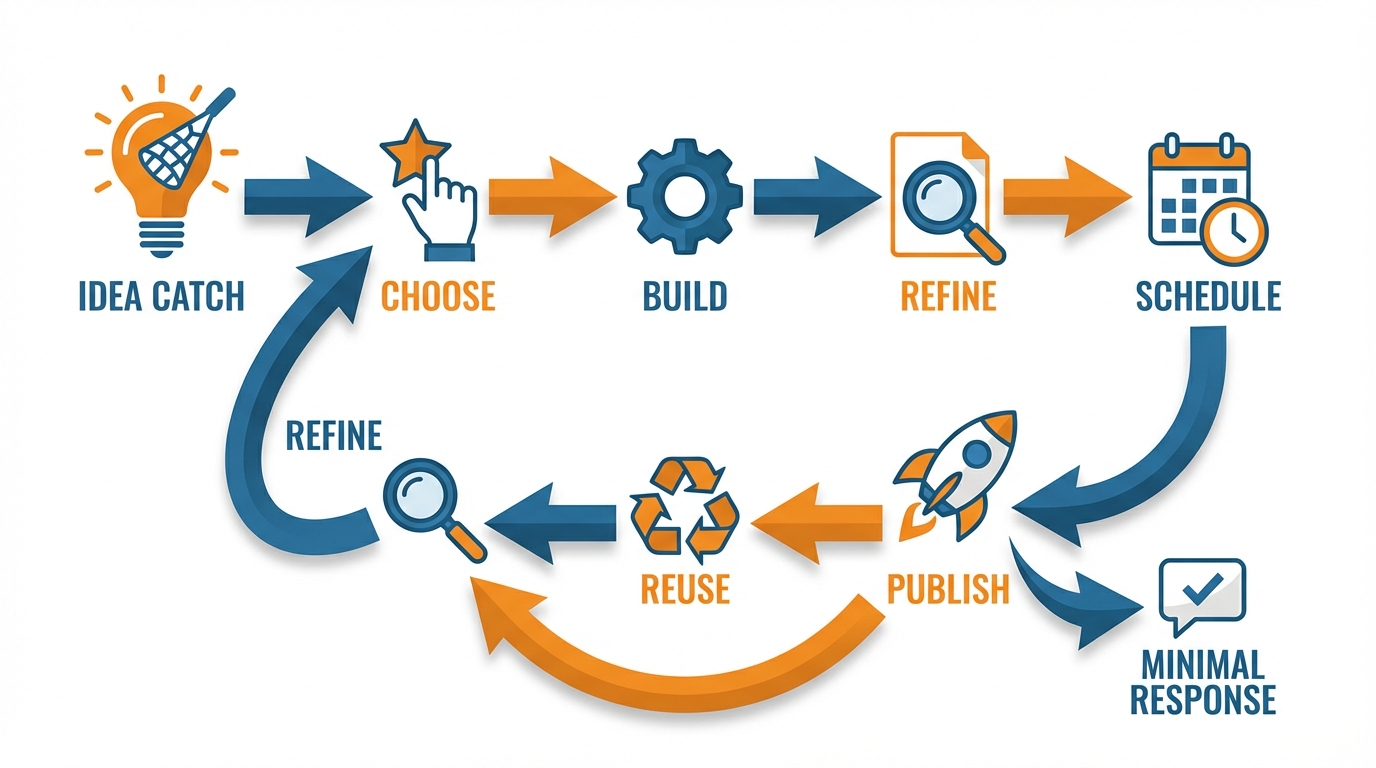
The first step is to stop making it an event and start making it a loop that you can turn, even when the week goes nuts: idea catch → choose → build → refine → schedule → publish → minimal response → reuse → refine.
And the second is to make sure that loop can withstand the juggernaut of reality: A single destination for all ideas (rather than five apps), a single time of the week when you choose what to ship, and a clear definition of done so posts don’t stall in draft purgatory.
Once I did this for myself, consistency ceased to be a personality characteristic and became a process with a throughput I could count on. If you want a clearer view of using a repeatable content engine, this pairs well with smart social media automation.
One: Make it as low-friction as possible.
Friction is the enemy of consistent small-business content.
And you make things low-friction by limiting choices:
- Choose a caption template that can be reused (hook, one insight, one proof point, one simple next step)
- Choose 2-3 creative constraints (same fonts, same colors, same photo style)
- Choose to cap your editing time
2-3 posts in 1 hour is a useful benchmark: if you can’t hit that, it’s too frictional, and you’ll slip back into fits and starts.
You don’t want a single perfect post, you want a repeating rhythm that gets you compounding reach and trust.
To prevent content debt, it is essential to implement a buffer.
Do this by creating small batches in a scheduled period and never ending without more content than you began with.
Having a 3-7 item buffer is good to be able to publish if the client work goes up.
Don’t tie generation to publication, so if it’s a heavy day, you can still publish.
One trick that makes the loop always work for me is that if I skip a day, I don’t generate double the next day (which would cause exhaustion).
I just return to the loop at the next curation point.
Last but not least, incorporate recycling into the process, not as an afterthought: every successful post should be converted into at least a follow-up post, a short-form version, and a re-angled version, because recycling is what enables small businesses to stay consistent without being glued to social media.
Have a weekly review, with just one question: what worked and generated engagement, saves, link clicks, or started a conversation, and how can I repurpose it and republish.
If your problem is ideation to post ratio, I occasionally use WoopSocial to generate a month’s worth of on-brand content ideas in minutes, and store it in my content bank, and then I choose and finalize only the posts that match this week’s goals, so that my content pipeline doesn’t freeze when inspiration fails. If you need a structured plan to guide what you ship, an AI social media strategy generator can support that planning layer.
From a performance context, Rival IQ’s benchmark report analyzed more than 5 million posts and 10 billion likes/comments/favorites and reports TikTok median engagement at 2.63%, which is a useful reminder that steady, repeatable shipping matters even when engagement shifts year to year.
Decide on the minimum viable frequency (broken down by platform and objective) that you can maintain for 90 days
If you want to learn how to fix inconsistent posting, the first thing to do is to stop striving for an ideal cadence, and instead figure out the minimum cadence you can commit to for the next 90 days.
I never talk about things like “post every day” because cadence is not a motivational headline; it’s a capacity decision.
First, decide what you want to achieve: growth requires more surface area and faster feedback, leads require fewer, more meaningful posts that build trust, and community requires a steady beat that people can depend on.
Then, decide the platform you’re on: fast feed platforms require more, because a post has a short half-life, while slower, more professional platforms reward you for consistency and clarity, because posts have a longer half-life and are more judged on signal rather than volume.
A useful rule of thumb for most SMBs: growth on fast-feed short-form (TikTok, Reels, Shorts), 3 posts per week min, because if you do less than that you are typically not giving the algorithm (and your own learning curve) enough reps.
Leads on slower professional platforms (especially LinkedIn), 2 posts per week min, because you want to maintain enough frequency to keep top of mind but enough distance to actually share evidence, examples, and positioning.
For community (Stories, Groups, X), 3 touchpoints per week min, even if 2 of them are low lift, because they don’t need shine, they need signal.
Important nuance here most businesses don’t understand: consistency stacks because there’s recency bias on every platform, and when you disappear for 2 weeks you lose momentum, which manifests as a 30-60% decrease in average reach per post over the next 2-4 posts until both the algorithm and your audience relearn your habits. Sprout Social notes its timing guidance is based on research that analyzed nearly 2.7 billion engagements across 463,000 social profiles over May 14 to September 3, 2025, which makes a strong case for recency and timing discipline.
To break the gap-and-surge cycle, you need 1 core channel and 1 secondary channel, not 5 channels that you feel guilty about.
You choose the core channel where your buyers already pay attention and where you can ship your easiest format: if you can talk faster than you can write, core might be short-form video; if you can write faster than you can film, core might be LinkedIn; if your work is visual, core might be Instagram.
Your secondary channel is just where you republish the same idea in a native wrapper so you get extra reach without extra thinking.
I keep this honest by tracking 1 metric: posts shipped per week for 4 straight weeks.
If you can’t hit your target for 4 weeks, the cadence is too high or the platform mix is too wide, so you narrow, not grind.
If you need to lower your cadence, you can step down without falling off the face of the earth by making the change clear to yourself: continue posting on the same days, just less frequently.
Going from 5x/week to 2x/week is okay if you still post every Monday and Thursday, since people trust you for regularity over quantity.
Also maintain a bit of a buffer so that you never have to go dark during weeks where you have a lot of clients, and recycle your content intentionally so that your good ideas get more than one go-around from different directions rather than you always needing to invent from scratch.
If ideas are what’s clogging up your cadence, sometimes I use WoopSocial to get 30 days’ worth of on-brand ideas at a time, and then I promise myself I’ll only post the minimum cadence for 90 days, which makes consistency feel less like a superpower and more like a game that you can’t help but win.
Pew Research reports broad platform adoption; in its 2025 research, 84% of U.S. adults ever use YouTube, 71% ever use Facebook, and 50% use Instagram, which is a useful reminder that picking the right core channel matters more than “being everywhere.”
Pillars, recurring series, and a reuse mechanism (and a ladder that doesn’t consume much energy)
Want to know how to cure inconsistent social media posting? Start thinking of ideas like inventory instead of lightning bolts. Your goal is to create content inputs so that you are never at square one.
Create 3-5 pillars that directly correlate to what your customers already ask, fear, or misunderstand: one pillar for problem, one for proof, one for process, one for objections and maybe one for personal.
When I do this right, I can open my idea bank and immediately know which bucket a post falls into, which keeps my messaging consistent and reduces decision time.
This is especially important for small businesses because the largest hidden cost of inconsistency is not the time it takes to post, it’s the time it takes to decide.
Then you turn each pillar into 2-3 serials because serials eliminate the blank-page tax.
You are no longer coming up with new concepts but rather cycling through easily-understood formats that your audience has learned to expect.
For instance, I might do a weekly Fix This First post (1 common problem + the fastest fix), a Proof Breakdown post (1 outcome + what made it happen), and a Customer Question post (1 actual question answered in 5 sentences).
You do not need more creativity.
You need fewer decisions: when you sit down to write, you only have to decide which pillar and which serial to use and then fill in the template.
As a rule of thumb, you should be able to outline a post in under 5 minutes or else your pillars are too broad or your serials are too complex.
You create a “repurpose map” so that each great idea gets translated into different content instead of exhausting itself as a single post.
For example, a “core idea” might be turned into a “short post with 1 key takeaway”, a “story post with a quick lesson”, a “carousel post with steps”, and a “long post with proof and context” - the key is that you’re re-packaging, not inventing.
From an engagement perspective, since the algorithm rules most feeds, and most of your audience never sees most of your posts, re-sharing isn’t repetitive, it’s essential.
The way I approach it is basic: any post that receives an outsized number of saves, comments, or swipes-up, I reframe and reshare within 14-30 days - it’s still topical enough to build upon but long enough ago to not be redundant. A Nature Communications paper on engagement reports it analyzed ~1,046,857 observations (posts) from 4,168 users and includes an online experiment with n = 176 participants, reinforcing the idea that engagement dynamics are measurable and repeatable, not mystical.
Last thing: practical solution to burnout.
You need to have a ladder of efforts - what you can post in 15 minutes (LE: an opinion, a single tip, a customer question), in 60 minutes (ME: an explanation and example), and in 3 hours (HE: a breakdown with proof and graphics), so you don’t have to count on the high-energy days to show up.
I also have an emergency backlog of 5-10 evergreen content pieces that need almost no editing, and approach it as insurance for when I’m traveling, have a launch, or a low-energy week.
If you want an additional safety net, I’ll occasionally use WoopSocial to get a month’s worth of pillar-based ideas relatively quickly in my voice, and then filter them into my series and effort ladder, so that consistency becomes a module that’s reusable, not a blank slate. If you want help turning drafts into platform-ready pieces, try an AI social media post generator.
If you want a practical example of consistent “real” content inputs, you might also like behind-the-scenes content.
Want to know how to fix inconsistent social media posting?
Consistency shouldn’t be a personality feature you do or don’t possess.
It should be the byproduct of a mini-system: Identify the true constraint, create a lightweight production line you can repeat even during busy weeks, and dedicate yourself to a minimum viable frequency for 90 days.
That way, the production of your content will no longer depend on available time but a system that can withstand client work, paperwork, and life.
The best way to keep that engine going is to guard your inputs.
You do that by maintaining an endless idea inventory: pillars that directly address what customers ask, recurring formats that remove blank-page decisions, and a reuse framework that creates multiple native formats from one strong idea.
That’s important because the vast majority of your readers will not see the vast majority of your posts; resharing and re-angling is not repetitive, it’s how you stack learning and visibility.
I track one health warning sign, too: if you can’t produce 2-3 usable posts in 1 focused hour, then your process is too complicated for a small business and your output will keep dying in the face of a real week.
This is your 90 days. This is when it counts.
Algorithms favour recency and consistency, so if you vanish for a fortnight you are normally back 30-60% on your average for the next 3-4 posts until they settle back in on your habits again.
It’s not about posting more frequently, it’s about posting consistently.
Maintain the same days, maintain a low enough bar that you clear it every week, and have the buffer and the recycling get you past the troughs and peaks.
Want to make it even easier?
Have a tool that will generate posts for you from your business that can then be edited into a ready-to-go post so you never have to start from scratch.
Sometimes I use WoopSocial to do a batch of quick posts to keep my stockpile full so I can keep my tone and voice consistent which in turn makes it easier for you to show up weekly without having to put in an extra hour or so. If your bottleneck is specifically creating on-platform drafts faster, an AI Instagram post generator can help you get to a usable first version quickly.
Related reads
4/27/2026
B2B SaaS social media benchmarks: Set the right targets.
B2B SaaS social media benchmarks: Set the right targets. The trouble with defining B2B SaaS social media benchmarks is that it's an inherently impe...
4/25/2026
Building a personal brand as a technical founder (without becoming a creator)
Building a personal brand as a technical founder (without becoming a creator) Creating a personal brand as a tech founder should feel less about ma...
4/20/2026
Creative Post Ideas for Sustainable Brands (That Don’t Sound Greenwashy)
Creative Post Ideas for Sustainable Brands (That Don’t Sound Greenwashy) That’s not what creative post ideas for sustainable brands should look lik...