How to Hire Your First Social Media Intern (Without Creating Chaos)
Hiring your first social media intern can transform your content strategy. Learn to scope the role, recruit junior talent, and structure the process to ship more content safely and consistently.
How to Hire Your First Social Media Intern (Without Creating Chaos)
The first thing to know about hiring your first social media intern is this: you aren’t hiring someone to post. You’re creating a low-risk position that will help you produce more, not less.
For a small business, social is too close to revenue and reputation to be entrusted to vibes.
All it takes is one off-brand caption, one misfired tweet, or one ignored comment from a customer to quickly lose credibility.
The win is shipping more content while maintaining brand quality, security, and consistency.
The biggest error I see is when someone uses an intern as a mini social media manager.
Rather, you need a clear lane defined with guardrails: this is what they own, this is what you approve, this is what access they have, and this is what success looks like on a week-to-week basis.
If you do this well, you can transform a few hours of your time into a content machine that has some legs.
In that one growth run of mine, what separated the middling from the magnificent was not the talent itself, but the operating system that governed the talent: crisp definitions of work, rapid feedback, and simple rules of completion.
In this post, I will show you how to scope the role so that it’s both safe and valuable, find and recruit the right junior candidates, select someone with potential rather than just bravado, and structure the process to avoid the most common pitfall: a lot of content is created, but none of it ever ships.
If you are looking for more speed of execution without the mess, then you have come to the right place. For a related system view, see this guide on smart social media automation.
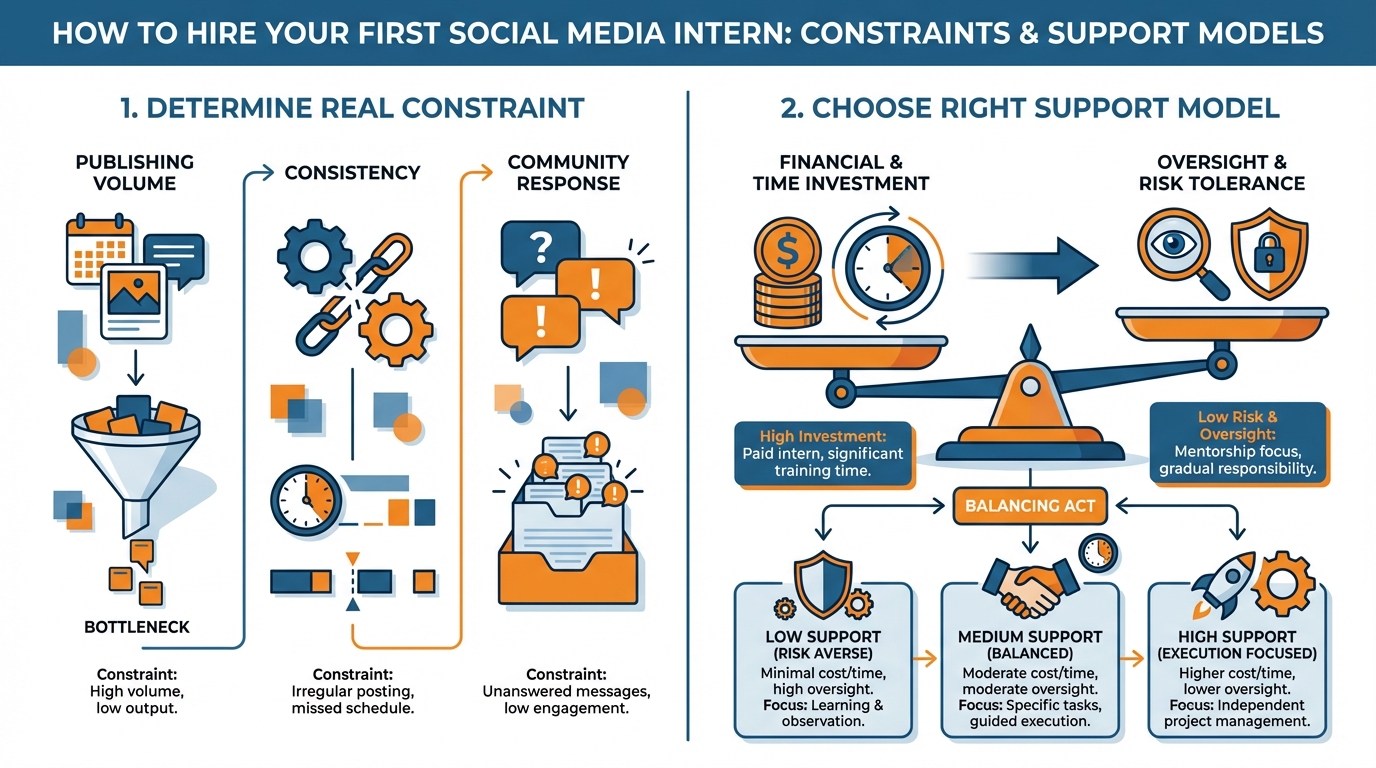
The very first step in hiring your first social media intern is to determine whether hiring an intern is a good decision. This may seem obvious, but before determining how to hire your first social media intern, determine the actual constraint you are trying to alleviate.
Determine the Real Constraint
While most people jump to “we can’t come up with enough ideas”, the truth is that most small businesses need help with more than ideas:
- We aren’t publishing enough volume to get reach.
- We aren’t publishing consistently, which trains the algorithm to not show us.
- We aren’t responding to community quickly enough and letting leads slip through the cracks.
- We can’t produce short-form video fast enough (because it takes 3 hours to get 20 seconds of content).
- We aren’t reporting on our analytics because we’re too busy guessing.
Identify which one (or two) of these constraints is costing you the most and document the constraint as a goal or outcome, rather than a task.
Example: We need to produce 5 videos per week, ready for review.
Or We need to respond to all comments within 4 business hours.
If you cannot define the constraint in one sentence, bringing on an intern will only increase activity, not progress.
Choose the Right Support Model
Then select the ideal support model by balancing the following four limitations: financial, time, oversight, and risk.
If budget is an issue and you can spend time in the week overseeing and teaching, then a college intern makes sense because you are essentially trading dollars for management time.
If time is an issue and you need less guidance to get completed work, then a freelancer is the better choice but it will cost more per project and quality may be inconsistent since they are managing multiple clients.
If you need a comprehensive system and entire creative team, then an agency is the way to go, but this is the most expensive option and often overkill for a service business that is only operating at a local level, or just getting off the ground.
A part-time coordinator is the compromise between all of these and is generally more consistent than an intern, less expensive than a full-time employee, and more likely to execute the systems, but you still have to provide the strategy and branding vision.
Define Safe-to-Delegate vs. Must-Stay-With-You Work
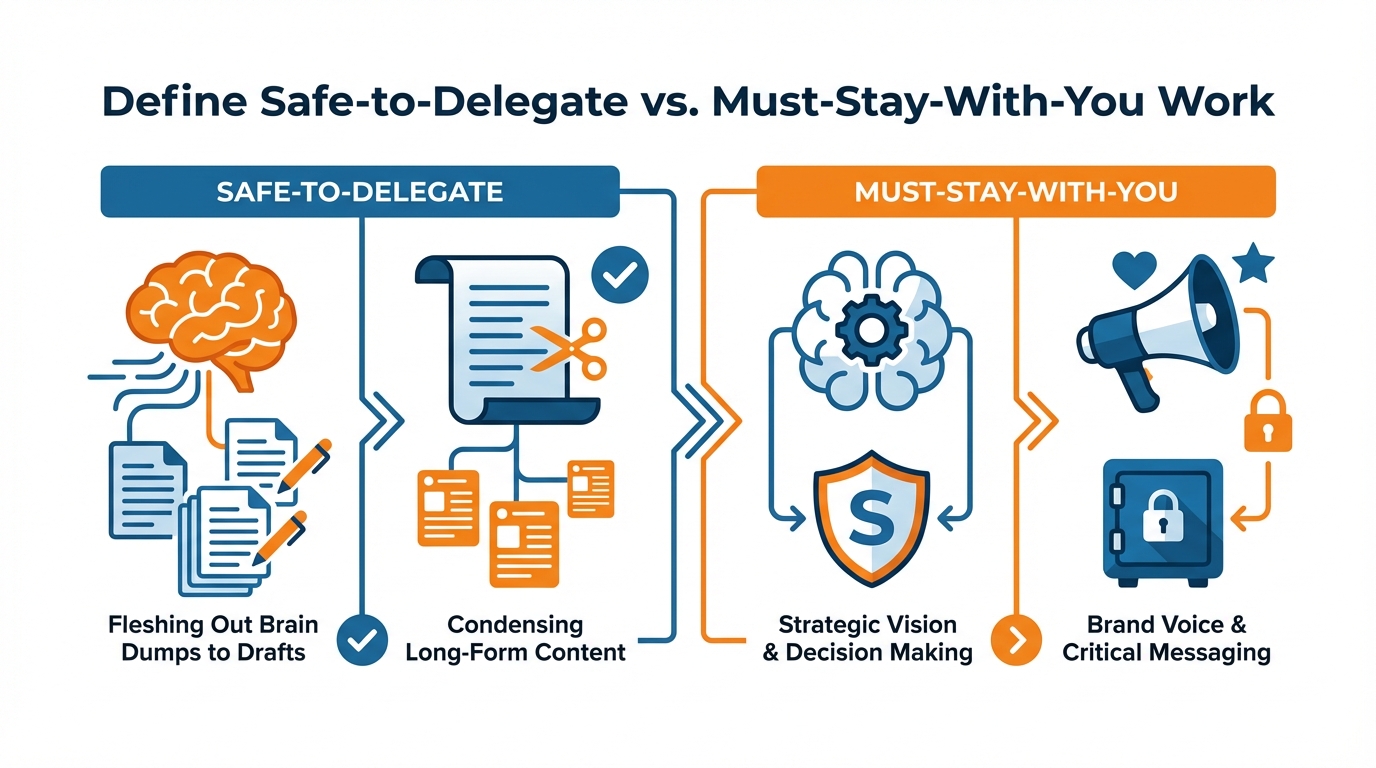
If you choose to hire an intern, determine which tasks are safe-to-delegate and which need to stay with you, and describe those tasks in such detail that you could assign them to a complete unknown and not risk damaging your brand.
Safe-to-delegate tasks might include: fleshing out brain dumps into drafts; condensing long-form content into short-form posts; drafting initial responses to community comments; extracting video clips from approved footage; sorting and categorizing an asset repository; and reporting simple weekly statistics.
Must-stay-with-me tasks include: strategy; messaging and positioning; issues management and crisis comms; anything that requires spending paid media dollars; sensitive partnership outreach; and final approvals for anything that carries legal, brand, or customer promise risk.
And when I’m trying to scale content fast, I think of drafts as an inexpensive commodity and approvals as a precious resource, so I build the job around maximum draft output with a narrow approval path.
Set Limits That Make the Role Safe and Appealing
Last, set limits that make this role not only safe but actually appealing to talented applicants.
Outline what they can share without permission, what they’ll always need permission for, and what they shouldn’t ever do: engage in a comments debate, share thoughts on a political topic or major news event, share a promotion or special offer, offer to help a customer solve a problem, and respond to criticisms beyond a scripted hand-off message.
At the same time, ensure this role is appealing by creating some learning objectives, such as weekly feedback on writing and headlines, an expected frequency of meetings, and tangible deliverables like 30 days of content, a video content reserve, or a quick monthly report on metrics connected to business objectives.
The best way to lure in top talent is to promise professional development and visible achievements, not just access to your social media profiles.
Want to hire your first social media intern? Start by building the job description on an actual process rather than a list of tasks.
Want to know How to hire your first social media intern without creating chaos? Stop listing tasks and start designing a simple system for them to operate. If you want a calendar-first framework, use this social media content calendar resource alongside your role scope.
Build a Simple Workflow (So Work Actually Ships)
Your intern needs to push a workflow around a circle: brief, research, create, review, schedule, engage, report, iterate.
You’re responsible for the brief and the sign-off; they’re responsible for the flow.
In real life, that translates into you providing a weekly brief, with an offer, audience and content objectives, and your intern coming back with researched ideas, first drafts and finished work to be reviewed, then published, then followed up with in the community, and learned from.
I’ve seen small businesses increase content production by 100% just by formalising the handovers, because the intern is not having to guess what done looks like at each stage.
A quality post isn’t a feeling, it’s a checklist you create once and then apply with a light touch.
Before they create the first post, you tell them what the rules for brand voice are, some do and do not examples, what the structure of the post should be, what a hook is, what the formatting rules for the platform are, etc.
You will know the impact: instead of editing everything, you’re accepting or rejecting based on that list.
A good rule of thumb is that on most platforms, the first sentence is doing 80% of the heavy lifting.
If the first 1 to 2 seconds of a video or the first line of text does not contain a promise of value, watch time and reach tanks.
Once you’ve determined what the promise of value is for your company, editing becomes mechanical and your intern becomes competent in a few days, not a few months.
Hire for 2026, Not 2019
You should be hiring for 2026, not 2019.
You need a short-form video factory to produce derivatives, a way to trendjack within guardrails, and UGC-esque work that looks unfinished.
Here’s a directive for your intern: You can trendjack as long as you can connect the trend to our customer problem in one sentence, and you can do it as long as you stay inside our defined voice and messaging frameworks.
I personally get interns to create a lot of variations: multiple hooks for the same piece of content, two caption options, three alternate thumbnails, because ultimately the platforms incentivize a ton of testing rather than a single, perfect post, and small companies can beat big companies by just learning faster.
Guardrails: Permission, Security, and Deadlines
Lastly, guard the company and avoid the most common pitfalls: content is created but nothing happens.
You do this with a permission and security framework and deadlines that move things forward.
Use platform roles, 2FA, require asset and tool access only as needed, and establish a pipeline for errors so that nobody freaks out when they occur.
Then, establish a review cadence that works: establish review deadlines, batch reviews, and choose a posting frequency that is within your ability to review so the pipeline isn’t clogged.
If you can only review twice a week, plan for that, because the easiest way to burn out an intern is to leave approvals as the clog in the pipeline.
How to Find, Interview, and Hire the Right Intern (Using a Scorecard)
I’ll show you how to find, interview, and hire your first social media intern. Using a scorecard designed for hiring a junior candidate.
To get your first social media hire right, hire people where action is proven, not promised.
Platforms will get you better applicants than resumes, because the feeds are the resume.
Search for students that have shown up on one platform, scrappy people with portfolios, those active in micro-communities, and org members who already manage an account for an event or club.
I don’t care where you went to school, I care that you’ve posted 30-100 times in the last 6 months when I’m hiring for small business.
Second, score with an intern-specific rubric, not a junior staff rubric.
You’re not paying for years of experience, you’re paying for coachability and throughput.
Score for writing quality, taste (did they choose the right content and visual), reliability (did they make their deadline), throughput (can they spin up lots of variants quickly), and ability to learn new software and processes without complaining.
A good way to make this rubric objective is to rate each of these dimensions 1-5 and apply a min to reliability and coachability, because a brilliant intern who flakes will suck up more time than they save.
I’ve seen smaller accounts blow bigger accounts away because the smaller account took the notes, improved, and came back strong.
I look at portfolios. As a platform, not a marketer.
I want to be able to point to the hook, and tell you precisely why you’d stop scrolling in the first second or line.
I look for retention logic. I look for pattern interrupts, for pacing, for edit, and for whether the video is earning the next second.
I read their captions, for structure and clarity, not just grammar.
And I check their comment instincts by looking at how they respond when someone comes at them, or asks them a [this-is-explained-in-the-first-five-seconds] kind of question.
The brand fit test is straightforward: I should be able to see them fitting the voice, without making the brand look like any other corporate account on the platform.
I ask if their voice can flex without fracturing.
Lastly, use an exercise that is close to the job, something that shows thought process and then interview for judgement and risk sense.
Send me 3 posts for 1 offer with 5 hooks each; suggest a micro 7 day plan; write a brief note on why the post will work for the audience and which algo signal is being looked for (watch time, saves, shares, comments).
Then, in the interview grill them on how they handle trends, sensitive comments, misinformation, uncertainty.
What do they do when they are unsure, how do they escalate, where do they draw the line.
The best interns aren’t the ‘shoot first’ types; they are quick thinkers with decent judgement and a good sense of what to pause on.
Recruiting reality check: intern hiring is stable, with eight out of 10 employers expecting to maintain (47.2%) or increase (32.2%) intern hiring for 2023-24 vs. 2022-23, and nearly 61% sourcing interns through open applications—see NACE’s research on 2024 intern hiring stability and sourcing.
And for channels, more than two-thirds of respondents viewed in-person fairs and on-campus recruiting as effective in 2023-24, while fewer than one-fifth deemed virtual fairs/recruiting effective, alongside a decline in virtual fairs participation to 58.8% in 2024—details are in NACE’s analysis of why in-person recruiting outperforms virtual.
If you’re hiring into a high-demand category, note that the average applications per internship rose to 109 in 2024-25 (up from 62 in 2023-24), and technology internships averaged 273 applications per posting, as reported with Handshake data in CNBC’s coverage of internship applications nearly doubling.
Onboard for Outcomes in the First 30 Days
Here’s how to hire your first social media intern by onboarding for outcomes in the first 30 days:
The key to getting immediate value from your first social media intern is to clarify expectations from the very beginning.
You don’t want your intern to second-guess themselves, and instead, empower them to take the lead.
Establish clear deliverables for their first week and first month, decide on an acceptable response time for comments and DMs that they are authorized to handle, and establish clear channels of communication so you’re not scrambling to find updates in random locations.
Additionally, establish clear guidelines on what a “good day” looks like (i.e. X number of drafts), what a complete handoff entails, how many revisions are standard, and what should be flagged immediately.
When you establish clear guidelines upfront, you can avoid the inevitable “they’re trying their best, but we’re still falling behind, why?” conundrum that so many small businesses face.
Then arm them with enough brand context to produce something that’s on-brand, without having to be psychic.
Your intern needs a mini brand bible that’s applicable, not aspirational: the top 3 pain points you sell into, your one sentence positioning statement, the objections you hear before someone buys, and a shortlist of past posts that clearly won and clearly lost with a one sentence summary of each.
Also include some competitive intelligence, but make it actionable: choose three competitors and ask your intern to track posting frequency, recurring formats, and the engagement the content gets in the last 30 days, and then turn that into five ideas for formats you can ethically borrow from. If you need a repeatable cadence, align this with social media calendar automation.
I also include a ‘don’t go near this’ list when I onboard an intern, because speed only makes sense when it’s safe.
After the first month, I recommend evaluating an intern based on more operator-like metrics than “highlight reel” metrics.
For example: What was the quantity of assets shipped? Did they maintain a consistent cadence of posting and engaging with their community? Did the quality of the asset improve week-over-week, as measured against your rubric?
For measuring asset quality, you can assign a 1-5 for the strength of the hook, the clarity of the asset, the fit to your brand voice, and the fit to the call to action, then just track the overall average each week for improving quality.
I would also introduce some basic engagement and reporting mechanics in order to “train the marketing muscle.”
Saves, shares, comments, and any notes as to why they thought it performed that way.
Remove the need to “go viral.”
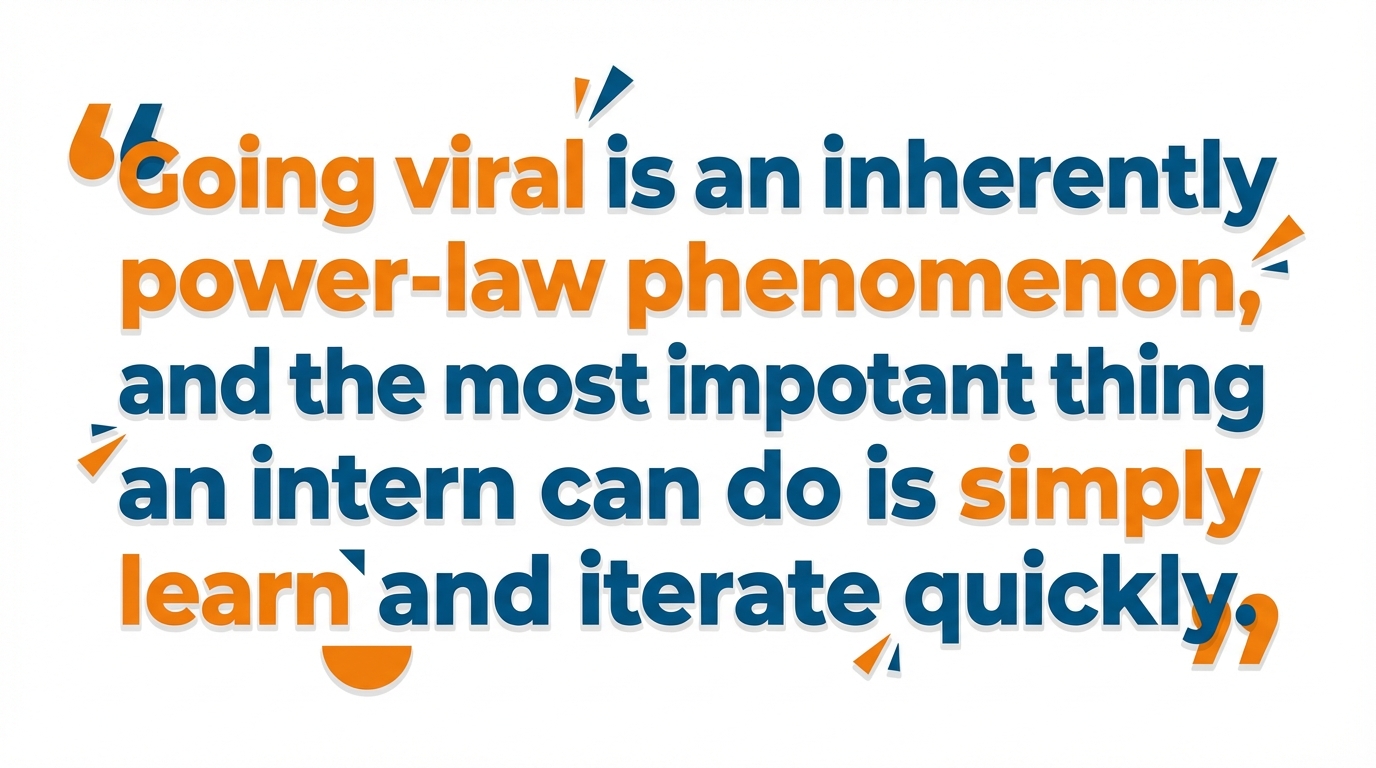
Going viral is an inherently power-law phenomenon, and the most important thing an intern can do is simply learn and iterate quickly.
Lastly, create a feedback loop that multiplies your time instead of burning it.
Create a weekly review that looks at a small batch of assets and one performance report, then runs a quick feedback loop: what did we keep, what did we change, and what rule did we just learn?
The goal is to translate feedback into repeatable rules so that next week your intern isn’t making the same mistakes.
Once the posting process is solid, add one growth lever outside of your owned media: a small partnership or outreach routine that they can execute safely with clear guidelines for who to target, what to say, and what to offer.
I have seen small brands build disproportionately large distribution through simply doing small, polite outreach, because even 5-10 micro-partnerships a month can beat another month of posting in the dark.
To increase the odds this turns into a long-term pipeline, remember that 79.9% of graduating students reported being satisfied with their internship experience and 81.6% felt a sense of belonging, according to NACE’s roundup of what drives intern conversion.
And when you decide whether to run the program in-person or mixed, note that employers extended full-time offers to 62% of their 2024 intern class, with offer rate averaging 72% among employers with in-person internships vs. about 56% for mixed remote/in-person internships—see NACE’s report on intern offer and conversion rate shifts.
Conclusão
Em conclusão,
If you think of your first social media intern as a MacGyvered version of an experienced marketer, you’re going to get inconsistent results and increased brand danger.
How to hire your first social media intern, the version that actually works for a small business, is to approach hiring your first social media intern as a way to build a small content creation and publishing machine, you’ll know exactly what to do.
You’ll define the scope, set the guardrails, establish the selection criteria, and develop an onboarding process that will ensure your new hire’s success.
And that will get you the outcomes you’re looking for: a steady stream of social media content, a shorter ramp-up time, and a solid framework to leverage when you’re hiring your second (or third, or fourth) social media intern.
You need predictable results, so treat the role as a pipeline instead of a popularity contest.
Once you describe what done means at every step, you’re no longer wasting that time on revisions.
On one growth sprint I led, the teams that wrote down their process and quality gates produced about twice as many approved assets as the teams that worked off instinct and recall, because it made approvals a fast decision instead of a long discussion.
Your intern doesn’t need more autonomy, they need more guardrails to make it fast.
You also shield your brand because separating creation from publication gives you the space to have them draft a ton of work, try different things, edit stuff, while you still control the point of publication, sensitive responses and anything related to offers or other things until you get to know them a bit.
Small businesses have less wiggle room for errors, because each piece of content is closer to your revenue and your reputation, and one wrong remark can undermine a month of content.
But the good news is that: A well-defined scope for your intern can lead to a serious increase in the amount of testing you do, and the key to success on any modern platforms is volume. If you want to go further on systems, this playbook on outsourcing social media to AI pairs well with a guardrailed intern workflow.
So when you put all that together, it means the intern is an investment, not a risk.
You have a scalable process that means quality goes up week over week, the time it takes to edit keeps dropping, and you keep publishing great content even while you are busy leading the team.
And that is where the magic is: not just in having more content, but having a more efficient engine that just keeps producing, and keeps improving, and keeps making your next hire that much easier.
Related reads
4/27/2026
B2B SaaS social media benchmarks: Set the right targets.
B2B SaaS social media benchmarks: Set the right targets. The trouble with defining B2B SaaS social media benchmarks is that it's an inherently impe...
4/25/2026
Building a personal brand as a technical founder (without becoming a creator)
Building a personal brand as a technical founder (without becoming a creator) Creating a personal brand as a tech founder should feel less about ma...
4/20/2026
Creative Post Ideas for Sustainable Brands (That Don’t Sound Greenwashy)
Creative Post Ideas for Sustainable Brands (That Don’t Sound Greenwashy) That’s not what creative post ideas for sustainable brands should look lik...