Educational Post Ideas for EdTech Startups to Build Trust
Learn a repeatable system to generate educational post ideas for EdTech startups. Build trust, target key personas, and streamline purchasing.
Educational Post Ideas for EdTech Startups (That Build Trust and Move Deals)
If you’re building an edtech startup, then trust isn’t a nice-to-have, it’s the product wrapper that means you get a meeting. Your customers are making big decisions that impact children, outcomes, budgets, and reputations. They have long sales cycles. They have lots of stakeholders. They make security and privacy a second job. And in this context, educational content is the most efficient trust accelerator because it enables you to prove your ability pre-procurement, opening up their spreadsheet.
The issue is that if you Google educational post ideas for edtech startups you end up with all the wrong stuff. Edtech startup ideas. Trend reports. Content marketing. But that’s not what you’re looking for if you need to fill the funnel with pilots, reduce your objection rate, and cut the length of the time from interested to approved. You need the types of posts you can publish that answer the precise questions teachers, district leaders, IT and finance are already asking in the words they use, with the level of proof and implementation detail that makes risk feel less risky.
In this guide, I will show you a repeatable system to generate educational post ideas that target the right people, streamline purchasing, and have a long tail effect through targeted distribution. If you want a companion system for consistency, see this post on a social media content calendar.
By the end of this guide, you will have a repeatable system to turn your product insight, customer conversations, and launch experience into blog posts that your customers will save, share around, and take to decision-making meetings.
I’ve relied on this system to get content to do the things that you cannot do every day, particularly as a one-person team.
Blog post ideas for edtech companies that fit each buyer persona (teachers, admins, IT, parents)
Blog post ideas for edtech companies that fit each buyer persona. (teachers, admins, IT, parents)
If you want to generate Educational post ideas for edtech startups that feel immediately valuable, the most direct path is to stop writing for edtech as a vertical, and to start writing for a stakeholder that has a job to do.
I organize each idea around who is making what decision: the teacher who must decide whether it fits into tomorrow’s lesson plan, the leader who must decide whether it is worthy of a pilot program, the IT person who must decide whether it is safe enough to touch student data, or the parent who must decide whether it is trustworthy in the home.
Your aim is simple: teach one stakeholder one decision they must make, using the constraints and language that they will apply, so that your content instinctively reflects the questions that arise in sales calls and committee meetings.
Teacher-focused posts: time, pacing, and classroom practicalities
In order to engage teachers, you have to pay attention to time, pacing, and classroom practicalities.
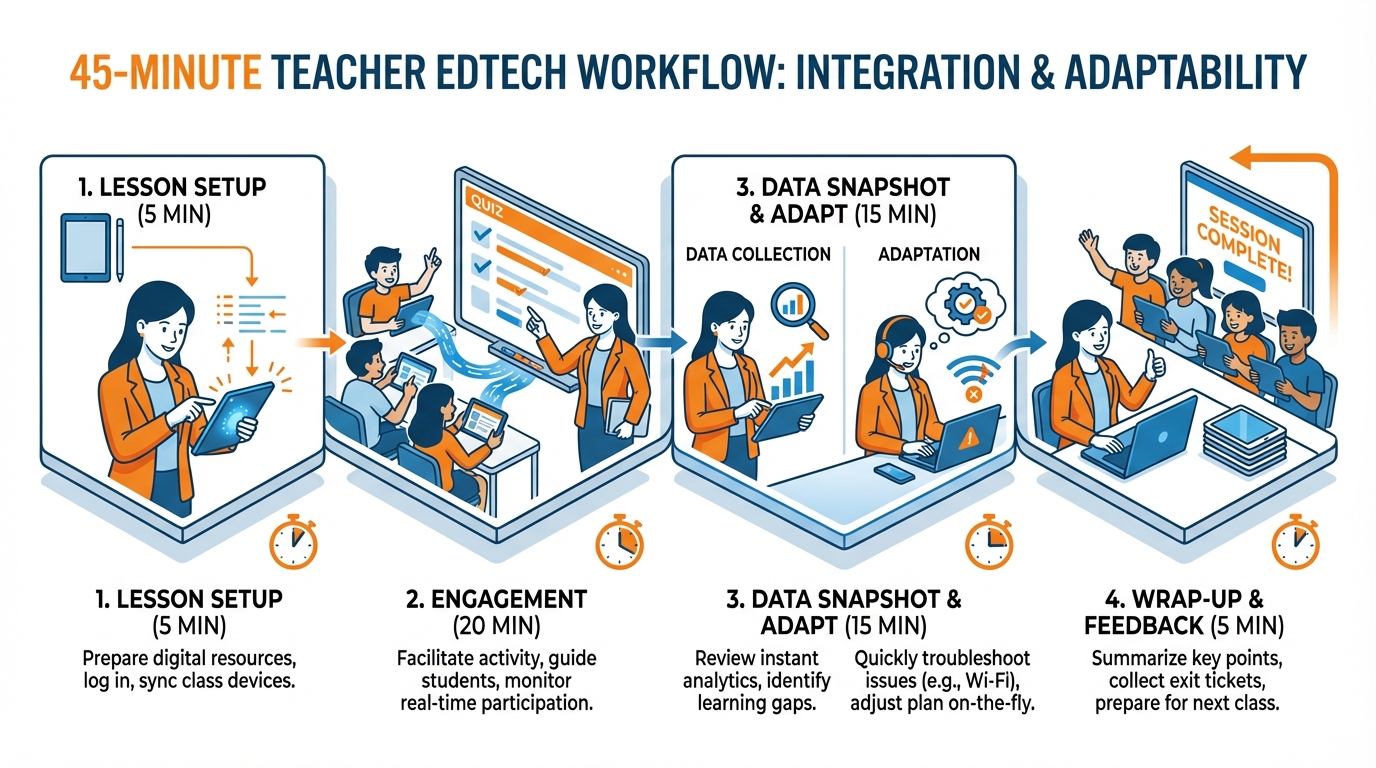
You should write posts that demonstrate how the tool fits into your workflow and lesson plans, not simply inspirational-sounding rhetoric: how you would use the tool in a 45-minute class period, what to do when the Wi-Fi is slow, what to do when devices are shared 2:1, and exactly where it will save you time on grading. For a distribution angle that complements this, you can also build behind-the-scenes trust via behind-the-scenes content.
I personally like to use formats where I do a step-by-step lesson plan, including ideas for what to do with early finishers and students who need extra support.
If you want to take on a top-performer style post, give teachers some ideas about how to manage cognitive load and transition time, as those precious minutes mean the difference between a tool that gets used every week and one that only gets used for the initial demonstration. This aligns with recent teacher workflow realities: a Gallup report found that in the 2024-25 school year, 32% of teachers used AI at least weekly and estimated saving 5.9 hours per week, which is summarized in this Gallup report on weekly AI use by teachers.
Admin and district leader posts: adoption math, pilots, and rollout variability
Educators and administrators, your best content should teach your product’s value proposition: for them, you can teach the math of product adoption, and the math of mitigating the risk of an integration.
You should teach what to measure, how to measure, and how to talk to the district about money and pilots, and how to set up a pilot that will yield some insight in 6 to 9 weeks.
I write a lot of blog posts that talk about what a roll-out looks like in stages, who’s responsible for what, and how to handle the inevitable disparity between some schools and others, because administrators are typically concerned with variability, not averages.
A great proprietary insight here is that pilots tend to fail because of insufficient enablement, not because of a weak product, so you can also teach what enablement plans look like on a small team and a realistic timeline.
This is also where budget context matters: UNESCO’s GEM finance monitoring notes public education expenditure is 4.2% of global GDP and highlights an estimated USD 97 billion per year SDG4 financing gap, which you can reference via UNESCO’s GEM finance monitoring when explaining constraints.
Security, privacy, parents, and students: remove doubt and increase visibility
On the security and data privacy front, your education should remove doubt, not fuel it.
I suggest posting a simple overview of your security model, data flow diagrams that show what data you collect, how it moves, how long it’s stored, and who has access to it, and a vendor-risk FAQ that matches your customers’ procurement checklists.
I like posts that cover one integration decision at a time, such as SSO vs local accounts, which rostering option to use, which roles use least privilege, and what happens on offboarding.
And for parents and students, your focus should be on visibility and control: what learning outcomes they can expect to see, how you respond to screen time issues, how safety manifests in real life, and how they can facilitate learning at home without becoming the teacher themselves.
If each post solves one specific question for one specific persona, you will feel the impact immediately: fewer non-value-add objections, quicker internal circulation, and sales conversations that start closer to the other side of the trust chasm.
Types of educational posts that alleviate common concerns
When it comes to edtech startups, there are several types of educational posts that can be created to alleviate the common concerns of (implementation, effectiveness, acquisition, and data privacy).
Here are a few:
- How to successfully integrate our product into your classroom/school/district
- The most effective ways to use our platform to achieve specific learning goals
- Success stories from schools and districts who have already used our product
- A breakdown of how we stack up against similar products on the market (including a comparison of features and pricing)
- What student data we collect and how it is protected in our systems
- Tips and tricks for writing a purchase order for our product
- How to get the most out of our free/paid trial period to ensure the product is right for you
Want the secret to the fastest, most scalable, and most likely to convert list of post ideas for edtech startups ever?
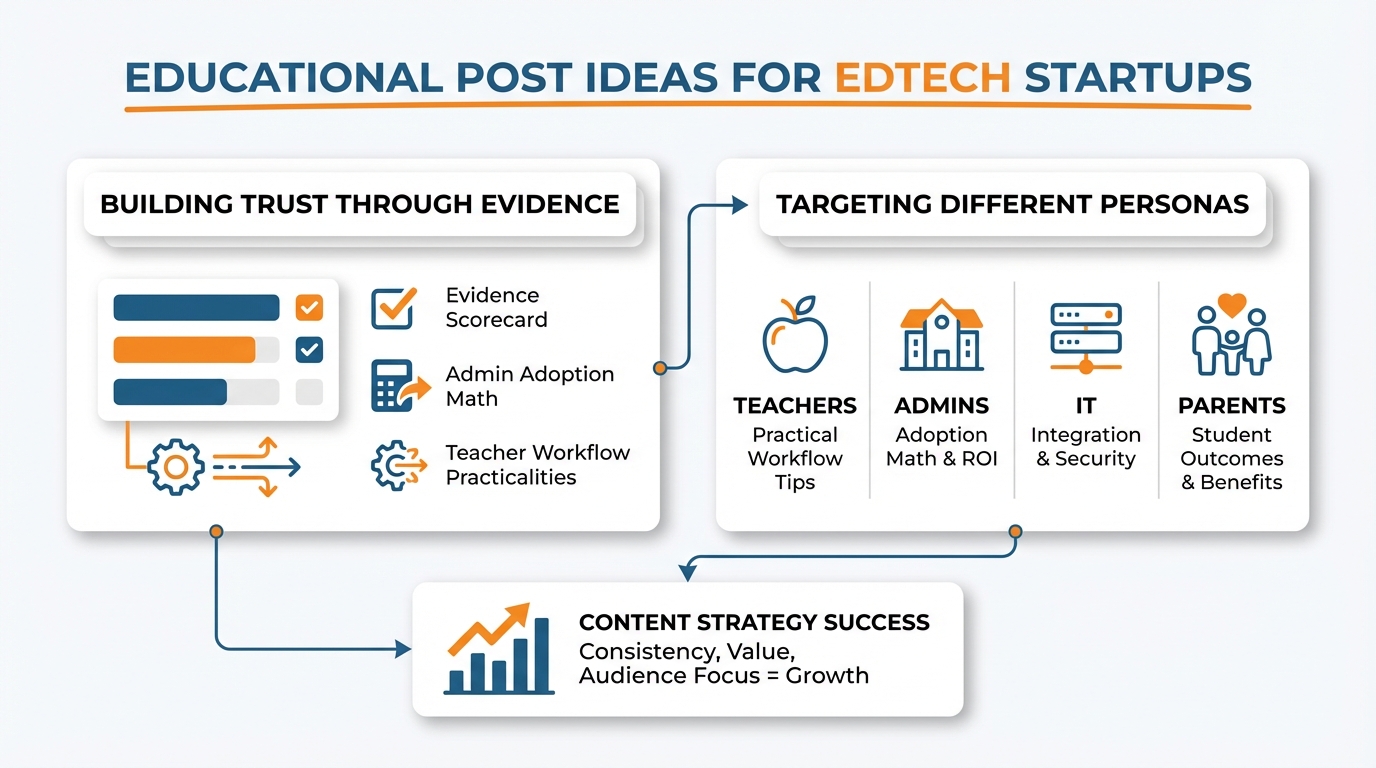
Build proof-driven educational content around what stalls or kills deals and renewals, not what’s on the spec sheet.
In practice, most objections fit into four categories: can we deploy this and not die, will this really work for us, can we afford this, and is this thing secure.
The right content should feel like enablement before the fact: you’re providing stakeholders the precise set of inputs for making a decision in the order that they need them so that the narrative is moved from “why you?” to “how do we roll this out.”
If you want a deeper operational approach, this complements a broader plan for smart social media automation.
Start with implementation reality content
It’s best to begin with implementation reality content, breaking out lofty statements into a concrete implementation plan, since implementation risk is exactly what causes small districts and schools to stall.
You mitigate this objection by documenting the planned weekly roll-out, relative training for teachers and administrators, and typical trouble areas in the first 30 days.
Use concrete numbers: list concrete adoption metrics that a principal can independently verify without any special software (e.g. % of invited teachers that complete initial training, # of active classes per week, % of students activated, time until first assignment, etc.).
I publish a one-page responsibility matrix whenever I create implementation content, to prevent that inevitable conversation where IT assumes that training is curriculum and curriculum assumes that rostering is IT.
Implementation content is most valuable before a demo and immediately after a demo, when you need to convert excitement into action and the biggest hurdle is perceived implementation risk.
Pilot playbook posts that remove “we tried this before” and fairness objections
Next, write pilot playbook posts that eliminate the we tried this before objection and the fairness objection.
Your aim is to demonstrate how to pilot in a way that can’t be biased by accident: to choose a representative set of classrooms, to define success criteria in advance, to measure a baseline before the tool is used, etc.
To define success as time-bound, e.g. a 6 to 9 week pilot, with leading indicators by week 2 (e.g. set up completed, teacher repeat usage) and outcome indicators later (e.g. assignment completion rates, quiz retakes, writing volume, intervention minutes).
You also want to educate on data to collect that is meaningful and procurement-friendly: e.g. anonymized usage logs, rubric-based samples, not sensitive free-form student content.
This content is most relevant during the planning of a pilot, and during week 1 of the pilot, as stakeholders work to agree on what constitutes success.
Efficacy without overstatement
For efficacy, the emphasis is on being strong without overstating, because overstating harms credibility and delays sales.
There are a number of efficacy without overstatement pieces up on Medium that explain the distinction between product usage and student outcomes, what you know already and what you are still checking, and what valid data looks like in real classrooms with real obstacles.
You can teach customers why small samples, non-comparable cohorts, and novelty effects can exaggerate outcomes, and then you can show the protections you include instead: pre- and post-tests, comparison groups where feasible, common metrics, and subgroup analysis so that averages don’t mask equity problems.
I often show a simple evidence ladder so readers can see what evidence is needed for each claim, from usage and adoption, to instructional time and efficiency, to actual learning outcomes; that builds credibility because you are not asking them to trust you, you are showing them what to check.
Procurement and compliance 101 (including legal blockers)
Third, we have the “can we buy it?” and “will legal block it?” questions, which you can mitigate with “procurement and compliance 101” content.
This content demystifies your approval process by explaining what usually kicks off a review, what accessibility looks like for your tool, how your data protection practices work, from soup to nuts, how you address AI-related issues such as data retention, model training, and human review, and, if you’re feeling generous, you can also educate buyers on what they should ask every vendor to sound as cool as you: what data do you need, what’s your breach notification timeline, who are your subprocessors, how long does it take to remove student data, how does that work at the end of the school year, and so on.
This type of content is most valuable after a demo and throughout the procurement process, and should be updated every year for renewal to include what changed, what was audited, and what was fixed.
Educational post ideas for edtech startups that make AI practical (classroom-safe, policy-aware, measurable)
Here are some educational post ideas for edtech startups that make AI practical (classroom-safe, policy-aware, measurable):
- Here's an example of a problem we've been trying to solve for years!
- It's OK to report results like these.
- What if you could make 6 AI-driven decisions like these, every month?
- You asked, we did it: [new feature!]
- These 5 K12 companies are using AI for good.
- How to read (and understand) a research paper on AI in education.
- From the trenches: How we used AI to solve this education problem.
- AI in the classroom, live: video from a recent pilot.
- What every teacher ought to know about AI in education.
- Why we're not afraid of AI in education.
- Which education policies affect the use of AI in schools and districts?
- How we used AI to improve learning outcomes by X.
- Here are X ways AI is improving K12 education today.
- A field guide to AI tools for the classroom.
- The difference AI can make in K12 education.
- AI literacy for teachers: yes or no?
- How to separate AI fact from fiction in education.
- How AI can support K12 teachers.
- How AI can help with teacher shortages.
- What AI can do to improve education outcomes.
- AI in K12 education: what's the value proposition?
- How AI is being used in K12 education today.
- Can AI really improve K12 education?
- How AI is changing the K12 classroom.
- How AI can support personalized learning.
Want the most valuable educational post ideas for edtech startups about AI? Instead of questioning whether AI should be used in schools, discuss how to use AI in schools.
The more useful and practical your content, the better it will perform, so use teach-first posts to help schools determine what’s okay and what isn’t, and how to communicate those policies clearly to teachers, students, and parents. In higher education, AI usage has also rapidly normalized: a HEPI/Kortext survey reported student use of any AI tool increased from 66% (2024) to 92% (2025), highlighted in this HEPI/Kortext survey on student AI adoption.
You can make acceptable use and academic integrity a recurring content topic by explaining specific policies that actual schools can implement, such as using AI for idea generation but not for answering questions, how to disclose AI use at various grade levels, and how to help teachers recognize AI cheating without turning teachers into AI police.
I often create a one-page cheat sheet or decision tree that summarizes who can use AI for what, how they should disclose it, and what the consequences are for violating these rules, since clear policies can help prevent arguments better than strict enforcement can.
Teacher workflows where AI is a power tool, not a shortcut
Further, you build trust when you share teacher workflows where AI is used like a power tool, not a shortcut.
Share blog posts that show how to use AI to streamline the creation of 3 different versions of a learning goal, or to create a set of exemplars and non-exemplars for a rubric, or to chunk up and group the feedback from 30 students’ messy exit tickets into feedback themes in less than 10 minutes.
Make it concrete: show a before-and-after workflow in which a teacher would normally spend 45 minutes writing comments on the work of 30 students, but instead uses AI to create feedback that aligns to a rubric, and then spends 15 minutes cleaning up for voice and accuracy, thus saving 30 minutes per stack.
You also need to show how to create teacher-side constraints that prevent AI-generated sameness, such as requiring multiple cultural contexts, multiple reading levels, and an anchor example written by the teacher, so that the AI-generated materials don’t flatten the instruction into a one-size-fits-all model.
Safety and equity: be critical, be practical
The third lane is safety and equity. Here’s where you get to be critical. This is where you can teach kids what bias and hallucination look like in student language, how to use the parts of the tool or tool programming to share sources and uncertainty, how to actually use the tool in age-appropriate ways (e.g., restricted open chat for younger students, but teachers use AI to plan lessons). It’s where you talk about the times when the tool improves access, like converting text to simpler language, and generating captions, and times when it reduces access, like producing varying reading levels and not handling dialect and multilingualism.
I often model a simple class protocol: check facts with one of the sources we have, mark AI-generated responses as such, and require a peer check before turning something in or presenting it.
Assessment and measurement when AI is involved
Last, write assessment and measurement pieces that show schools how to assess learning when AI is involved, rather than pretending it’s not a factor.
You can explain what does and doesn’t change: while tests still measure what students know, assignments increasingly focus on process - the evidence of their thinking you see in oral defenses, drafts, and reflection.
Then you can also make your tool’s implementation measurable by telling school leaders what metrics to follow: wherever feasible, the learning outcomes, the time it saves teachers, the breadth of adoption - average number of classes per week that use the tool, for example - and markers of quality, like the degree to which assignment rubrics incorporate your tool and the frequency of revisions.
By explaining how to do a six-to-nine-week pilot that includes baseline measurements, second-week leading indicators, and end-of-pilot outcome measurements, you can establish your brand as the steady, policy-wise partner that will help schools move forward even if everyone else in the room has doubts. As one additional adoption signal, Cengage reported 63% of K-12 teachers say they (or their district) have incorporated GenAI into their teaching process, which you can cite via this Cengage AI in Education report summary.
Partnerships, community, and smart distribution mechanisms
To get more traction and scale, edtech startups can leverage partnerships, community and smart distribution mechanisms. Here are some educational content ideas that can be used for that.
Content for your blog posts, social media or newsletter: Share success stories of partnerships that you have done. Host webinars in partnership with other businesses. Share customer testimonials, case studies or how-to videos.
Create a community: Support other communities or discussion groups. Host AMAs (Ask Me Anything).
How to educate your target audience? Share tutorials on how to use your product. How to apply your knowledge. Share industry trends and research. Share updates about your company.
How to educate other stakeholders? Educate other stakeholders like investors or potential employees. What is the problem you are solving? What impact can this sector have. How will the ecosystem evolve in the future. Share what your company is doing in this field.
Where can you get the necessary education and training? Educate your team: Offer a free course or a free book to train your team. Share what and how your team is learning.
Who are the educators in your field: Who are the thought leaders. What do they say about your field. What are they doing in this space. Who else is providing education and information.
The edtech marketing blog post idea generation template (distribution that compounds)
The edtech marketing blog post idea generation template only works when you can convert one idea into several impressions without having to pay for them.
The edtech marketing blog post idea generation template I like starts with a list of folks you have a vested interest in educating each other with, which is a key difference between an edtech influencer list and an edtech marketing blog post idea generation template.
These are classroom teachers, instructional coaches, edtech influencers, and independent school consultants who already write about practice-based advice.
Think of it like a mind map of who in edtech can reach which stakeholder segment, which is why you want to develop 2-3 reusable formats that they can all leverage, such as “Pilot Planning Month 1,” “Debunking Edtech Sales Mythology,” and “Week-by-Week Edtech Implementation Planning.”
When done correctly, a single edtech marketing blog post idea can be shared into several niche networks that already trust the author, which is why I find that edtech marketing influencer-based content distribution almost always outperforms edtech company-based content distribution when edtech credibility is a constraint.
In order to make the ecosystem actually share your content, you have to create each post in a way that makes it shareable by stakeholders, not just readable by fans.
That means you have to include assets that can be copied from the post and pasted into an email to a superintendent, or into a school district newsletter, or into the agenda for a PLC meeting without any editing.
I create posts with pull-out quotes, mini-infographics, policy extracts, and checklists so that the content can be extracted and shared as a standalone artifact even when the attention span is limited to 15 seconds.
That matters because email forwarding is the real EdTech algorithm, and the post that gets shared as a screenshot in a meeting will outperform the post that gets likes; it will also reduce your sales cycle by arriving in a format ready to be acted on. If you need an easy workflow where you can screenshot emails, this can help package examples for stakeholders quickly.
Your highest-leverage source: webinars, office hours, demos, and support tickets
The greatest source of high-leverage content is in your webinars, office hours, demos, and support tickets.
You should record each repeat question verbatim, classify it by persona and deal stage, and organize into a recurring blog post series that answers one objection at a time, with implementation detail.
I also create a stack of blogs to the same question; for example, one focused on a teacher’s 45-minute class period, one focused on an admin’s 6-9 week pilot, with week 2 leading indicators, and one focused on IT, on data flow and offboarding.
In many edtech funnels, there are a few questions that drive the majority of the stalls, so when you can consistently publish answers, you are not just creating content, you are also reducing friction on renewals, expansions, and new logos, at the same time.
Maintain frequency without sacrificing credibility
In order to maintain that frequency, without sacrificing credibility, leverage minimal automation to maintain your tone and address your compliance requirements.
Use your author tool to catch questions as they emerge, label them against your ICP so you can draft by persona, and stage privacy, performance, and security approvals so you aren’t sweating rewrites.
I also have a basic evidence scorecard to ensure claims can be trusted: what we see, what we measure, what is being tested.
The aim is consistent publication, external partners should want to share as a means of teaching their readers, and internal stakeholders should want to share to ensure a confident and informed choice. This relates closely to the idea that teacher buy-in is the multiplier: one dataset notes teachers who embrace edtech report higher student engagement (up to 70%), covered in this analysis of why teacher buy-in matters in edtech.
The basic concept
The basic concept is pretty straightforward, and it’s why Educational post ideas for edtech startups can finally stop feeling like a game of chance: the best topics are stakeholder segmentation + objection removal, plus practical AI guidance, plus scalable distribution that aligns with how education actually communicates.
When you combine those, that’s how you create a content-to-purchase pipeline that actually works because in edtech the algorithm that matters is “hit forward and screenshot for a meeting,” not public likes.
Small teams get the bonus that this approach is compounding: one solid post can get reused across a pilot proposal, a purchasing email chain, a PLC meeting agenda, and a parent newsletter, which is why decision-driven ed content tends to outperform awareness-driven content in the long term.
If you want to see a lot of change quickly, don’t scale back your vision. Instead, focus on one stakeholder and one decision.
Choose an educator who has no time, a district with different and different administrators, a CIO who must keep the network safe, or a parent who needs to know how to manage this new skill with her children.
Then choose a single obstacle that always seems to trip you up, and write a sequence of short pieces that teach a decision, not a feature.
The right test is a reader can do something in 10 minutes.
This might be create a list of indicators for success in a pilot, describe a data integration flow, outline the rules for acceptable AI use, or create a list of indicators that we should expect to see by the end of Week 2. For keeping a steady cadence when you’re stretched thin, this pairs with the reality of inconsistent social media posting.
If you do this, you will see that the conversation has moved from the baseline to the implementation, and people are making decisions more quickly.
The posts with the most bang for your buck are the ones with proof that can be shared without editing: a one-page assignment chart for the rollout, a basic evidence stack to prevent over-claiming, a purchasing “FAQ” that echoes the committee questionnaire, an AI “in classroom” policy that limits risk without stopping work, etc.
That stuff makes your work accessible within the buying process, which is the goal.
If your post can’t be copied and pasted into an email to a superintendent or inserted into a school staff meeting agenda, it’s news, not enablement.
Now what? Pick one stakeholder, pick one objection, ship a condensed series that teaches a decision, and listen to what your community and partners want next.
Grow by letting distribution roadmap: the posts that get forwarded, quoted, or requested in conversations are the next series, and the partners who already educate your audience are your multiplier.
That’s how educational post ideas for edtech startups becomes a repeatable engine rather than a monthly scramble.
Related reads
4/27/2026
B2B SaaS social media benchmarks: Set the right targets.
B2B SaaS social media benchmarks: Set the right targets. The trouble with defining B2B SaaS social media benchmarks is that it's an inherently impe...
4/25/2026
Building a personal brand as a technical founder (without becoming a creator)
Building a personal brand as a technical founder (without becoming a creator) Creating a personal brand as a tech founder should feel less about ma...
4/20/2026
Creative Post Ideas for Sustainable Brands (That Don’t Sound Greenwashy)
Creative Post Ideas for Sustainable Brands (That Don’t Sound Greenwashy) That’s not what creative post ideas for sustainable brands should look lik...