Amplify judgment with AI, don’t diminish it
Amplify judgment with AI, don’t diminish it AI can totally amplify your social media content when your strategy is amplifying. If you use AI like a...
Amplify judgment with AI, don’t diminish it
AI can totally amplify your social media content when your strategy is amplifying. If you use AI like a social media auto-captions tool, you will get what all the other auto-captions tool users get: same-sounding, fast-sounding, professionally sounding, totally forgettable content that disappears into the feed. If you’re a small business owner, you don’t have time to post more of that.
The key benefit is when you use AI as a systems enabler, rather than a silver bullet. You provide the two things AI cannot figure out for you: a deep understanding of your audience, and a strong POV. You then use AI to create platform-specific content from those inputs, generate intelligent iterations, and refine them with data. That’s the way to leverage AI for content creation without sacrificing your tone, watering down your brand, or ending up with the equivalent of AI junk food.
I’ve found that the best results come not from telling AI to generate a post but from telling AI to perform a repeatable process:
- Determine what your customers are interested in.
- Develop specific story angles and hooks.
- Generate several options for each channel.
- Then use analytics to figure out what to amplify further.
In this post, we’ll walk you through exactly how to make all of that happen while keeping your content unique, on-brand, and performance-driven, and making it faster, to boot.
And begin with a pre-AI brief (so the output doesn’t sound like everyone else).
If you want to learn how to generate social media content with AI without getting lost in the feed, you have to define the one thing that content is meant to accomplish before you generate one single caption. If you want a practical baseline for building that system, see this guide on a social media content calendar.
You can pick one job per platform because each platform incentivizes a different definition of success: on Instagram, you are usually trying to maximize saves and shares that tell you something is valuable, on TikTok you are trying to maximize retention and re-watches, on LinkedIn you are trying to maximize thoughtful comments and profile clicks, and on Facebook, you are trying to maximize conversations inside the right local or niche groups.
If you try to educate and convert and community-build all at once, AI is more than happy to produce a totally reasonable paragraph that accomplishes none of the above.
Figure out what winning looks like for you over the next 30 days on each platform, and then you can ask AI to generate content designed for that win condition, not for fluency. A 2024 study summarized by Capterra’s 2026 GenAI social content projection found that companies plan to use GenAI to produce an average of 48% of their social media marketing content by 2026 (vs. 39% in 2024), and 90% of businesses using GenAI for social content report moderate to significant time savings.
Start with a pre-AI brief
Second, nail the context signals that AI cannot predict, since that’s where small business owners often surrender their personality.
You need a one-paragraph reader profile that outlines who you are writing to, what they already believe, what they are skeptical of, and what the enemy is.
The enemy is not a competitor.
The enemy is the bad advice you refuse to follow, like post every day no matter what, be everywhere, use 30 hashtags, or always be inspirational.
When I fill out that section, I’m also writing down one uncomfortable truth I’m willing to say that my customers feel but can’t usually express out loud.
That sentence becomes the foundation of your prompts, your hooks, and your POV, and it’s the fastest way to prevent AI from spitting out the same polite, generic content your reader is scrolling past.
Build message architecture
Next build message architecture, so you can increase volume without losing impact.
Use 3-5 content pillars, aligned to how your business really succeeds, such as results and proof, how I work, customer queries and concerns, myth-busting in my category, and what’s wrong with the current state of things.
Within them, identify 10-15 repeatable content angles that can be used indefinitely, such as most common errors, analysis of a real-world example, before-after, comparisons, myth vs reality, cost of inaction, and what I would do if I were starting over today.
Include proof assets that can be repurposed across media formats, one mini case study with metrics, two customer testimonials, three specific things I notice in my week, and a basic results milestone timeline.
One metric to keep you grounded: AI content accounts for ~50% of the pages circulating online, according to big content studies, which means the typical blog post is part of an ocean of very similar-sounding and structured content; it’s not the AI content that differentiates you, but your proof points and angles. As another real-world signal, Basis Technologies’ 2024 marketer usage snapshot reports that 90% of marketing professionals use generative AI tools at least once a month, and 70% use generative AI weekly.
Define voice and safety fence posts
Last, give your voice and your safety fence posts enough definition that any AI tool serves as your editor rather than your stand-in author.
Define the words you use, the phrases you omit, the reading ease, the formatting style, and the tone of your calls-to-action so you don’t suddenly find yourself sounding like a news release.
I always have three examples handy: this is us, direct, specific, a little opinionated; this is not us, vague, motivational, buzzword-y.
Include your brand safety guardrails that will save you in the long run: the claims you won’t make without data to back you up, the topics you won’t broach in a public forum, and what needs a human fact-check before publication, especially numbers, promises, and anything related to health, legal matters, or finance.
If you’re using a content generator like WoopSocial, this pre-AI brief is where you really reap the benefits of its speed and branding features, because you’re populating it with an actual content strategy and an actual voice rather than asking it to dream one up for you.
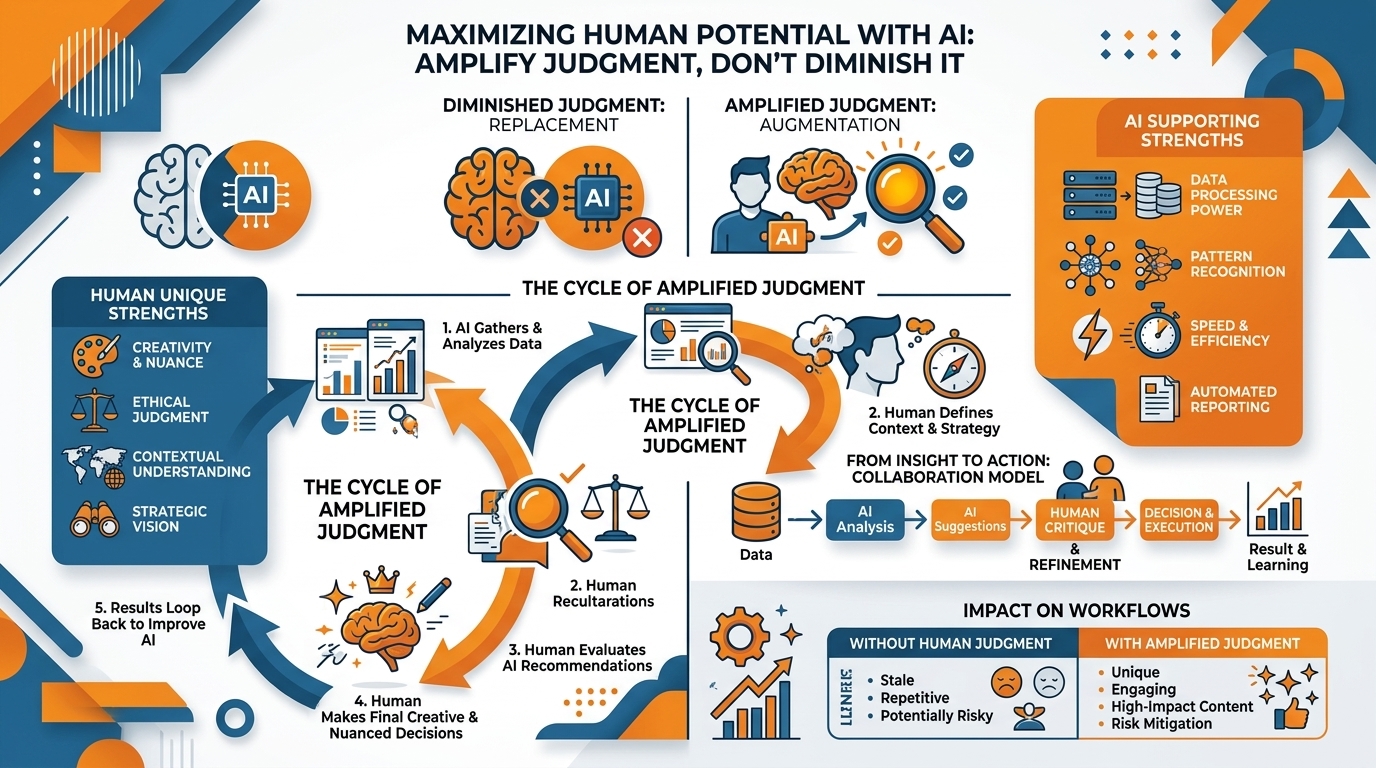
Use a looping approach (batch-generate) instead of a one-shot prompt
If you want to generate social media content with AI without getting generic results, quit asking for posts first.
Start by feeding your pre-AI brief into the AI and treating it like a production line:
- Get 25-50 angles for 1 pillar.
- Get 25-50 hooks for your top angles.
- Get 3-5 posts for your top hooks.
Yes.
This order matters.
Angles give you strategic variety and hooks give you performance leverage.
When you one-shot prompts, you’re usually deciding to go with the first good idea instead of exploring other higher-upside ideas that would have taken the same amount of time to generate.
In reality, this alone can be the difference between 15 minutes of prompting and 1 week of posts that actually feel different. If you want a deeper system for making that repeatable, this breakdown of a weekly social media system fits the same workflow.
Add scoring before expansion
I now include a scoring process before expanding any lengthier content. This way, I’m not doubling down on something mediocre.
I rate each hook based on 5 factors: clarity in 2 seconds, uniqueness, connection to an existing pain point, concreteness, and whether it feels like my writing.
You can make this process more concrete by rating 1 to 5, and then only expanding hooks that score above a certain threshold (e.g. a 20 out of 25).
My reason for doing this is that long-form expansion is where AI falls into the trap of being just okay. If a hook is terrible, 180 words of it is still a terrible post.
I think the science-backed observation to take from this is that most scrolling decisions are made almost instantly. So optimizing that first line is a higher leverage activity than optimizing that last paragraph.
Convert winners into controlled versions
Once you have your winners, convert them to controlled versions, not random rewrites.
Request three A/B hooks that keep the same idea but change the opening pattern, then two CTA styles, one soft value post that teaches and asks a small next step and one more direct conversion post that makes the offer clear but isn’t pushy.
This is how small businesses win without posting nonstop: you are testing message fit, not just publishing volume.
If you use a generator like WoopSocial, this is where speed gets dangerous in a good way, because you can create those variations in minutes, then select the winner before you create an entire month of content.
Build a “content genome”
Lastly, create a content genome of what works so the next month is easier.
Once a few posts succeed, distill the common elements, including hook type, hook length, structure, tone, example style, and how fast you get to the point, and apply them to new topics.
Run a humanness filter at the end where you add one thing AI doesn’t know, such as a lesson I learned when a customer said no, an actual constraint from last week, a contrarian nuance I now believe, or an aside from customer calls.
That one fact is all that’s needed to not make your content sound generated, even when you generate it in bulk.
Make it native to the platform
(Same concept, different creative execution)
Want to get good at creating social media content with AI?
Forget about trying to write the same post five times.

Your goal is to adapt the same message into the structure that each platform prizes most, since that’s what the algorithm and the user experience are optimized to recognize.
On LinkedIn, you start with a hot take, build authority fast with a credibility marker, write for quick scans, nail a single core benefit, and wrap up with a call for personal anecdotes rather than engagement bait.
On Instagram, you build a carousel: one claim per page, strong first paragraph, caption flow, a quick framework worth saving that can be read on a phone.
On TikTok, Reels, and Shorts, you optimize for watch time with a 1-second hook, pattern breaks, open loops, tight on-screen text cadence, and spoken language instead of a blog post masquerading as a script. Research shared in the 2024 paper, evidence from a large-scale UGC field experiment, found that giving ~1 million users access to AI-generated video titles increased the likelihood of videos having a title by 41.4%, showing how “packaging” and metadata can materially change outcomes.
That same translation goes for X and search-led destinations.
On X, you write a bold claim, add some meat in the form of evidence or an example, and use a thread only if it’s truly necessary; then you create quote-tweet prompts that enable people to add to your point without having to go on a rant.
On platforms like Pinterest and YouTube where the packaging is the thing, you begin with search-led titles and images, then use AI to generate variations that are keyword-aligned but that retain your unique perspective, so you don’t slide into “vanilla content”.
One of my tests for small businesses, in order to be significant, is that the smallest tweaks to packaging should significantly change results, as in YouTube testing, changes to title and thumbnail alone can drive drastically different CTRs even if the video content remains the same, which is why platform-native packaging isn’t optional for consistent distribution.
Have AI serve as creative direction, not just copy, and you will feel a major lift in quality.
Rather than generating just a caption, you generate the first few seconds, text overlay lines, B-roll ideas, and edit beats that are likely to retain viewers.
Sometimes I will ask AI to generate three different hook ideas for the same concept, such as a before-after screen recording, a quick mistake demo, or a results screenshot, and then I will select the one that seems most aligned with platform expectations around what users would want to see or read next.
Your aim is to make the content feel native because people can tell within the first second if something is not, and the platform generally responds with a poor starting point in the algorithm.
The number one way to maintain your speed without sounding like AI goo is to develop a format library, a set of recurring types of posts that you’ve found already work for your business, “myth vs reality”, “one mistake and the fix”, “behind the scenes of how I do it”, “a mini case study with one metric”, “a simple checklist”, and then have AI fill it in for you instead of attempting to start from a blank slate each time. If you want to lean into that specific format, this is a useful companion on behind-the-scenes content.
Then your edits are just a matter of how well the new AI content fits the template, which is much faster.
With a platform like WoopSocial, this is where speed is actually valuable for a small business, you can whip up platform-specific variations from your library of formats much more quickly, and still retain the same tone and visual aesthetic across your platforms instead of trying to use one-off inspiration from your daily life.
Consistency is a pipeline (not a personality trait)
Regular publishing.
Automating things that suck.
Optimizing through feedback loops.
Consistency is not a personality trait, it’s a pipeline.
Find a tempo that you can maintain for 90 days, then use AI to front-load production so that distribution isn’t a function of daily inspiration.
For SMBs, that tempo is typically 3-5 times per week per core platform, because it’s enough frequency for the algorithm to figure out who to serve you to, but not so much frequency that quality falls apart.
I use AI as my production advance team: I batch develop next month’s concepts, titles, and copy, and then I’m just doing minor editing on a weekly basis.
THAT is the key to how to generate social media content with AI at scale, as you shift from having to produce fresh to being able to curate a pipeline.
To make that rhythm as painless as possible, try to create and schedule in batches if possible.
You’re aiming for a system that lets you generate 30 ideas quickly, easily maintain a tone of voice, and maintain visual branding without having to tweak.
If I need to move quickly but still want things to feel like my brand, I’ll use a tool like WoopSocial to grab my branding from my site, quickly generate on-brand content, and auto-brand my visuals so it always looks like it’s from the same brand.
The pain isn’t in the writing, it’s in the formatting, resizing, rewriting, and visually rebranding over and over again, so those are the things to automate first. This pairs well with building a repeatable workflow like social media calendar automation.
Refine with feedback signals (not vanity metrics)
Once you’re posting regularly, you’ll need to refine your approach based on feedback signals that predict outcomes you actually care about, not “vanity” metrics.
For short-form video, focus on 3-second views and completion rate, as an amazing caption won’t salvage a bad opening second.
For Instagram and LinkedIn, consider saves and shares a better “value” signal as they mean the content was valuable enough to save or share, which is often a better predictor of tomorrow’s reach than likes.
Finally, use your comment themes and sentiment to discover what your next posts should be and what objections you need to overcome, as if everyone keeps asking the same follow-up question, there are your next 5 posts right there.
AI is really powerful here, so just copy your last 20 comments, ask it to cluster them into recurring pains, points of confusion, and buying hesitations, and write about them next week.
Do a basic optimization loop every week: find your top 3 pieces of content per channel, distill the variables that worked, then tell AI to create new content based on those variables and nothing else.
For instance, I might tell AI to ensure hook length is under 12 words, to include a specific proof point by the second sentence, and to close with one direct question that encourages people to share their experience, not simply engage.
Simultaneously, phase out whatever is not working so you’re not sending mixed signals to the algorithm.
Finally, prior to publication, put each piece through a basic risk filter: fact-check and fact-check statistics, avoid inadvertently spreading disinformation, ensure you have the necessary rights to any photos/music, and adhere to best practices around disclosure when partnering or making sensitive assertions.
That extra minute saves you from the costliest form of variability, the post you have to remove or defend.
A useful benchmark here: HubSpot’s 2024 Social Trends Report states that marketers who say their social media strategy was effective in 2023 are 185% more likely to use generative AI tools to make social media content.
Amplify judgment with AI, don’t diminish it
If you want to learn how to generate social media content with AI, use AI as an amplifier of your judgment, not a replacement.
The quickest way to create content is to give a blank canvas to a model; the optimal way is to give it a smart brief, a clear definition of success by channel, and guardrails to keep it human.
Your edge as a small business isn’t scale; it’s nuance: the customer conversations you do hear, the trade-offs you do see, the local context you operate in, and the opinions you can defend.
Here’s what does work: Angles and hooks by batch, with a scoring loop: you develop a few in a bunch, then filter hard before growing into the next form: if the first line isn’t clear, or too generic, or unprovable, then it’s dead.
Here’s where the SMBs lose time: shining up “fine” content instead of choosing one with higher potential.
I’ve watched basic scoring gates reduce writing time, even as quality increased, because you’re no longer pouring time into mediocre ideas in captions, scripts or carousels that are doomed to not get the attention.
Then you translate, not re-share.
You preserve the key message but rework the vessel to suit each platform’s rules, which means shifting formats, shifting cadences, and shifting evidence delivery.
You maintain a strict feedback loop so AI learns your real-world data, not just generates variations that sound good: every week, you filter what worked, determine the key factors that drove success, and ask AI to work within those constraints only.
This is how AI becomes a growth channel: by helping you increase the number of good reps, at higher speed, with less creative burnout. If you want a broader industry data point to pair with that, the Basis Technologies 2024 marketing AI report (PDF) notes that 67.4% report embracing generative AI as part of their content creation process in 2024 (vs. 52.5% in 2023).
Last, slap a human gate on the end.
We do the spot checks that algorithms and users penalize us for getting wrong: fact-check, asset rights checks, overpromise check, and add one fact that only you would know so that the post can’t be flagged as generic AI content.
With a platform like WoopSocial, the upside isn’t just speed, it’s speed with guardrails: your branding and tone remain consistent while you remain in control of the judgment calls that actually build trust and drive sales.
Related reads
4/27/2026
B2B SaaS social media benchmarks: Set the right targets.
B2B SaaS social media benchmarks: Set the right targets. The trouble with defining B2B SaaS social media benchmarks is that it's an inherently impe...
4/25/2026
Building a personal brand as a technical founder (without becoming a creator)
Building a personal brand as a technical founder (without becoming a creator) Creating a personal brand as a tech founder should feel less about ma...
4/20/2026
Creative Post Ideas for Sustainable Brands (That Don’t Sound Greenwashy)
Creative Post Ideas for Sustainable Brands (That Don’t Sound Greenwashy) That’s not what creative post ideas for sustainable brands should look lik...