Threads for business: How to get started in 2026
Discover how small businesses can leverage Threads in 2026 for conversation-led growth. Learn to test offers, build a routine, and convert attention to action within the Meta ecosystem.
Threads for business: How to get started in 2026
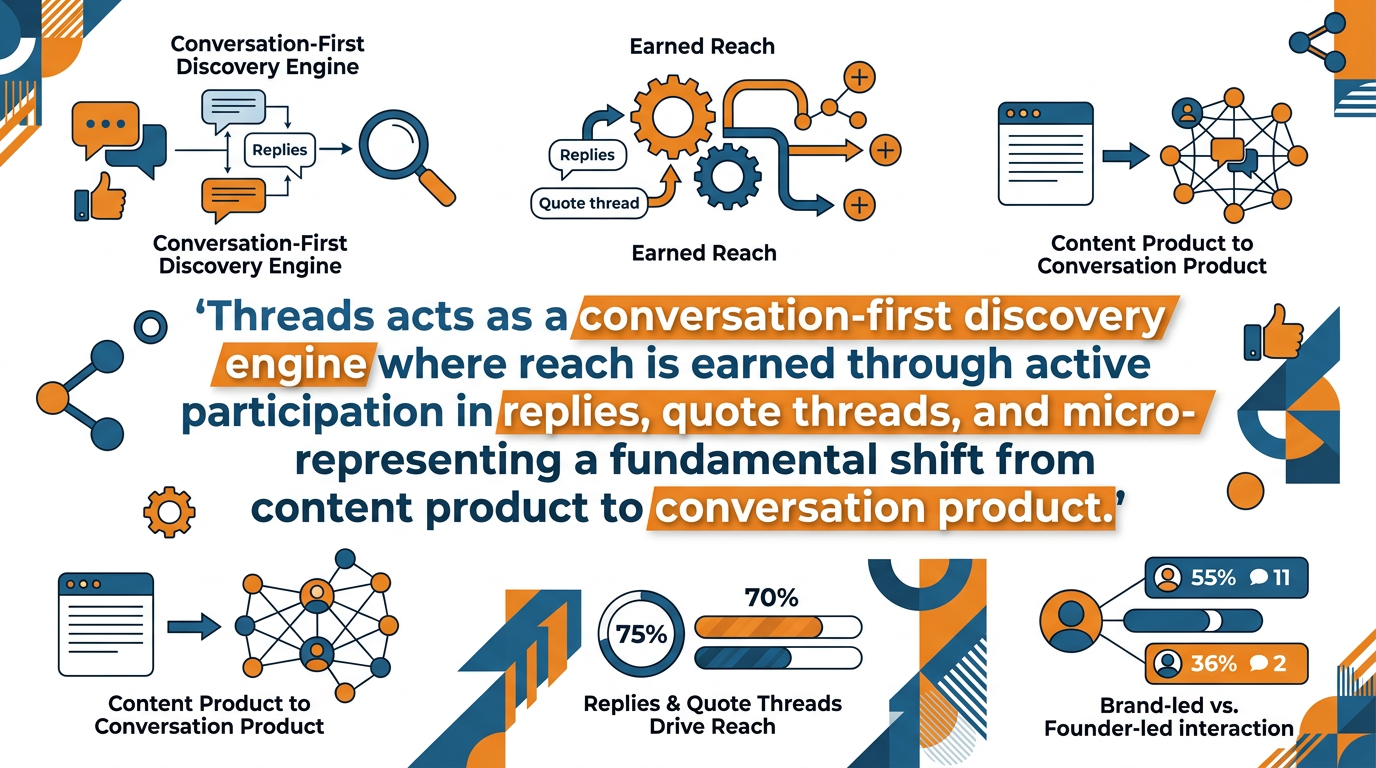
Threads for business: Getting started in 2026 remains one of the most under-rated decisions a small business can take because Threads is no longer a post-first platform, it is a conversation-first discovery engine. In 2026, reach is increasingly earned through replies, quote threads and ongoing micro-topics, not polished broadcast content. Why should small businesses care? Conversation offers the fastest feedback loop: you can test an offer, a price point, a hook, or a pain point in public and receive signals in hours, not weeks. And since Threads is part of the Meta ecosystem, you can use those signals to generate momentum across Instagram and beyond, with one identity, one audience graph and a more direct line from attention to action. Meta states Threads had more than 150 million monthly active users at the time (referenced to Meta Q1 2024 results), as noted in Meta’s Cannes Lions 2024 update on Threads and AI tools.
This guide is for you if you don’t want fluff and pre-coverage ‘advice’ like post more, or be authentic. You want to know what to set up before you launch, what to do in the first week so the algorithm and real people learn who you are, and how to build a repeatable routine that slots into a busy workday. I’ve used conversation-led growth to explore niches quickly, to identify what actually converts, and to turn those insights into simple systems that a small team can execute without burning out. If you want a complementary system lens, see weekly social media system.
Ultimately, you'll have a setup process to follow, a Week-1 daily routine, a basic funnel to leverage replies -> profile views -> customers, and a monetization & metrics model that matches how Threads works in 2026. You'll understand what to do next, what to measure, and how to tie Threads results to tangible business impacts like leads, scheduled calls, foot traffic, or purchases.
Whether you are a startup or a small business, this is your ultimate guide to getting started with Threads in 2026. Threads usage among U.S. adults (Feb 5-Jun 18, 2025 survey): 15% of ages 18-29, 10% of ages 30-49, 6% of ages 50-64, and 3% of ages 65+ report using Threads, according to Pew Research’s U.S. social media demographics fact sheet.
What can you do during Day 0-Day 7 of onboarding?
The first time you consider posting you need to think about your account model as it defines the kind of reach you will get in 2026.
- Brand-led accounts perform best for clarity and consistency when you offer a simple product with a narrow promise such as a local bakery, a webshop, or a single service provider.
- Founder-led accounts perform best for trust and speed when you sell expertise such as coaching, agencies, trades or niche retail as the algorithm and people reward recognisable voices that reply regularly.
- Hybrid is the most powerful model for most SMBs as you post like a person but package like a brand meaning your Threads voice is human and opinionated and your offer and proof remain structured.
If you are not sure then consider going with a hybrid model and commit to that for 30 days as switching voices later quietly wipes out how people understand your posts.
Next, you should optimize your profile for conversions, not aesthetics.
Your name and handle should reflect what your target audience is typing into the search bar, not be some pun that you think is funny.
Your bio should include a value proposition and trust indicator, e.g. the type of customers you work with, the benefits you provide for them, and a reason why they can trust you.
In 2026, attention spans are short, so you need at least one trust indicator in your bio to help you stand out, such as how long you’ve been in business, how many clients you’ve worked with, an area you serve, or some specific result you can deliver over and over again.
When it comes to a one link strategy, you should be using a dedicated landing page only when there’s a single next step your target audience can take in the next 30 days, such as booking a consultation, requesting a quote, claiming a promotion, or starting a free trial, because the fewer decisions someone has to make, the more likely they are to complete it.
If you have a link-in-bio tool, it should only be used when you are serving several use cases at the same time, such as a restaurant that has separate pages for location, menu, online ordering and reservations, but even then, there should be a callout for your most profitable action at the top, and everything else should be secondary.
Next, pre-seed some credibility so your first posts aren’t greeted with crickets.
I want three lists by the time you hit D1: a list of community targets where your customers are already engaging, a list of peer accounts in your niche who are actively producing, and a small list of customers or partners who you can draw in early on by posing a direct question or highlighting a minor success.
I’ll build a reply graph of 15-25 accounts adjacent to my target audience, and I’ll start engaging with their content with directly helpful, non-performative replies for a few days before I ask for anything.
Your early reply behavior is important because Threads likes accounts that start conversations, and practically speaking, it means you’ll have some familiar faces willing to engage when you launch publishing.
This isn’t about gratuitous networking, it’s about ensuring your first week has some dialogue, because that’s what’s most likely to get passed around beyond your followers.
Lastly, choose a key result for your first month and a momentum metric that isn’t followers.
Select a business result you can deliver quickly such as leads, bookings, foot traffic, and trials and commit your first content to this single result.
A strong momentum metric for your first month of Threads in 2026 isn’t a Like; it’s the number of high quality reply threads per post as long threads & conversations are how you sustain distribution and drive profile visits that convert.
The first month of content should train the algorithm and your audience; start with positioning that makes your audience clear, followed by evidence that is specific, followed by a worldview that draws a clear line you stand for, followed by question posts that invite your ideal customer to share their stories, along with a few build-in-public content pieces that demonstrate your progress without oversharing. If you want a more structured approach, review a social media content calendar.
Lower Week 1 expectations; engage where your customers already consume content, respond quickly to everyone who comments, and drive further reply threads by asking one additional question rather than leaving a generic Thanks!
Avoid the first month faux pas that quietly tank your distribution or trust; too many links in the first 7 days, a brand tone that resembles advertising trying to masquerade as conversational, posting like a broadcast channel that never responds, or trying to inject yourself into trending conversations that generate impressions from those who will never be your customers.
Threads for business in 2026: Getting started with reply-generating content
Threads for business: How to get started in 2026 is simple once you shift your mindset from Threads as a content product to Threads as a conversation product.
Your goal is to generate responses because in 2026 the feed is largely personalized and Threads learns most from ping-pong interactions, not static consumption.
I write a post thinking I need to create a loop someone has to close: one clear claim, one hard fact that proves I am qualified to make it, and one prompt that makes answering the most obvious next move.
A practical heuristic you can use: If your final sentence can be answered with yes, same or cool then rewrite it so it requires a story, tradeoff or choice.
That’s how you turn the same amount of views into more conversations, more profile taps and more business results. For more on building consistency without chaos, see consistent social media growth.
To keep being identifiable in-feed, you must have a viewpoint, not just a niche.
In 2026, people follow patterns more than categories: the kind of things you notice, the way you describe them, and the tradeoffs you justify.
You should identify 3 to 5 recurring opinions you can reuse regularly, such as why you value speed over quality, why you charge flat rates, or why you ignore an industry norm.
I do this because when someone sees a post and instinctively thinks this sounds like you, you win twice: you get more comments from people who agree or disagree, and you get better algorithmic filtering because the algorithm can safely send your posts to people who like or need similar thinking.
Then build a set of formats that can be repeated while still being human. That way you don’t ever have to sit down and think “what should I talk about?”
You can alternate opinion and prompt, behind the scenes and decision, small win and lesson, customer story and question, but make sure each is tied to a specific moment in your week.
For example I’m going to share a bad decision I made that cost me time/money, and ask how you would have handled it, which works great to attract operators who want to argue something.
But you can do the same for SMBs: talk about a pricing experiment you ran, a delivery problem you solved, a supplier you changed, a customer objection you overcame, and ask people how they do it.
The post is the match, the comments are the fire.
What differentiates businesses that take off on Threads from businesses that don't is what they do with the replies.
You should use your comment section as mini case studies: find common pushbacks, screenshot the words your customers use, and spin the best threads into future posts that use the exact words your market has written for you.
When someone pushes back on you, don't defend yourself generally; instead, address the pushback with 1 example and 1 clarifying question, because that will keep the thread going and turn pushback into social proof.
Your initial post angles should depend on what kind of business you have: B2B or SaaS businesses should start with problem definition and teardown-style posts from the perspective of a founder or operator, service-based businesses should start with diagnostic questions, mini-audits, and stacking credibility through specific solutions, and ecommerce businesses should start with product stories, actual use cases, and soliciting feedback on drops and experiments.
To scale your distribution without ads in the early days, you can build in some lightweight collab into your routine by developing a simple people map of other businesses you can work with, adjacent companies, and creators in your niche, then find ways to add value to one another's posts by replying to one another with actually valuable contributions so both audiences see an actual, live conversation instead of a forced collab post.
Threads for business: How to start in 2026 and turn attention into leads and sales
What’s missing from most of the Threads tutorials is the funnel dynamics that will make it all worthwhile.
In 2026, the algorithm incentivizes conversations, so your funnel must begin in public, not on a landing page.
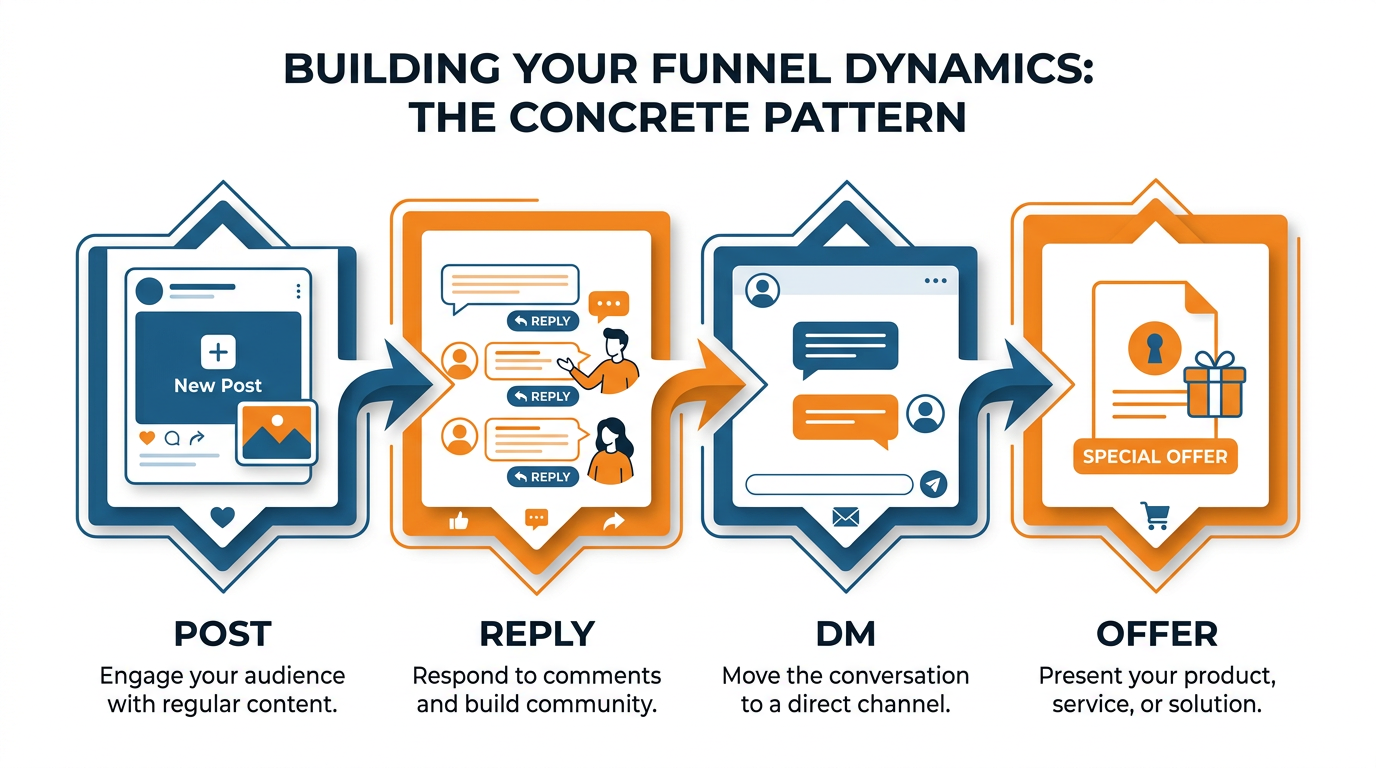
You convert attention into money by creating a simple pattern that you can replicate: A post that signals the right problem, replies that reveal intent, a profile that proves trust, and one call to action that fits their position in the buying process.
Your task is to craft each post so that it organically creates a need for someone to raise their hand in the replies.
I accomplish this by posting about topics that involve a tangible tradeoff and then noting who wants to know more, who wants to describe their circumstances, and who wants to disagree with my approach, because those three behaviors are normally good signs that they are either in the process of buying, or will be advising on the purchase.
Offer design is huge on a text-first medium where everyone can sniff out a pitch the moment it happens.
You get way more conversions from CTAs that don’t feel like a pitch but rather like the next sentence of the text: lead with what problem you solve, not what you sell, and participate: state a symptom, give the underlying cause and then force a Yes/No answer with a question.
If you need to nudge people forward, use problem-first invites, intent-based prompts (who wants me to share an example for their case?), and instead of pitching, say “if you reply with what you’re dealing with, I’ll share a quick outline.”
The way to use reply to get X mechanics without sounding spammy is to have X be specific and situational (a pricing structure, a checklist for your niche, a quick diagnosis based on what they comment) and keep the conversation based in their situation, not a pitch.
Your linking strategy needs to match how people are using the platform: On Threads, people are reading to understand rather than to click.
Retain on-platform for reach, trust, and objection handling, and for off-platform only for clear intent.
As a guideline, early-stage posts can have no links and focus on replies while mid-stage posts can encourage profile taps and pin a next step for people who are already agreeing.
When you do drive traffic off-platform, the page needs to be optimized for Threads visitors: one promise above the fold, one proof piece that continues your Threads tone, and one action that is under 60 seconds, because traffic from Threads should be treated as warm curiosity rather than search intent.
To demonstrate ROI without over-complicating it, use UTM tags on all links, and analyze one weekly thread: profile visits to link clicks to conversions, plus assisted conversions when people come back later through another channel who originally found you on Threads. If you need a practical reference point for this, see GA4 social media traffic.
The fastest ethical route from public discussion to private decision is a simple DM and comment process with trigger phrases.
If they answer back with something specific - like their digits, their deadline, what they use or their limits - that is an invitation to ask one more public clarifying question, and then go private for anything sensitive like details, prices, or dates.
I personally like to keep the first part public (as proof, and as a magnet for other similar customers), and only use DM when they request my assistance or when the very next message in the conversation would require sensitive information.
To get an owned media asset out of Threads without disrupting the conversation is to leverage the results of posts rather than the posts themselves: gather the very best objections, language, and micro success stories from the comment section of a post, and then build them into an email narrative, a community post, or a call agenda that takes the original point and then expands upon it with more background information.
This way, Threads remains conversational and vibrant, and your business continues to build up a library of content that generates value for you when you’re not around posting.
As for businesses: I think the best way to approach Threads in 2026 is by taking advantage of both organic + ads (the synergistic approach):
I reserve paid on Threads in 2026 until I see evidence from organic, because paid ads can’t make up for a positioning that’s still unclear, hooks that still don’t work, and an offer nobody wants.
You should wait until you see at least a few repeatable signals: posts that get long reply chains from the right people, profile visits that spike with specific topics, and a clear pattern of comments that contain intent words like budget, timeline, location, which one, where do I start.
You know you’re ready when you can predict which angle will get conversation going before you post, and when your profile converts curiosity into action without needing extra explanation.
If you’re still dependent on one-off viral posts or your comments are mostly generic agreement, you need to keep building organic.
Paid will only amplify noise.
The 2nd path is organic-to-paid: you leverage your organic wins to test your ad creative instead of guessing what works.
I treat every organic winner as a test card; I extract the hook that got people to stop the scroll, the objection or question they kept repeating in comments, and the profile sentence that got them to tap my bio.
I do this because Threads optimizes for conversational clarity, and that same clarity drives ad creative performance in Meta.
When you go paid, you are not developing new ads; you are rearranging your organic winners into formats and keeping the claim constant while switching between proof: a mini success story, a statistic, a before-after, or a constraint that makes your offer sound defined.
You shouldn’t be surprised if early paid on Threads in 2026 is a snooze fest: to minimize waste and maximize ROI, serve cold ads to warm attention, then gradually scale out.
Begin with retargeting users that have interacted with your content or visited your profile, since they’ve already indicated some level of interest and usually come in at a small fraction of cold traffic costs.
Then, mirror over your warm audiences from Instagram - particularly video views and engagement - and greet them on Threads with a text-first ad that finally answers the question that Instagram often can’t: why is this different and who isn’t it for?
Your optimization goals should match your business: if you need leads, optimize for leads; if you need sales, optimize for sales; don’t just default to engagement because it’s seemingly cheaper, since cheap engagement usually comes from folks that love to argue, not purchase. CNBC reports Meta said Threads has more than 300 million monthly users, and CNBC reports Meta said 3 out of 4 people on Threads follow at least one business, as covered in CNBC’s report on Meta testing ads on Threads.
In 2026, the measurement of paid Threads should focus on creative-level insights and incrementality, not on cheering about inexpensive likes.
Think of your ads as testing to see what you learn per dollar per creative: what hook is most attractive to your target audience, what proof leads to less objection, and what CTA yields more downstream activity such as scheduling calls, requesting quotes, adding to cart, or visiting your stores.
Think incrementality by measuring weeks or months with paid ads on Threads against weeks or months with ads paused while leaving your organic activities the same, and then looking at the net change in leads or revenue, not platform conversions. Threads reached over 350 million monthly active users (as stated in the article), and Threads added 30 million users in Q1 2025 (as stated in the article), per TechCrunch’s coverage of Threads surpassing 350M.
2026 reality check: we’re seeing increasingly aggressive personalization, so you’ll need to test several ad copy variants for the same offer because the feed will place it in various micro-contexts; brand safety is increasingly important since you’ll be reaching more people beyond followers, so avoid edgy ambiguity and write copy that cannot be easily clipped out of context; and ensure that your content stays consistent as it’s increasingly distributed by keeping your organic and paid messaging sounding like the same company in the same conversation, just at a louder volume. Threads topped 400 million monthly active users (as reported, citing Adam Mosseri), and the article reports Threads had reached more than 350 million monthly active users in late April 2025, implying ~50 million MAU growth over the quarter (as described in the piece), according to Yahoo Finance’s report on Threads passing 400M.
Threads for business: What’s working in 2026
Threads for business: What’s working in 2026 is simple: the algorithm favors accounts that use the platform as a dialogue tool, distribution channel and lead gen channel.
In other words, the rate you grow depends more on your ability to provoke meaningful responses from the correct audience than on your post quality.
For SMBs, the value is in speed of signal; you can gauge what objections, price sensitivity and demand looks like in a day, for free, instead of paying to learn through advertising or expensive sales conversations.
That’s the key: preserve the order of operations, and you’ll get there quicker and with less work.
You get the conversion in place first, so the profile taps have somewhere to land, you get a Week-1 rhythm going so the algorithm and your audience can learn what you’re about, you get the replies going so reach starts to multiply via conversation, you get the conversation hooked up to an actual funnel so reach turns into bookings or sales, and then you turn on the ads so you’re increasing the volume on a message that’s already working rather than paying for bewilderment.
I’ve seen so many companies invert that order, spend a ton of money right out of the gate, and be left with a lot of activity but zero return.
You need to take action under time constraint, not more planning.
Choose your account type, determine one single 30 days action based result you can achieve and decide on a 14 days work cycle where you can gather some data and try to improve from it.
Basically, if you post and reply for two weeks you should be able to understand what your clients are interested in, what types of questions generate intent responses and what’s the value proposition on your profile that pushes people to the next step. If you want to go deeper on process, see smart social media automation.
From there, you win by doing less, better, and more consistently.
You double down on the few angles that get you long reply chains from your target customer, you turn common objections into new posts that pre-sell your product, and you let what’s working organically determine where you spend paid dollars.
That’s how you can make Threads feel fun in 2026 without it feeling frenetic: you’re not optimizing for impressions, you’re optimizing for a repeatable conversation-to-customer process.
Related reads
3/7/2026
TikTok to Reels Crossposting Workflow 2026: The Ultimate Guide
Learn the 2026 TikTok to Reels crossposting workflow. Optimize for speed, views, and Instagram-native quality to beat algorithms & grow.
2/21/2026
How to Market a Law Firm on LinkedIn
Market your law firm effectively on LinkedIn. Learn a system that leverages individual lawyer profiles to build trust, relationships, and attract ideal clients.
2/17/2026
Vertical Video Aspect Ratios for Every Social Platform Guide
Learn the optimal vertical video aspect ratios for TikTok, Instagram, YouTube, and more. Shoot once, edit once, and publish everywhere without cropping.