Startup Storytelling on LinkedIn: A Narrative Systems Challenge
Discover how startups and small businesses can leverage a narrative systems approach for LinkedIn storytelling to gain attention, build trust, and generate inbound interest consistently.

Startup storytelling on LinkedIn is a narrative systems challenge
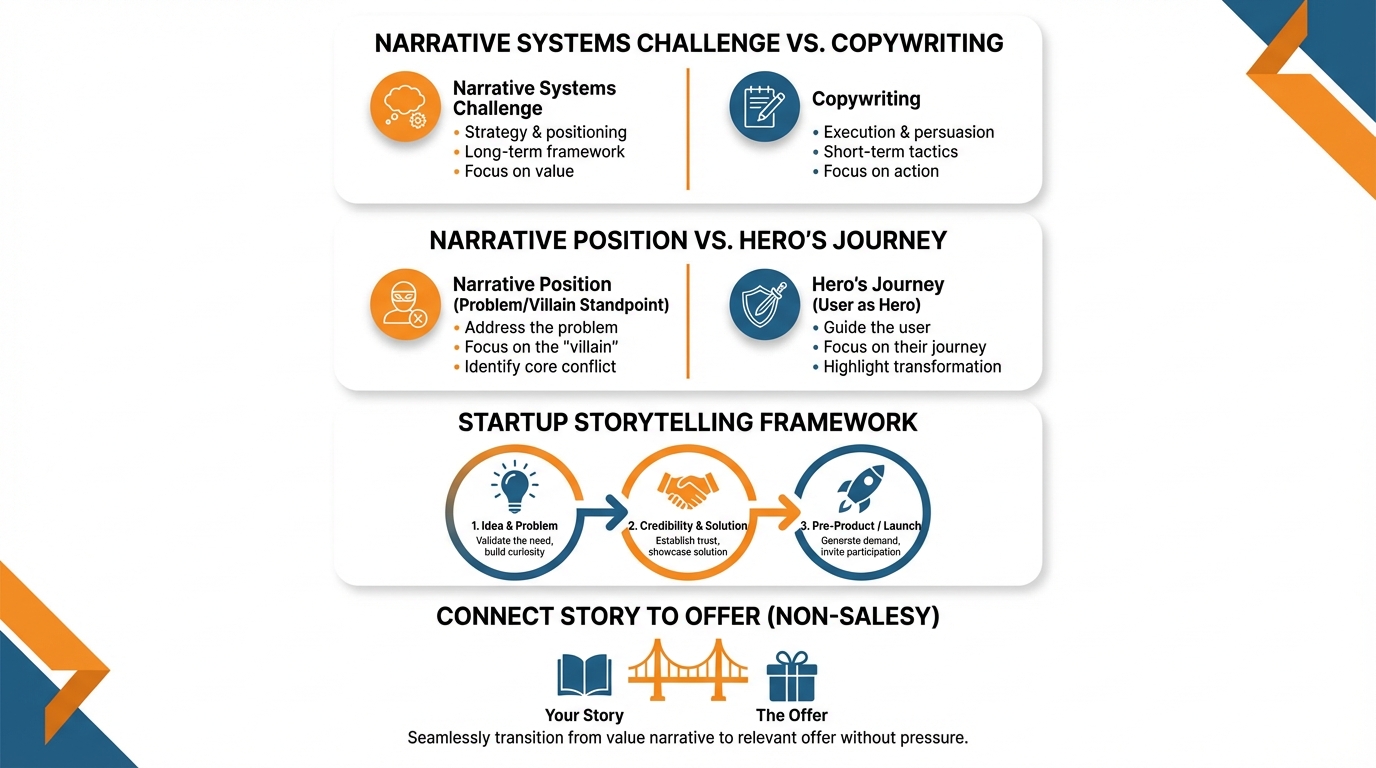
Storytelling as a startup on LinkedIn shouldn’t be a copywriting challenge.
It should be a narrative systems challenge. If you are a small business or early stage founder, the quickest way to gain attention without paying for it is to create a serial narrative of what’s already going on inside your business: why you’re here, what you’re learning from customers, what’s changing in the marketplace, and what you’re doing about it. If you do that well, that story earns trust at scale and quietly generates inbound interest from customers, investors, and employees - all without making your feed read like a sales pitch.
The vast majority of the advice you’ll find is obsessed with post-level actions like hooks, frameworks, and templates for virality. Those are useful, but they don’t address the core issue: how to be consistent without being repetitive, and how to grow without being sales-y.
You’ve got to have a clear POV, a few story beats to pivot between, and a way to transition from one story into a logical next step. I’ve seen founders go from posting haphazardly to getting weekly inbound by merely capturing the right moments and wrapping them into a simple story pattern that both the LinkedIn algorithm and humans understand.
In this tutorial, you will construct that loop. You’ll learn how to mine your startup reality for story material, how to select narratives appropriate to your stage even when traction is scarce, and how to convert stories into conversations that propel your venture forward. If you want a broader view of social media automation, see social media automation.
You need a narrative position, not a hero’s journey
When it comes to startups and LinkedIn, you need to have a narrative position, not a hero’s journey. Most of the startup stories I see on LinkedIn are essentially promotional. They are pitched from the hero standpoint (the startup).
Flip that to a story pitched from the villain’s standpoint (the problem in the market). If you can identify a specific pain (time, money, risk, reputation) that your customers are living with, you’ve got a great starting point.
Instead of saying “businesses struggle to hire”, say “small teams hemorrhage candidates because the process takes 18 days”. Instead of saying “businesses waste time”, say “ops teams lose two days a week reconciling numbers across five tools”.
Next, define your point of view: one simple controversial view of the way the world should be in your category. Controversial is the key here, because neutral positions don’t get noticed on LinkedIn. Choose a controversial position you’re comfortable defending in public and in sales calls.
I’ve seen small companies successfully go up against much noisier companies just by pounding on one controversial point of view until it became their signature, and the engagement wasn’t just likes; it was comments from buyers saying “this is exactly what we’re facing.”
Your POV is your filter for what you share, what you critique and what you create.
Second, define what you aren’t, since most startup feeds drown in a sea of generalized aspirations. Skip the platitudes about building the future of X or the game-changing platform for Y. That won’t get you remembered. You want the reader to know at once what this is and what we will not tolerate.
When you know what you’re not, your content will become more defined. Your customer fit will become more defined. And your team will stop posting one-offs that don’t tie into anything.
Lastly, convert positioning to a few signature storylines that you can come back to over and over again to teach your readers about your perspective, not your news. Consider repeatable lanes like:
- revealing a dirty secret of the status quo
- relaying a customer insight that reinforces your point of view
- explaining why a common practice in your space sucks
- capturing a trade-off you had to make in the build
When you rotate through the same few angles, startup storytelling on LinkedIn will cease to be a hunt for topics and start to be a narrative cycle where each post reinforces the last, educates your customers on how to think, and makes your solution seem inevitable. If you’re building your posting rhythm, you may also want a social media content calendar.
The Startup Storytelling Framework for LinkedIn: How to talk about your startup at different stages of development - from pre-traction to blowout success.
If you’re at pre-product or idea stage, startup storytelling on LinkedIn is less about trying to imply that you have data that you don’t actually have, and more about piling up signals of credibility that are much harder to fabricate.
You should talk about the problem with some specificity: its costs in time or money or risk or reputation, and how you know it’s real.
You should share evidence from patterns, not data: what you’ve heard 15-30x in customer conversations, what workarounds keep showing up, and what surprised you the most.
You should ground it in founder-market fit, in everyday language: why you’re the person to care about this problem, what your unfair advantage is (access, domain expertise, distribution, or a repeatable way to learn), and why now.
I’ve seen an idea-stage post outperform a product launch post simply because it named one uncomfortable truth that the market acknowledges but nobody says out loud, and then backed it with a tight handful of observed behaviors from real conversations.
This is especially true if you’re pre-seed and in early pilots: demonstrate demand and ability to learn, not ego.
Share verbatim quotes from customers on key themes: the moment they committed, the sentence that showed you what truly drove their decision, and the objection that nearly lost the deal.
Then show the feedback loop: what you changed within a week due to that feedback, what you dropped, what you redesigned, and what you decided not to build.
Report to people the decision journal, not a highlight reel: the small bet you made, the outcome you got, and the next bet you’re placing.
To be most memorable, share lessons learned in reverse: the pricing hypothesis you had that was wrong, the feature you believed was critical that wasn’t, and the one thing you regret that you shipped that you later fixed.
Done well, buyers will perceive you as lower risk because you move fast, and peers will see you as more credible because you can communicate lessons learned, not just passion.
When you are at the seed and early stage, these stories should feel less like discovery and more like repeatability. What happened when you normalized onboarding, when you restricted your ICP, when you defined activation, when you changed your pricing, when you altered your positioning - and then point to one key metric, even if you can’t quite show the full dashboard yet.
What about when you pulled a single operating lever: you altered one step in the first week experience and suddenly customers weren’t stalling; you stopped serving 3 types of customers and your sales cycle shortened; you increased prices and you discovered who your true customer was; you changed one promise on the website and the quality of the funnel changed.
I like to structure these stories as a kind of before-and-after, where the hero isn’t my company - the hero is process: what we thought, what failed, what we changed, and what became routine after that. It’s powerful for small companies because repeatability is the real flex, not scale.
When you are at Series A and later, you should emphasize leadership and operations. People want to know how your business will perform under the conditions of scaling and time, so show them how it performs. Write about how you plan, how you prioritize, how you hire, how you manage and how you fire.
What are your operating principles? How do you structure your teams? What are your key performance metrics? How do you make the hard decisions? Highlight the things that show you are in control.
Every stage also requires some discipline and guidelines for what and when to share. Startups are businesses too, and eventually you will find yourself sharing more than you should. Keep these guidelines in mind.
If it’s sensitive, share when the emotion has passed. Never share anything that could affect your pricing power or negotiating leverage. Never share customer data. Never share partner negotiations. Never share performance management issues. Never share negotiating points. Post the decisions after they are made and share data in aggregates.
Connect the story to an offer (without being salesy)
One of my favorite hacks for boosting conversions when you’re doing startup storytelling on LinkedIn is to connect the story to an offer:
Now before I dive into this, I want you to be careful here.
You absolutely cannot and should not be salesy when you do this. It will erode the trust that you have built with your audience and make them distrust you.
Stories win on LinkedIn when you use them as a funnel, not a journal.
You’ve got to separate them into three categories: Awareness stories tell the villain and the cost of doing nothing. Consideration stories show your approach and how you think. Conversation stories offer low risk in exchange for a response.
One way to distinguish: if they can like without knowing your product, it’s awareness. If they can assess your approach without purchasing, it’s consideration. If they can envision a low risk next step with you, it’s conversation.
Once you’ve organized your most common story themes into these three categories, you can quit seeking engagement and start designing outcomes. If you want help making your posts consistent, an AI LinkedIn post generator can support the workflow.
Now, let’s talk about converting engagement into pipeline.
For every such repetitive theme, I identify a single suggested next action that continues the theme, rather than being forced.
If I wrote about learning something was a costly bottleneck, don’t try to sell me. Offer to chat so that we can reason through the logic of my current process.
If I wrote about experimenting with a new workflow, don’t try to sell me. Offer to run a pilot with a specific scope and constraint, since you’ve just read evidence that I can manage that sort of thing.
If I wrote about a shift in category or expressed a strong point of view, don’t try to sell me. Ask if I want to partner up with other operators, agencies, or adjacent tools to run a small experiment.

I do this in my posts, by ending with a branching next step: if you’re facing problem A, reply with your current baseline; if you’re exploring solution B, share your constraints.
This preserves the trust because the ask is a continuation of the story, not a disjointed pitch.
Credibility beats big results
Credibility is what gets startup stories on LinkedIn to work when you don’t have big results to show for it.
Stack proof inside of the story: share the constraints, the trade-offs, and what you decided on when you had to.
Instead of generic wins, share specific signals your buyers care about like cycle time, failure rate, refund rate, sales objections, or implementation time.
Even when you can’t share a dashboard, you can share what you said no to, what you removed from scope, what you priced higher than you wanted to, or what you stopped delivering to preserve results.
The quickest way to sound credible is to share the downside you accepted and why, because hype ignores trade-offs and real operators dwell in them. This idea connects with how B2B leaders allocate budget-lead generation receives the highest share of B2B budget allocation (36%), with brand building close behind (30%)-as summarized in LinkedIn’s benchmark write-up on the Ipsos-backed B2B Marketing Benchmark work.
It doesn’t need to be a post because if you have a small follow-up process that feels like a human, you are building a relationship.
In the comments it is taking every question you get and sort of dealing with it like a mini consulting case: clarify the context, here is some background and the rule of thumb is X and here is one question to get you started so that the conversation is productive and it keeps the thread in the air so people can see it.
In direct messages the first thing is don’t repeat the post; like the fact that they even responded is already a success, then just say hey, you responded to this line and can you tell me just one more thing so I can help you out, then just have that first message be less than 60 words so it doesn’t feel like a pitch.
Finally, doing a second touch post where, like, within a week you say “Hey, here’s three things I learned from everyone who talked about this”: the number one thing I got wrong and here’s the next test I’m going to do.
So that sequence just builds trust and you get repeat exposure and it sort of makes it a cycle and not a story without ever being spammy.
Startup storytelling on LinkedIn distribution: engineering reach through people, partnerships, and systems
Startup storytelling on LinkedIn only compounds if you treat distribution like a product, not a lottery ticket.
Start by identifying where attention already aggregates in your niche: the operators who run teams like yours, the creators who teach your buyers, the communities where your ICP hangs out, and the adjacent partners whose customers overlap with yours.
Then build collaboration loops that repeat: you contribute a sharp insight from your customer reality, they add their perspective from their angle, and both audiences get a more complete mental model.
I have seen small businesses double their effective reach simply by turning one good post into three collaborative touchpoints: a co-authored perspective, a comment-driven follow-up, and a partner’s counterpoint that makes the original idea more credible. If you want to go deeper on this kind of process, read content distribution automation.
To make this predictable, you need a simple relationship map so distribution is designed not hoped for.
This means knowing who can amplify (big reach, aligned audience), who can co-create (shared expertise, complementary offer), and who can refer (trusted introducers with high intent access).
Keep it light, but up to date: even 30 to 60 is sufficient for a small business, and each contact can be labeled by audience, what they’re interested in, and the one story thread that connects you.
When you do this, you stop writing into the ether, and start writing into existing attention, and that’s when startup storytelling on LinkedIn becomes an engine, not a habit.
Collaboration is where trust multiplies, as long as you trade insights instead of links.

A great format is writing a piece and asking someone else to go public with a single assumption you got wrong, a single constraint you didn’t consider, or a single real world example that invalidates the outcome.
Strive for collaborative content that provides value without requiring a single click: two lessons learned side by side, two operator playbooks side by side, two teardowns side by side, or two founders explaining how they tackled the same challenge in different ways.
This is because LinkedIn punishes links and rewards engagement, and people trust insights that have been stress tested by other people they trust. Research also suggests intent drives differentiated engagement patterns: the paper research on intent-guided engagement forecasting reports a 2.96% absolute error reduction (coarse-grained) and 3.48% absolute error reduction (fine-grained) vs. baselines on engagement prediction tasks using LinkedIn anonymous user data.
Lastly, add process to make it more consistent, but not robotic.
You should document your learnings (sales conversations, onboarding issues, delivery surprises), refine content (the same content, better explained, more clearly bounded), and maintain a basic community playbook that emphasizes engagement and discourages noise.
Track engagement beyond likes (engagement: comments that include some kind of context or ask a real question), qualified engagement (e.g. messages about a pain you’ve written about), introductions to potential partners, interest in hiring, and repeat commenters that fit your ICP. For a quick way to quantify this, use an engagement calculator.
I’d much rather have 12 comments that help me understand where to find my buyers than 300 likes that give me a dopamine high (because the former is an indicator of revenue, and the latter, not so much).
This is how you turn LinkedIn content marketing into a repeatable pipeline for your startup
This is how you turn LinkedIn content marketing into a repeatable pipeline for your startup:
- Decide on a narrative strategy.
- Position that narrative for the phase of your startup.
- Repurpose the story into a value-add, low-trust ask.
- Share it from humans and via other channels, not just your company page.
When you do, you can finally quit judging the effectiveness of your content by its view count and judge it by the kinds of conversations it starts, the deal-killers it gets out of the way, and the speed at which you refine your pitch until your target market parrots it back.
If you want this to work for a small business with no time, just keep your rule of operation simple: every post must help your reader understand the villain better, and every comment must get one more real customer closer to understanding.
The metric to care about is not likes, it’s intent signals: comments that provide context, DMs that name a specific pain, and multiple replies from the same buyer.
And if you track those, you’ll start to notice what works in 2 to 3 weeks, because you’ll start to see the same language in responses, and that language becomes your next headline, your next sales pitch, and your next product.
When making an offer, preserve that trust by making the ask as low-friction as possible and as congruent with the narrative as possible.
The reader should feel like they’re still in a conversation, not entering a sales funnel.
If you wrote about a bottleneck, they offer to share what theirs is so you can sanity check it for them.
If you wrote about a trade-off, they offer to share what constraint they’re optimizing for so you can show them a different way to solve it.
I use this mechanism to generate flywheel effects off of any single narrative thread: story creates language, language creates conversation, conversation generates better stories, better stories generate more qualified conversations, etc. This is why thought leadership matters even when buyers aren’t “ready”: the Edelman-LinkedIn thought leadership report notes that 95% of business clients say they are not actively seeking goods or services at any given moment, based on surveying nearly 3,500 management-level professionals across seven countries.
Last but not least, turn distribution into a scalable commodity.
Develop a tiny network of amplifiers, co-creators, and referrers and keep cycling your top story to different collaboration channels so that it can be re-amplified multiple times without repeating itself.
This is the line between writing posts and architecting compounding attention.
When done this way, startup storytelling on LinkedIn ceases to be a ritual you have to sustain and becomes a growth machine you can manage. And because long-term impact is hard to quantify, it helps to remember measurement is a known pain point-LinkedIn’s update on proving campaign performance shares that 87% of B2B marketers say it’s getting harder to measure the long-term impact of a campaign, based on a YouGov survey of 1,014 B2B marketers (fieldwork: Nov 29-Dec 20, 2024).
Related reads
4/18/2026
Can AI Replace a Social Media Manager in 2026?
Can AI Replace a Social Media Manager in 2026? By 2026, AI will become an imperative part of social media, not an accessory. It’s baked into cre...
4/14/2026
Streamline Your Social Media With a Simple Operating System
Streamline Your Social Media With a Simple Operating System If you are looking for ways to streamline your social media, you probably aren't short...
4/13/2026
The Best Time to Post Instagram Reels for US Startups
The Best Time to Post Instagram Reels for US Startups There's no one-size-fits-all posting window for US startups that will automatically boost you...