Social media strategy for solo founders
Solo founders, stop posting just for consistency. Learn to create purposeful social media content that drives business results. Define your customer, map your messaging, and choose relevant content pillars.
Social media strategy for solo founders
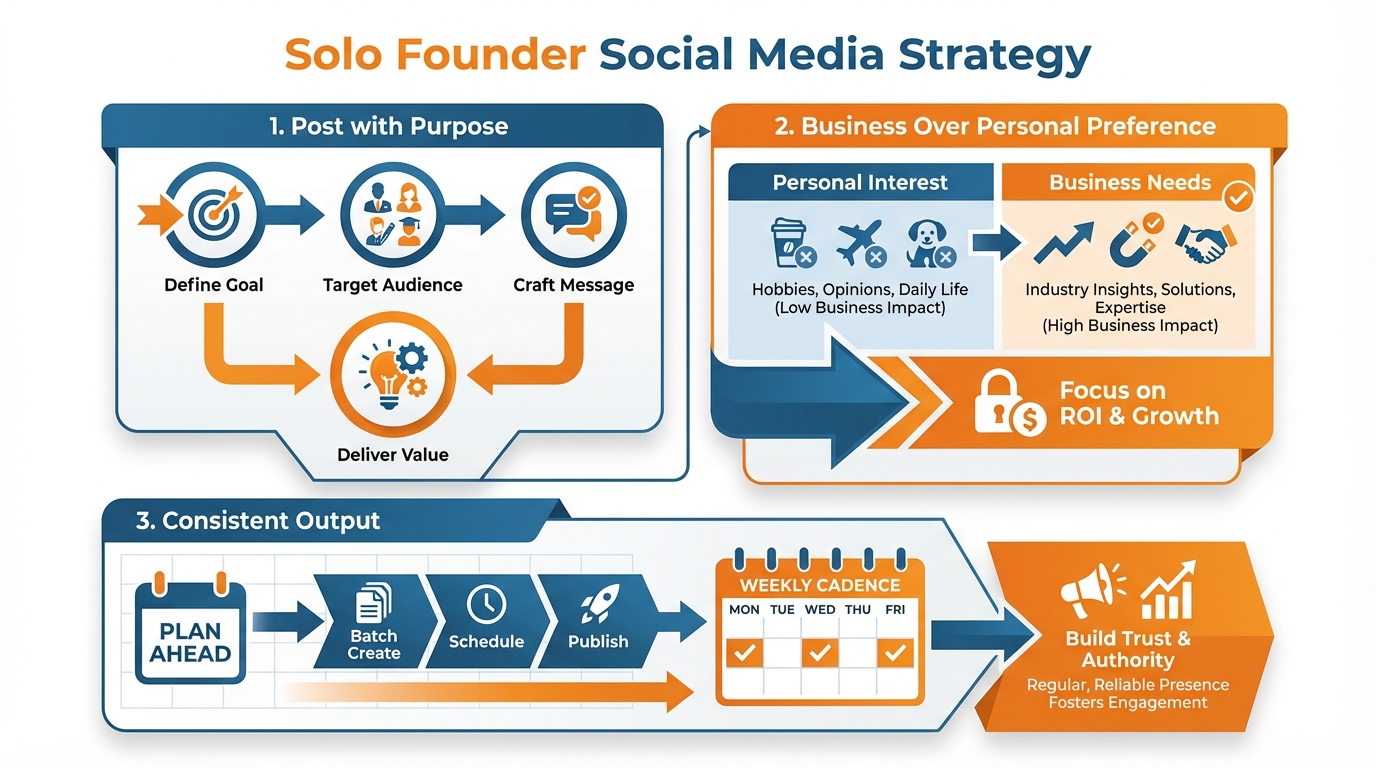
I see a lot of solo founders going into social media with the goal of posting more. But as a solo founder, your goal should be to post with more purpose, so that every piece of content push the right people for the right reasons toward a business result. When you’re a solo founder handling sales, operations, and marketing, your danger isn’t so much consistency as it is relevance. When you post tips one day, a personal story the next, and a product announcement the next, and your content doesn’t build on itself, your audience can’t easily answer the questions: who’s this for, and what do I gain from following?
You start by filling out your one-sentence customer definition and outcomes statement. Mine goes like this: I serve a specific kind of customer to move them from problem to outcome by predictable mechanism. Once you have that, turn it into a one-page messaging map you can actually use daily: the top problems you solve, your point of view on why the usual advice fails and what you do instead, the proof you can point to, and the next step you want people to take. That next step matters because attention without direction rarely turns into leads. If you want a structured way to plan this weekly, see social media content calendar.
Then pick 3-5 content pillars that directly tie back to ICP pains and buying triggers. Not generic advice, but what decision-making content will help a buyer choose an approach, what objection handling will explain why they are pushing back and what proof will get the risk to zero? For example, I know that I will publish a post that compares two approaches that a buyer is evaluating, a post that takes down the most frequent objection I get on sales calls, and a post that demonstrates a mechanism or lesson learned that led to results. That is content that gets you closer to making a sale even if they never like a post. If you’re trying to reduce the time it takes to produce those posts, auto-generate social media posts is relevant here.
You don’t need a big following to prove credibility. You can borrow it. Partner with those next to you. Offer value to get quoted. Highlight customer success (with metrics). Summarize things you’ve noticed in your work that show people how you think, not just what you do. Finally, further refine your content strategy by defining what you won’t write about. This eliminates noise topics which in turn sharpens your yes topics, results in a consistent stream of content, and helps your audience filter itself.
Photo by Finn Hackshaw on Unsplash
I wrote in this post about why I focus on Twitter for my online presence as a solo founder. In short, my business model requires me to build a community. I write in the post about why I think that building a community around a product is the best way for a solo founder to de-risk a startup. If you have an alternative view, I’d love to hear it!
Since building a community is my priority, I think that Twitter is a better platform for me than other options, for a few reasons:
Why Twitter works for me
First, Twitter is generally a more conversational platform than other social media apps. Twitter incentivizes discussion, debate, and engagement. For example, every Twitter post has a comment field right underneath. I’m not sure that’s true of other platforms. As a result, I think that it’s easier to engage with people and build relationships on Twitter than on other platforms. On Twitter, people are more likely to talk to each other rather than simply broadcasting their thoughts.
Second, Twitter seems more geared towards topical interests than most other platforms. For example, there are lots of Twitter accounts in the “startup” space. Lots of people interested in startups and entrepreneurship are on Twitter. For example, here are some accounts that you might enjoy if you like mine:
- Justin Jackson
- Dan Kim
- Patrick McKenzie
- Rob Walling
- Shai Schechter
- Andreas Klinger
- Sahil Lavingia
- Hiten Shah
The Twitter accounts above all write and talk about startups. Most of them are solo founders or have worked with solo founders in some capacity. Many of them have built and sold successful businesses. They all have great insights on startups, business, and life in general. But I digress.
My point is that there are a lot of people interested in startups on Twitter. I think that’s partly because Twitter is a great platform for engaging with topics and interests. In general, I think that people use Twitter to explore their interests and passions. This is as opposed to using Twitter to keep up with friends and family, for example. Twitter is just generally a “topical” network more than a “social” one.
For all these reasons, I think that Twitter is a great fit for me as a solo founder. Do you have thoughts on this? Which social media platforms do you think are best for solo founders? Why? Let me know in the comments!
Thanks for reading! If you liked this post, you can sign up for my newsletter here or follow me on Twitter here.
Don’t decide based on your personal preference
I see too many founders who just like, say, writing, so they decide they're gonna build a company blog.
Or, they like video, so they're gonna do a YouTube channel.
You want your main platform to be dictated by business considerations: your sales motion, average deal value, who your buyer is, what kind of discovery mechanism your niche relies on, etc.
If you're a low-dollar, self-serve purchase, you'll typically need a ton of volume and a very short discovery cycle, so platforms with robust recommendation algorithms and shareability will often be better.
If you're a relatively high-dollar offering, or especially if you're B2B, trust and risk mitigation will be a factor, so you'll need somewhere where your audience vets authorities publicly, where conversations that lead to deals can originate from a comment, and where buying teams can pass your content around.
I also do a quick sanity check with the question: where's a qualified lead ALREADY when they're searching for a solution to this problem, and what do they typically do next, Google it, ask their network, follow the experts? If you’re dealing with inconsistent output while you figure this out, read inconsistent social media posting.
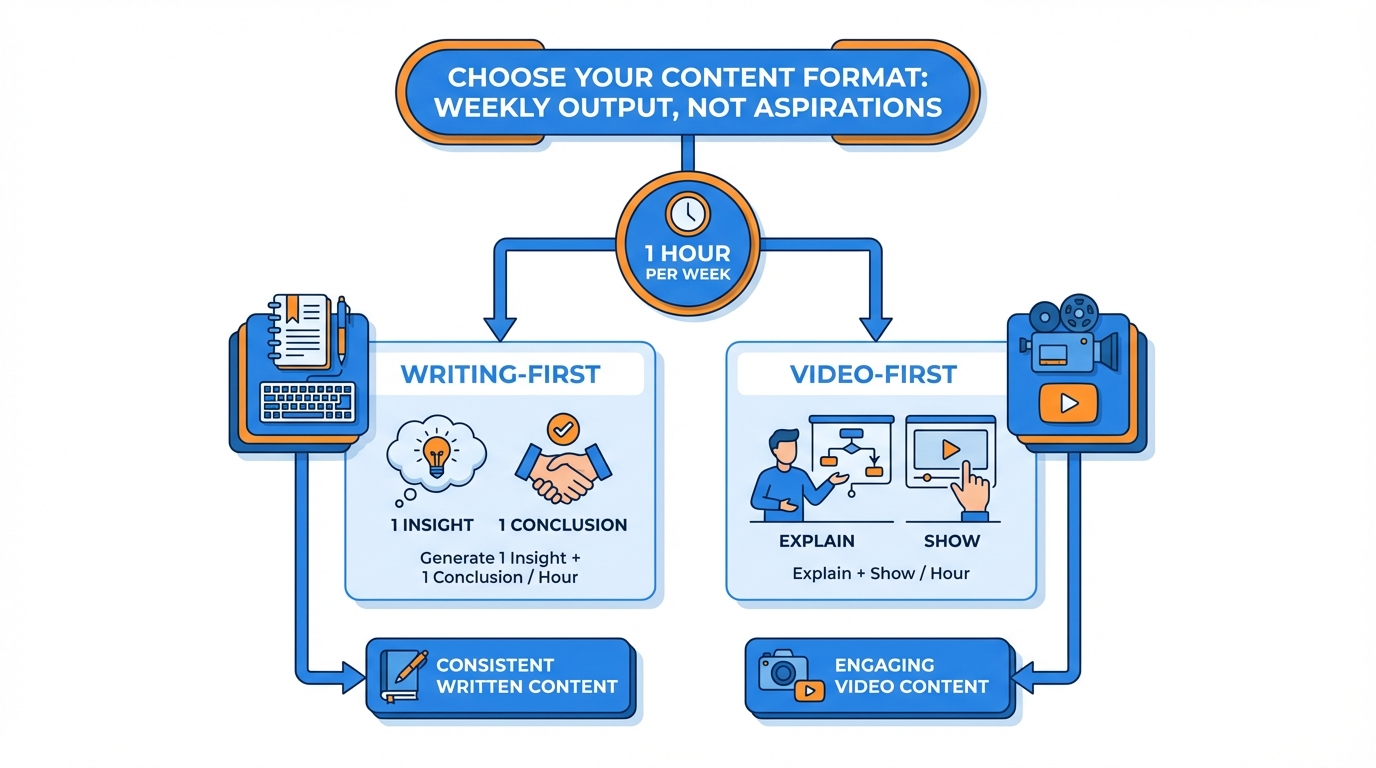
After selecting the platform, select the format that matches your weekly output, not your aspirations
The compounding only kicks in if you deliver the same format long enough to learn what works to generate views, and what works to generate comments.
Select writing-first if you can consistently generate 1 insight and 1 conclusion within an hour.
Select video-first if you can explain and show without a script over days.
Select community-first if you can consistently show up, comment, and moderate discussion.
Then commit to a single, repeatable, weekly cycle you can sustain even in the worst week.
In most platforms, the winners aren’t the most creative, they’re the ones most consistent delivering a recognizable format that customers learn to anticipate.
Second, define your distribution channel so you aren’t counting on the algorithm to bail you out
Explain precisely how your next customer is actually going to find you: through search intent, platform suggestions, shares from bigger pages, subreddits, other creators, or through affiliates whose followers overlap with yours.
It’s your responsibility to architect at least two different ways that your target customer can find you, so maybe you have a front door through search-optimizing posts, and a side door through share-optimizing posts.
I mentally categorize each post as being optimized for search, shares, or relationships, and evaluate its success in that way as well, since getting fewer likes but the right few profile views and DMs can be worth more than semi going viral with the wrong crowd.
Last but not least, create a partnership strategy that you can execute single-handedly without exhaustion: maintain a small, hand-selected list of similar content producers and businesses that have a similar audience to yours and engage with them in a simple content swap.
Every now and again swap your best stuff that is highly relevant to your audience.
This is a low-maintenance way to leverage existing trust to spread your message multiple times without being spammy.
Never consider posting on other platforms until you have a post type that performs predictably well on your main platform, posting mediocre content on multiple platforms is a surefire way to get mediocre results on multiple platforms.
Social media strategy for solo founders that turns content into pipeline (without being salesy)
A Social media strategy for solo founders can only work as fast as possible if you design the funnel before you design the content.
What do you want a stranger to do at awareness? What do you want a warmed-up follower to do at consideration? What do you want a ready buyer to do at conversion?
Then write content that moves people one step forward instead of trying to close everyone in one post.
In practice this means you pick one measurable action per stage and track it weekly: awareness is reach plus the right kind of profile clicks, consideration is replies and DMs from your ideal customer, conversion is qualified conversations that turn into calls or trials.
My rule of thumb: if you are getting views but less than 1 to 2 percent of viewers click through to your profile, your positioning is unclear; if you get profile clicks but almost no replies, your content is interesting but not specific enough to a pain that warrants a reply.
Now that the funnel isn’t clogged, you can align your CTAs with intent so you never come across as sales-y.
Early funnel CTAs should generate conversation and indicate fit, e.g. posing a diagnostic question only your buyer can answer, or asking folks to share their biggest constraint right now so you can respond with a suggested next step.
Mid funnel CTAs should express intent with minimal effort, e.g. offering to send a checklist, template, or quick teardown if you leave a comment or DM me, since that shows intent better than a like.
Late funnel CTAs should be direct and qualifying, so you don’t get as many but higher quality leads: you clarify who it’s for, what problem it solves, and what the minimum bar is to make it worth your while talking.
When you do all this successfully, the number of likes you get isn’t as important as the ratio of substantial responses to comments, since pipeline is built on intent, not applause. This is where it helps to understand vanity metrics as a category; see vanity metrics.
The “right” way to build social-to-DM mechanics is to think of DMs as customer support rather than a trap door to a pitch.
You engage in the comments first to provide value and show your thinking, and then move to DM when they ask for help or clearly signal the problem you’re solving.
In the DM, you open with one helpful question, one relevant suggestion, and one low-friction next step, and make it easy to stay in the conversation without committing.
When it’s time to move out of DMs, you do it with consent and clarity: you suggest continuing by email for context and followups, or you suggest a call only after you have qualified fit with 2 to 3 parameters like budget range, timeline, and current approach.
Anytime you feel the need to rush, just… slow… down… Pressure destroys trust, and trust is what converts a solo founder’s content into revenue.
To keep the pipeline flowing without depending on blasts, build proof loops and amplification loops that you can execute solo.
Provide proof as a side-effect of your work: insights from customer calls, delivery milestones tied to user milestones, before/after data, and experiments documented in a “I tried X -> Y -> Learned Z” format.
Proof has a flywheel effect because it decreases risk, and decreasing risk is how you go from prospect -> customer.
Then add amplification that scales: a simple network of who has your target audience, what you could co-create together, what was shared, what the response was (in terms of profile views -> DMs -> etc), and what the next touchpoint is to keep it warm.
I’ve seen entire small businesses get their highest quality leads from a single very good collaboration because borrowed trust is faster than cold attention, and unlike going viral, you can do it again. This matches broader spend trends too: the IAB’s creator economy spend projection notes U.S. creator economy ad spend is projected to reach $37B in 2025 (+26% YoY).
Here's a step-by-step guide on how to implement your solo founder social media strategy, automate it, and track its performance.
This will help you avoid time-wasting habits.
Cadence, automation, and tracking
A social media strategy for solo founders has to be about cadence not hustle.
So your weekly motion is to carve out a chunk of time and batch create, and then you share a tiny bit throughout the day and then do one weekly audit so you’re never “on.”
You should know exactly what a good week looks like before the beginning of the week.
Like, I’m going to spend 90 minutes writing 3 core posts, I’m going to spend 15 minutes a day sharing and engaging, and I’m going to spend 30 minutes Friday looking at what actually drove people closer to a next step.
And when I can do that, I stop making algorithm food and I start creating compounding content because I can do it even in a busy week. Data backs the workflow shift: in HubSpot’s 2024 social trends survey, 71% of social media marketers use AI tools, and 71% of marketers using generative AI to create content said it performed better than content made without AI.
I love automation, but for things that waste founder time and don’t build trust.
Automate things like queuing, reminders to reshare a post that performed, consistent tagging for topics and formats, and some basic reporting so you don’t have to keep it in your head.
Keep the human elements human.
Engagement, relationship building, and conversations are how you make money.
Nobody can take the tone and nuance out of DM-worthy content.
If it goes to a person, it should be on your best behavior.
If it’s a process, it should happen in the background without much noise. If you want an automation starting point that fits this workflow, social media calendar automation is a direct match.
For this reason, it’s critical to track leading indicators for your pipeline, not vanity metrics.
You need to know what “buying intent” is.
You track profile actions (anybody clicking on your profile, contact, or links), saves and bookmarks (a person actually telling you that this is important), qualified responses (your ICP describing your solution in their own words), incoming DMs, repeat engagers (the same individuals coming back week after week), and conversion to that next step you outlined earlier.
If you have a lot of impression volume but profile actions are low, your positioning isn’t hitting fast enough; if profile actions are good but qualified responses are low, your content is interesting but not urgent; if DMs are coming in but conversions are low, the next step is unclear or not aligned with buyer readiness.
I personally treat saves as a more authoritative buying signal than likes, as people save things they intend to use, share with other departments, or come back to when budget and timing are available. The market is also moving this direction operationally: the IAB’s 2025 creator spend and strategy report says “three in four” brands are using or planning to use AI for creator marketing-related tasks.
Next, do a weekly kill-keep-double down exercise, and be brutal.
Know which content was bringing the right audience, which medium was delivering intent, and what you should kill even if it was useful.
Know what’s working after 30-60-90 days in terms of behavioral and pipeline signals such as increased repeat participants, a steady amount of quality responses per week, and a clear DM-to-call or trial conversion, not follower metrics.
Test one thing at a time whether that’s removing one pillar, refining one call-to-action, or testing one medium so you actually know what is what. Platform behavior varies too: the CreatorIQ 2024 creator marketing recap reports that in 2024, 29% of brands/agencies chose Instagram as their most integral platform for creator marketing, while 27% chose TikTok-and YouTube as “most integral” doubled from 8% (2023) to 16% (2024). And for many small businesses, paid social is already baseline: a Visual Objects study covered by PR Newswire found 70% of small businesses invest in social media advertising (2022).
Related reads
4/18/2026
Can AI Replace a Social Media Manager in 2026?
Can AI Replace a Social Media Manager in 2026? By 2026, AI will become an imperative part of social media, not an accessory. It’s baked into cre...
4/14/2026
Streamline Your Social Media With a Simple Operating System
Streamline Your Social Media With a Simple Operating System If you are looking for ways to streamline your social media, you probably aren't short...
4/13/2026
The Best Time to Post Instagram Reels for US Startups
The Best Time to Post Instagram Reels for US Startups There's no one-size-fits-all posting window for US startups that will automatically boost you...