Medical Aesthetics Clinic Content Ideas That Convert
Discover a unique content system for medical aesthetics clinics. Convert local strangers into consults by mapping content to patient decision stages, ensuring localization and compliance.
Content ideas for medical aesthetics clinics (that generate consults)
I’m guessing if you’ve ever Googled “Content ideas for medical aesthetics clinics” that you’ve found the usual rehashed list.
Here is a before and after.
Some answers to common questions, and a little BTS video.
Those formats can be fine, but they hardly ever tell you what to post next week that really moves a local stranger into a consultation request, and then into a booking.
In this guide, we’re not sharing a list of generic prompts. What you’re getting is a system that you can operate as a small clinic, with limited hours and a small staff. You will match content to real patient decision stages, from initial curiosity to high intent comparisons and price inquiries to the final trust check before they book.
You will also be localizing each concept to appeal to your market and draw in local patients, not just “likes” from outside of your service area. And you will build it with compliance in mind so you can educate effectively without stepping over the line into questionable assertions.
I’ll also reveal to you how to ensure every idea is repeatable across the channels that matter most for clinics: social for demand, SEO for intent capture, and in-clinic touchpoints that reinforce confidence at the consult. For instance, I could turn one treatment topic into a local search page, a short video series that answers the top objections and a printed pre-treatment checklist that reduces no-shows and speeds up decision making. You'll walk away with content you can deploy quickly, and you'll be able to measure it by consults and bookings, not BS metrics.
Medical Aesthetic clinics can create content that caters to the patient decision journey.
If you’re building consistency, this pairs well with a system like a social media content calendar so you can map each patient stage to a weekly plan.
Here are some content ideas
If you need content ideas for medical aesthetics clinics that actually generate consults, do it this way: base them on how the hell people really choose things.
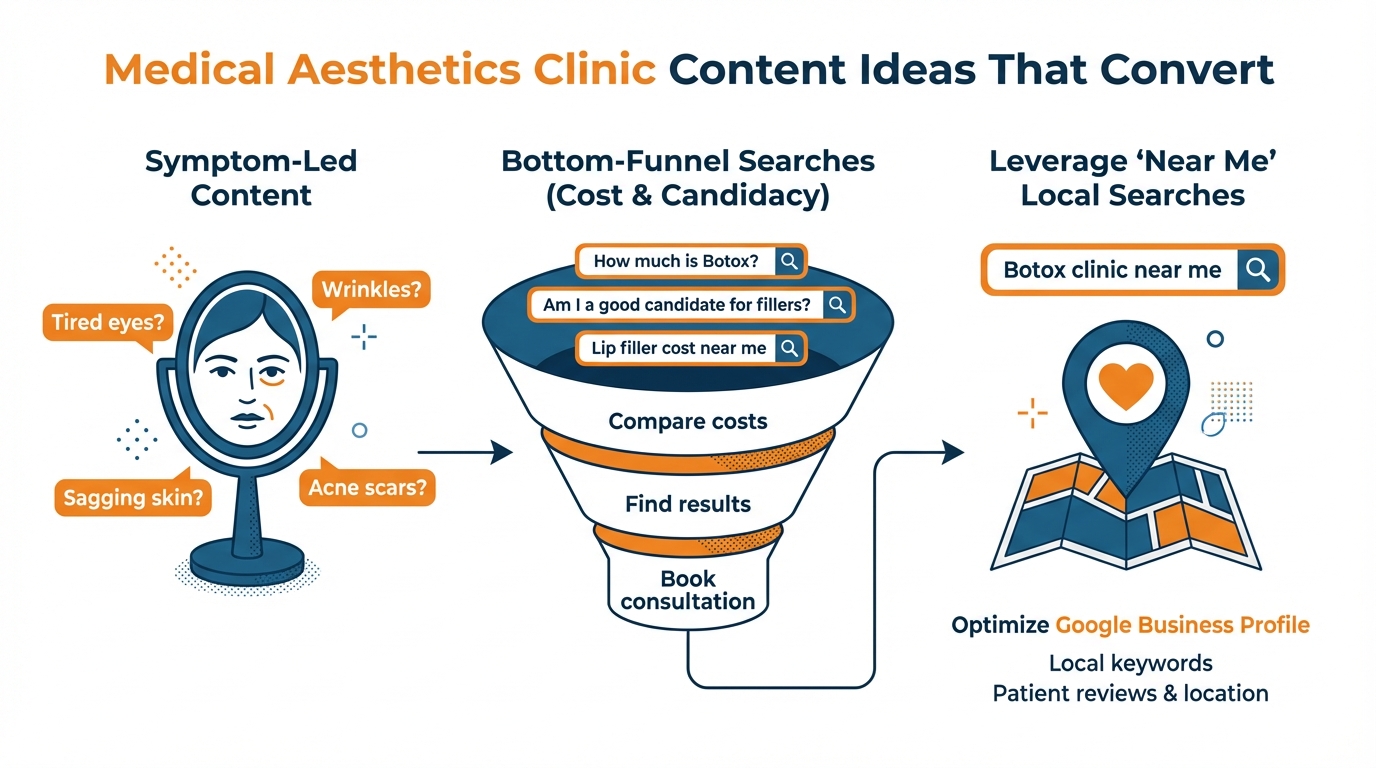
Awareness is not someone typing your brand name into Google, it’s someone realizing something is wrong when they look in the mirror, or in photos.
Do symptom-led content that allows them to self-identify (without diagnosing) and then match each symptom to a category of treatment that you offer.
Entire weeks can be based around one high-signal symptom: tired, puffy under-eyes, melasma that won’t fade, chin fullness when taking photos, etc., and then you educate on options, rather than pushing one procedure.
When I do this effectively, I notice that the leads are generally higher quality, because the patient comes in already framed in outcomes and limitations, not trends.
In this phase, you need to address the questions that patients aren’t comfortable enough to ask you directly, because those are what’s preventing them from moving forward. This is where you create content that straightforwardly addresses:
- pain level
- recovery time
- longevity
- risk of unnatural appearance
- reversibility
- what happens if they’re not happy
- how screening for safety works in their particular case
You also need to demystify the role of your providers: describe who performs what in your facility, what your screening process is for this, and how medical supervision plays out in real life.
A good rule of thumb is that most conversion-driven inquiry emails typically have 2 or more concerns layered together (e.g. does it look unnatural and how long does it last?), so your content should address them in clusters, not one at a time.
Decision-stage content is where little clinics dominate, because friction loses bookings.
You need to tell them exactly what will happen before the consult, what to bring, what meds and history to share, how to time treatments around events, and what kind of results to expect based on different starting conditions.
This is also where comparisons beat education: help them decide between toxin and skin tightening, brightening and pigment lasers, filler and biostimulators, based on their goal, timeline, and downtime tolerance.
I prefer using the language of “realistic pathways” rather than “ideal results,” because it keeps you compliant and it decreases the anxiety that makes them flake on you.
Because retention is a money maker, you need to approach it as a phase of content, not a second thought.
This means educating on maintenance frequency, the order of treatments within a skin-first treatment plan, and how to extend results within compliance such as sun protection, daily skincare, and how to space out treatments.
Combine that with a new patient start here hub of content that directs them to their next best step without information overload: one page or pinned content series explaining the types of patients you work with, the procedures you’re known for, what a consult entails, and how you will develop a treatment plan as you go.
By doing so, you’ll not only increase patient LTV and referral rate, but they’ll know what to expect and will feel as though you’re educating them instead of selling to them.
Medical Aesthetics Content that Converts (Not Just Engages)
Top Content ideas for medical aesthetics clinics that generate inquiries are the bottom-funnel searches that clinics hate to talk about.
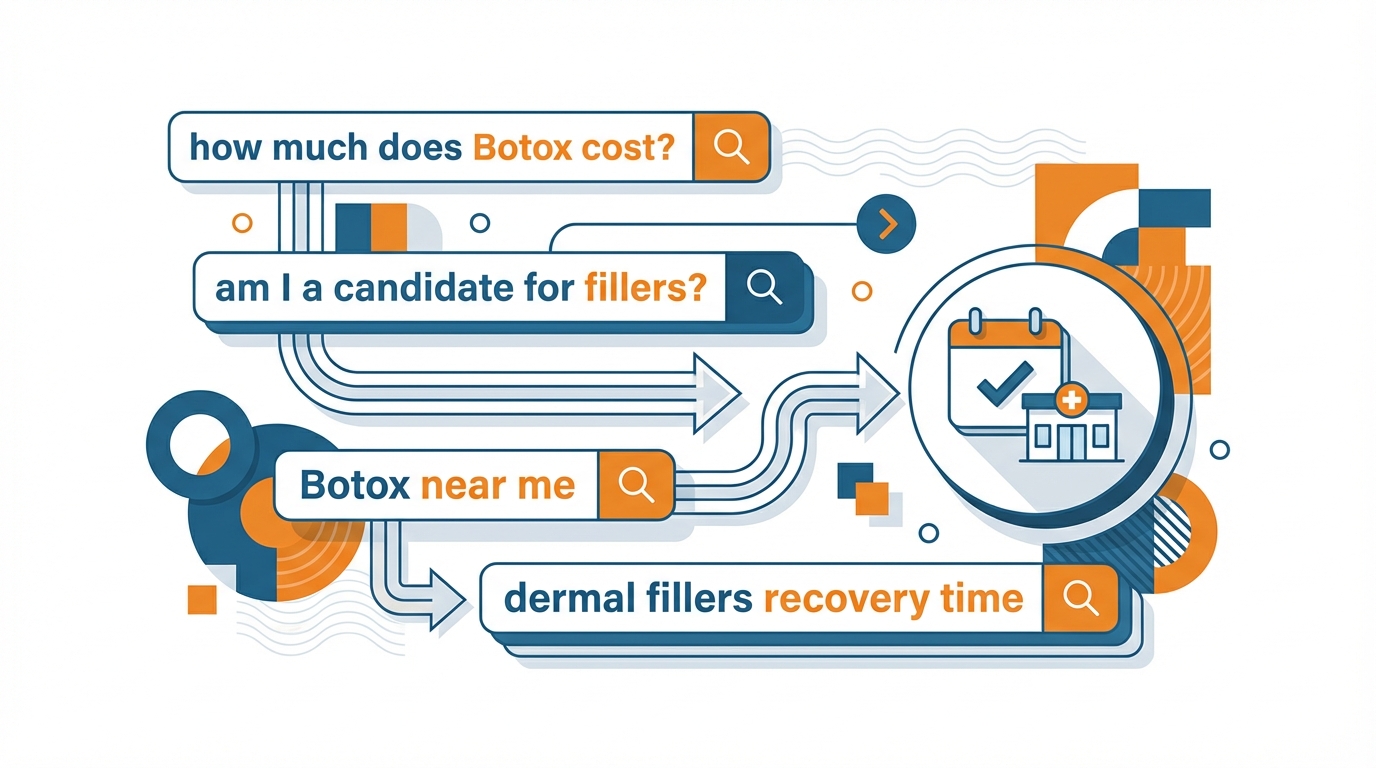
When someone is ready to book, they’re not searching for what is Botox, they’re searching for how much does it cost, am I a candidate, who shouldn’t do this, how many days will I be swollen, and what happens at the first appointment.
Create content and short videos on what affects the cost, instead of publishing one number, since this is where trust is built: type of product used, level of injector, number of units/syringes used, anatomical intricacy, desired results, and number of treatments needed.
Next, create ridiculously detailed downtime expectations, day by day, including when they can resume wearing makeup, exercise, alcohol, flying, or attending an event.
I’ve found that clinics who put this information out there will receive less tire-kicking emails, and more of the good stuff, because the patient filters themselves before ever sending you a message. If you want a broader framework for this, prove social media ROI to investors by tying these pages and videos to consults and bookings, not vanity metrics.
Second, push that comparison content, because it is the closest you can get to intent-driven searches that are booking more than anything else I can think of.
You want people typing neurotoxin vs neurotoxin, filler vs biostimulator, microneedling vs RF microneedling, laser options by concern, and body contouring modality comparisons to end up on your site and think you just answered the decision they were struggling with.
Organize them the same way, so it’s a repeatable model: best for, who should avoid it, pain and numbing expectations, number of sessions, average downtime, how long results typically last, and what a conservative plan looks like if they want natural change.
I use a basic decision filter that you can replicate: goal, timeline, downtime tolerance, risk tolerance.
That language keeps you from sounding salesy while still helping them find the next step.
Next, create and share content that directly addresses those concerns in a way that says, “I get asked this 100 times a week and I respect that.”
You need to talk dose protocol, facial proportion, and what you do when a patient wants more than you would recommend for safety and beauty.
You need to talk about horrible past experiences and how you approach correction, analysis of previous treatments, and why sometimes the best immediate action is dissolving, or waiting, or doing nothing at all.
You need to talk about needles and bruising in practical terms: topical vs injectable anesthesia options, breathing and pacing, which areas are more likely to bruise, how you work around events, and what aftercare looks like for bruising.
When you present side effects and risk in a practical, calm way, you convert the careful and considered patient that would have otherwise scrolled by.
Last but not least, invest in content that supports on-site conversions: here you need to beef up the business end of your website, because this is where you turn leads into patients without needing endless DMs and phone calls to the front desk.
Most clinics have a 1-paragraph consultation description and a “Book Now” button, so you need to spell out who this consult is for, how long it takes, what we discuss, what we need from you, and how we will create your plan.
Then you need pre-consult educational pages for your major procedures, an after-care resources page that’s easy to find, and an FAQ page that answers the exact repetitive questions your staff gets every week.
As for proof: if you can think beyond reviews and before-and-after photos, show people how you think, including practitioner and complication philosophy, results in terms of why this plan, why this procedure for this face and body.
I’ve seen small clinics outperform bigger brands because they made the invisible, unseen portion of the service visible, because when people understand the practitioner’s thought process, they trust the clinic faster and commit more easily.
For context on demand trends, the ASPS 2023 procedural statistics press release reported nearly 25.4 million cosmetic minimally invasive procedures in 2023, including 9,480,949 neuromodulator injections (up 9% from 2022).
Local Content for Medical Aesthetics Clinics to Attract ‘Near Me’ Patients
According to Google, ‘near me’ searches have increased by 28% in the last year alone.
People are looking for services in their area and are using search terms like “Botox near me”, or “dermal fillers near me”.
For medical aesthetics clinics, this is a huge opportunity to attract local patients.
But how can you capitalize on these searches and encourage people to come to your clinic?
Creating local content is a great way to do this.
But what type of content should you be creating?
In this article, we’ll take a look at some local content ideas for medical aesthetics clinics that will help you to attract ‘near me’ patients.
Why is local content so important?
Before we dive into some local content ideas, it’s worth exploring why local content is so important for medical aesthetics clinics.
Local content tells Google where you are based and what you do, helping your website to show up in search results for people looking for treatments ‘near me’.
It helps you to build trust with potential patients by showing your expertise and knowledge in a specific area.
It differentiates you from other clinics, particularly the larger chains that may not have the same local presence.
It improves your website’s domain authority, helping you to rank higher in search results.
Local content ideas for medical aesthetics clinics
So, what type of local content can you create to attract ‘near me’ patients to your medical aesthetics clinic?
Here are some ideas to get you started:
Blog posts about local events or awareness campaigns
Blog posts are a great way to create local content and can be used to discuss local events or awareness campaigns that are relevant to your clinic.
For example, you could write a blog post about a recent event you attended in the area, such as a charity fundraiser or a conference.
Alternatively, you could write about an awareness campaign that is taking place in your local area.
For example, if you specialise in skin treatments, you could write a blog post about Sun Awareness Week and how people in your local area can protect their skin from the sun.
Articles about treatments popular in your area
Another idea for local content is to write articles about treatments that are popular in your local area.
This will help your website to show up in search results for people who are looking for these treatments ‘near me’.
For example, if you have noticed that there is a high demand for lip fillers in your local area, you could write an article about this treatment, explaining how it works and what it can be used for.
Patient stories from your local area
Using patient stories is a great way to create local content and build trust with potential patients.
You could ask some of your existing patients who have had successful results from treatments if they would be willing to share their story.
This could be in the form of a written testimonial, or even a video reviewing their treatment.
When asking patients to share their stories, make sure to ask them to mention where they are from and why they chose your clinic.
For example, you could ask them to share their experience of having treatment at your clinic, and why they decided to choose you over other clinics in the area.
Content about local competitors (but be careful!)
While you might not want to draw attention to your competitors, writing content about them can actually be a good thing.
This could be in the form of a blog post discussing the pros and cons of different clinics in the area, or a social media post explaining why your clinic is different.
However, be careful what you write as you don’t want to appear negative or vindictive.
Remember to always follow ASA guidelines when discussing your competitors and avoid making any claims that you cannot back up.
Interviews with local practitioners or influencers
Interviews are a great way to add some variety to your content and can help you to build relationships with other practitioners or influencers in your local area.
You could ask a local practitioner to explain a bit about what they do and how they can help your patients.
Alternatively, you could interview a local influencer or blogger who has had experience with aesthetics treatments.
This will help you to reach their followers and attract more patients to your clinic.
News about your clinic in the local area
Finally, writing news articles about your clinic in the local area is another great way to create local content.
This could be in the form of a blog post discussing a new treatment that you are offering, or a social media post announcing a special offer.
You could also write a press release about your clinic and send it to local publications to help you to attract more patients.
For example, you could write a press release announcing the launch of a new treatment at your clinic, explaining what it is and how it can benefit patients.
You could then send this to local publications, such as newspapers or magazines to help you to attract more patients.
A good way to keep local publishing consistent is to standardize your schedule with social media calendar automation, especially if you’re operating with limited hours and a small staff.
Creating local “near me” content that wins
Want Content ideas for medical aesthetics clinics that rake in the “near me” searches?
Create subpages that help your primary “treatment in [city]” pages feel more deserving rather than keyword-stuffed with location names.
You do that by writing neighborhood guides that address very real pain points like where to park, what the building entrance looks like, which side of the street has metered parking, and the fastest way from the highway during rush hour.
Add “first visit from [nearby area]” content for the 3-5 zip codes you actually service, written as a mini day-trip plan: typical drive time, where patients get coffee afterward, what to expect if they come on a lunch break.
And mirror local lingo that people actually use, because it varies by market.
I see clinics get clicks when they match colloquial downtown, midtown, valley, lake area, or west end to their markets rather than forcing “official” neighborhood names no one searches.
The majority of clinics I consult don’t use this referral channel, which is partnerships with other local businesses.
Now, the best way to approach this is to propose a content-sharing partnership, not a, “Hey, can you shout us out on your social media?” kind of thing.
So you’re going to partner with a gym, a bridal shop, a hair salon, a wellness company, maybe even a dermatology clinic if it’s applicable, and you’re going to work together to create a piece of content that addresses one aspect of overlap between the two of you.
So you could create a short video that talks about skincare post-workout with a local gym.
You talk about the things that cause acne and redness, they talk about the best time of day to train based on recovery time, you both publish it, you both link to each other, and I actually try to get this to be a three-part series.
So one partnership equals three pieces of content, three backlinks, and one page of evergreen content on your site that ranks for “Botox near me.”
The smart way to do event-driven local content is to take cues from what’s happening in your city rather than cookie-cutter holidays.
You can offer consult windows based on the planning horizons in your region and then release guides on how long before X, Y, or Z you should consider it: before the wedding, before prom, before graduation, before the festivals, before ski season, before beach season, or before convention month when all of a sudden everyone needs to look good for all those meetings.
The key is these guides grab intent-driven searches for things like how long before an event should I get filler, Botox, lasers, etc., and that it decreases cancellations since you’re educating patients on what to expect regarding downtime, bruising, swelling, sun sensitivity, etc.
I’ve seen practices have huge success with consult quality when they build realistic timelines into their calendar posts such as 6-10 weeks out for treatments that may take a series of sessions.
The “near me” patient wants to have a good idea of your trustworthiness as soon as possible, so you’ll need to convert reputation and location signals into content instead of waiting for reviews.
To do that, you can teach your patients how to write reviews that contain the right information by turning your FAQ answers into questions your patients can easily answer, like how the consultation experience was, how you explained after care, and how customized the treatment plan appeared for their condition, which often encourages them to write longer reviews containing the specific terms new patients search for.
Then, you can respond to reviews using compliant language that also markets your practice by reiterating process, safety, and experience without guaranteeing anything.
Sprinkle in some location-based positioning content that reveals the stability of your practitioners, your local experience, and the kinds of local conditions you see the most, such as the kinds of sun damage you see in sunnier cities or the sensitivity you see in colder climates, so that the patient feels like you understand where they live, not just their skin.
If you want supporting data on how people consume related content, the peer-reviewed study how social media shapes plastic surgery interest reported that medically related content was commonly viewed on Instagram (72%) and YouTube (69%), and plastic surgery-related content was viewed on Instagram by 47% of respondents.
Differentiated and compliant content ideas
If your medspa doesn’t resemble everyone else’s, here are some compliant, differentiated content ideas:
If you’re looking for Content ideas for a medical aesthetics practice that’s fun and compliant, reverse-engineer your creativity from the ground up.
Teach your captions to talk results in a way that’s trustworthy: on average, ranges, factors that affect them, and what you’ll evaluate in a consult, but no promises or absolutes.
Make your B&A’s a consent story, not just a photo: you’ll need to demonstrate that you’ve obtained it, that lighting and angles are consistent, and that results vary based on baseline, dose, and aftercare.
Develop a habit of boring-but-effective disclosure habits, such as noting when a result required multiple sessions, multiple treatments, or space between.
And when it comes to talking about risks, keep it simple and technical: what’s normal vs what’s not, what you do to mitigate, and what the patient should let you know about, so it sounds like medical confidence instead of fear-mongering.
You differentiate yourself most powerfully when you demonstrate your philosophy in action, not just declare it.
If you focus on natural outcomes or skin-first, share your assessment and treatment planning process - how you determine what to tackle first, why you might address skin quality before shape sometimes, and when to prioritize a conservative tweak now versus scheduling a bigger change to be staged later on.
You can get several unique blog posts out of one procedure by explaining your dosing philosophy in lay terms (e.g. that you’re looking to preserve motion, balance, and longevity in your results rather than maxing out the effects).
I likewise appreciate content that discusses outcomes that are not about big transformations, such as photo pose confidence, improved makeup application, reduced redness, or more even skin color in consistent light, because it appeals to patients who are looking for conservative treatment and it weeds out patients looking for maximal work.
Trust content is where the little guys can shine against big brands, so show your quality filters.
Take your screening protocol and convert it to narrative: what do you ask, what medications and medical history are relevant, how does skin type influence your settings, and when do you defer treatment.
Do blog posts on contraindication training that are “heartfelt and empowering” like these are the people who shouldn’t get this treatment today, but that’s OK because they have other options without making it specific advice to individuals.
Take it one step further and make clear what you won’t treat and why, because saying no is also a sign of expertise: I won’t overfill, I won’t stack treatments when the skin is sensitive, I won’t treat a red flag medical history without clearance.
And lastly, show them what your follow-up and revision protocol looks like, so that they know that the care doesn’t stop at the first session, that there will be follow-up, that there will be some amount of time where you can tweak, and that there will be a way to escalate if something doesn’t feel right.
Transparency of decision-making helps your content stand out from the crowd, and can be replicated 1000 times over.
You should frequently give insights into how you choose particular devices or treatments: what you look for, which skin issues each is indicated for, what compromises there are, and what makes a good or bad candidate, using educational language to advise.
To ensure cost-effective production, cluster content into a ‘franchise’ for each topic, for example: one blog post to describe the decision process, short videos addressing each friction point such as pain, downtime, candidate fit, realistic outcomes, and finally a quick summary post that can be easily shared by your front desk when these questions come up.
I’ve seen this process succeed in that it is efficient from a provider standpoint but rich enough to inspire tentative local searchers to book a consult.
For additional perspective on the broader market, the ISAPS Global Survey 2023 report stated total surgical and non-surgical aesthetic procedures increased by 3.4% in 2023, to 34.9 million.
If you want to get ahead of the Content ideas for medical aesthetics clinics curve, don’t double down on quantity and frequency.
Instead, double down on sharing the information that patients are actually looking for to make their decisions: cost factors, pros and cons, how to qualify, what to expect in terms of downtime, risks and complications, and local social proof.
Clinics that are rewarded are those that cease the never-ending battle to create generic “engagement” and start filling their Content pipeline with the decision-making questions their patients are already typing into Google late at night before choosing your clinic over the one down the street.
If you want this to be sustainable as a small business, your content should flow like a patient journey assembly line: each awareness item should directly lead to one consideration item, then one decision item, then one trust item.
You’ll know immediately because your team will stop wondering what to post next, your front desk will stop answering the same questions, and your inquiries will come in pre-qualified with better ideas of timeframes, budgets, and realistic outcomes.
I’ve found that the single most effective way to boost conversions is to do the two most overlooked things: 1) be completely clear about costs, without giving a single price point, and 2) be really clear about downtime, without making it sound nice.
By telling people exactly how you price procedures at your practice, and by giving them an idea of recovery in terms of activities they care about, like exercise, putting on makeup, flying, or going to a wedding, you’re not only educating them, you’re removing risk, and risk is the number one conversion killer in aesthetics.
Lastly, take that final leap and localize the entire system: write as if you’re actually there to serve your city, not the internet.
You’ll build trust more quickly if your content betrays local purpose and local knowledge, everything from neighborhood lingo to office hours to the types of skin issues your climate poses, simply because it proves you’re a tangible, enduring, local presence and not just another page with before-and-afters.
If you need help avoiding inconsistent publishing while keeping this system lightweight, see inconsistent social media posting for how to keep output steady without chasing quantity.
Related reads
4/18/2026
Can AI Replace a Social Media Manager in 2026?
Can AI Replace a Social Media Manager in 2026? By 2026, AI will become an imperative part of social media, not an accessory. It’s baked into cre...
4/14/2026
Streamline Your Social Media With a Simple Operating System
Streamline Your Social Media With a Simple Operating System If you are looking for ways to streamline your social media, you probably aren't short...
4/13/2026
The Best Time to Post Instagram Reels for US Startups
The Best Time to Post Instagram Reels for US Startups There's no one-size-fits-all posting window for US startups that will automatically boost you...