Create Social Media Posts From Your Website Content
Leverage your website for social media. Discover how small businesses can use tools to create on-brand posts from existing content, automate workflows, and save time.
Create Social Media Posts From Your Website (Without Starting From Scratch)
If you have a website full of value, blog posts, landing pages, product pages, FAQs, docs, you have months of social media content. The quickest way to get that content posting on a regular basis is not to start from scratch. It’s to find the right tool to create social media posts from website, one that can read your website, and extract the most impactful points, and transform them into social media posts in your voice, not an AI one.
What you’re looking for, as a small business, isn’t more content ideas; you need leverage. You need a way to get multiple social media posts from a single page on your website, with hooks, examples and calls to action that match what you offer. To me, this is a conversion and accuracy issue, not a creativity issue, because your website already has the proof, the positioning, and the differentiators, and your social media content should be getting those facts from that instead of making them up.
In this article, you’re going to learn: What generate posts from my website actually means in real-life, practical terms, What a tool needs to give you to ensure that the result stays on brand and doesn’t fabricate anything, How to configure a basic workflow to take something from your website -> through your content pipeline -> into distribution channels, without losing factual accuracy or sounding boring. Along the way, I’m also going to show you how I would convert a single services page into a week’s worth of posts, so you can stop wasting time writing and get back to closing deals.
Also, recent data shows this is becoming normal: in HubSpot’s update on AI adoption, 74% of marketers are using at least one AI tool at work (up from 35% last year), and among marketers who use AI to make written content, 86% make edits before publishing-especially for social media posts and blog posts (marketers are doubling AI usage).
Convert my website to a legitimate input (url, rss, sitemap, etc. NOT copy and paste)
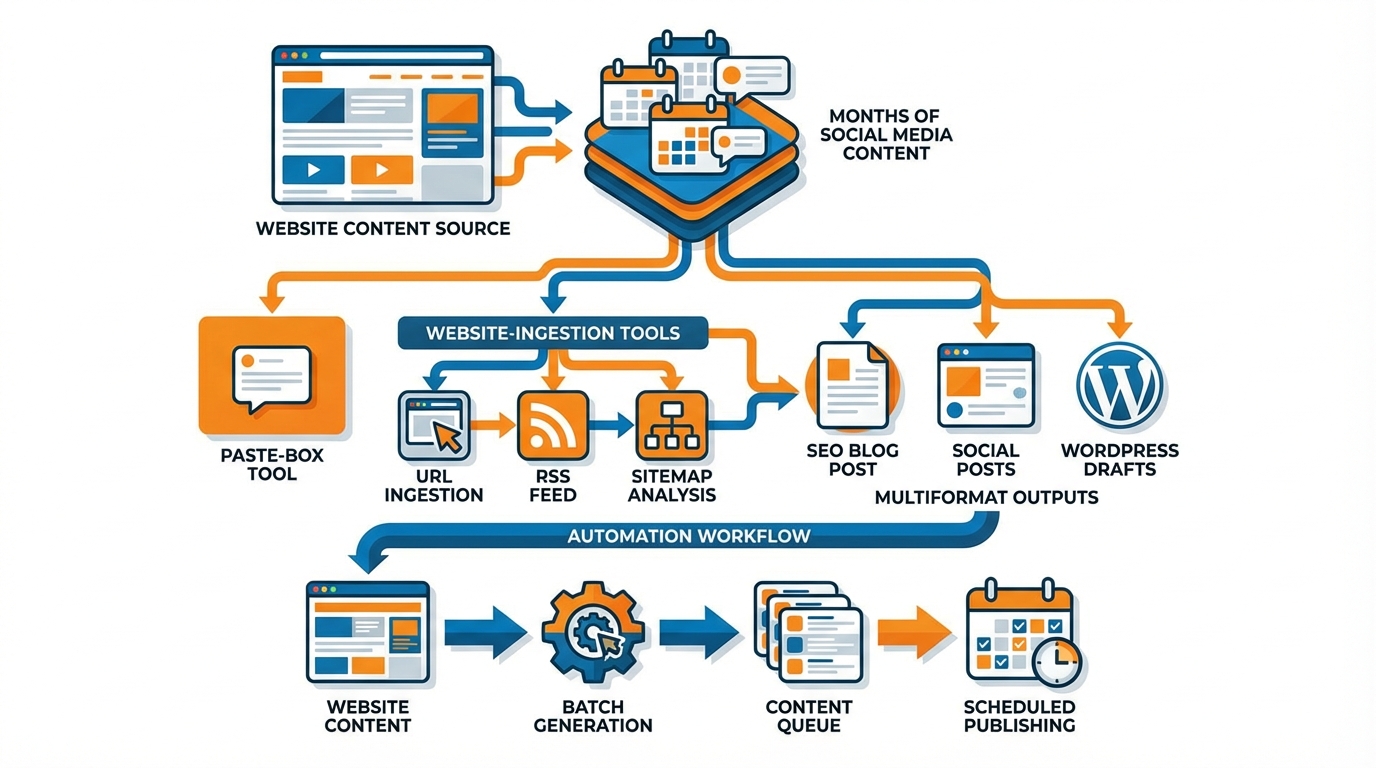
If you’re looking for a tool to generate posts from my website, the first thing you need to do is differentiate between paste-box tools and website-ingestion tools.
Paste-box tools look at your site as a document that you'll need to move around manually; ingestion tools look at your site as a source of truth that they can pull, verify, and re-use.
That distinction only works if the underlying web design is properly structured, with clean architecture and logical page hierarchy.
In practice, from my website means the tool should accept at least one real input:
- a single URL for a one-off page
- an RSS feed for anything new you publish
- or (preferably) a sitemap so it can discover and process multiple pages at once
For a small business, that’s the difference between occasional posting and a repeatable process you can run weekly without having to open old articles and copy chunks into prompts.
So let’s make that practical: we have a goal to “feed it” one money page, and our most recent content pages.
You will first need to feed it a URL to test that it is able to pull the page correctly (no sidebars, no cookie warnings, no gaps) and then move to RSS or sitemap to go to scale.
The sitemap is the most powerful for scale as it lets us turn one setup into repeatable volume: if you create 2 pages a week, that is 100 pages a year the system can keep feeding on without us having to lift a finger.
If I do this well, my last 20 pages can become 100+ unique variants quickly, because each page has a lot of different versions to it: problem, solution, proof, handling objections, direct use case that ties to what I am actually selling.
The key benefit isn’t time savings, it’s relevance and precision at scale.
A tool can get the content from your site and use it to tie your posts to the claims you’re already making, rather than writing generic benefit statements, price points, or outcomes.
However, you want more than a simple summary.
You need technology that extracts structured content for your use on LinkedIn and Twitter, including things like key points, data and statistics, product and service descriptions, mini FAQs, and short statements that could have been written by a person.
A good way to gauge this is to see if the tool can take a single page of services content and adapt it into five different social media post formats that don’t feel repetitive, such as a story with a hook, a checklist, a myth vs. fact post, a case study, and an objection-handling post that uses your exact words.
So before you sign up, make sure you can ingest a blog post, a landing page and a FAQ/pricing page. If you want a reference for keeping this repeatable, it helps to follow a process like a social media content calendar.
If the tool doesn’t cope with all of those formats, it will give you grief as you look to grow.
Also look for options like page inclusion rules (to suppress tags, categories, thin pages) and recency filters (to focus on the last 90 days).
Some tools like WoopSocial take this on-site approach to the next level, where your website is used to create the posts (keeping them relevant to your offers, your tone) rather than being ‘generic’. If you want to see what “from the site” looks like in practice, start with an AI social media post generator.
Choose what you want to be posts and ask for multiformat (de-fattened) output
The primary cause of disillusionment with my website post generation tool is that the term post refers to 3 fundamentally different results:
- New, original SEO blog posts
- Social posts (e.g., LinkedIn post, Facebook post, X post)
- or Drafts that can be directly published to WordPress CMS
If you don’t choose which of these is your target result first, you will evaluate the tool against the wrong scoreboard.
Social posts are the most valuable entry point for most small businesses because a single page of content can generate ongoing reach without requiring you to generate a new 1500-word post each week.
If you choose social as the objective, you should require output in the native formats the platforms incentivize, not a text summary.
You need single-message blasts that deliver one insight quickly and then five to ten versions of the same message with a different hook because that first sentence is what drives most of the reach. This also aligns with what marketers actually use AI for most: social media posts are among the top AI outputs, and a lot of written content still gets edited before publishing (what marketers generate with AI).
In real life, I use the hooks to function like A/B testing: if you’re able to generate five or ten different leads from a single URL, you can figure out how to get noticed and still make sure the text adheres to your website.
We can go one level deeper, and get format-specific, too, not just word count specific.
I want X threads, which mean a page broken down into a series of discrete, naturally connected steps, where each individual post demands the next.
I want LinkedIn carousel copy - which is copy for each individual slide, designed to be placed into a deck: a headline slide, a problem slide, a few example / proof slides, and a conclusion slide.
If I can turn a single services page into a short post, and a hook-style contrarian post, and a full X thread, and a full carousel script, I can use the same page 4 days in a row, and never feel like I’m repeating myself, because the medium changes the context.
A quick way to know if this tool is any good is this: go ahead and send one money page to it and ask it to spit out at least 4 different types of posts based on it, written in your voice and consistent with your offer.
If it churns out a bunch of generic motivational nonsense, that’s not gonna move the needle for you.
But if it churns out multiple formats consistent with your value and differentiation and stats, you might be on to something.
Tools like WoopSocial are optimized for this kind of multiformat repurposing out of your site, and this is how you can tell you’re getting something that’s actionable (rather than more words)… If you want more context on scaling this kind of repurposing, see content distribution automation.
Specific automation: website → batch generation → queue → scheduled publishing
A lot of products promise automation, but in such a way that you still have to do daily manual labor.
I'm not going to use a tool to create posts from my blog unless it has automation that I can describe in one sentence, which requires the automation to be meaningful: you give it 10 URLs or a sitemap, it creates 5 variations of each post in the platform's native formats, it cycles through offers and hooks so you don't repeat yourself, and it queues up the top 30 posts for the next month.
If you can't describe it like that, you don't have automation, you have another content editor. If you want to systematize that cadence, it pairs well with social media calendar automation.
For that to be useful in practice, you should be able to create the pipeline in 4 steps.
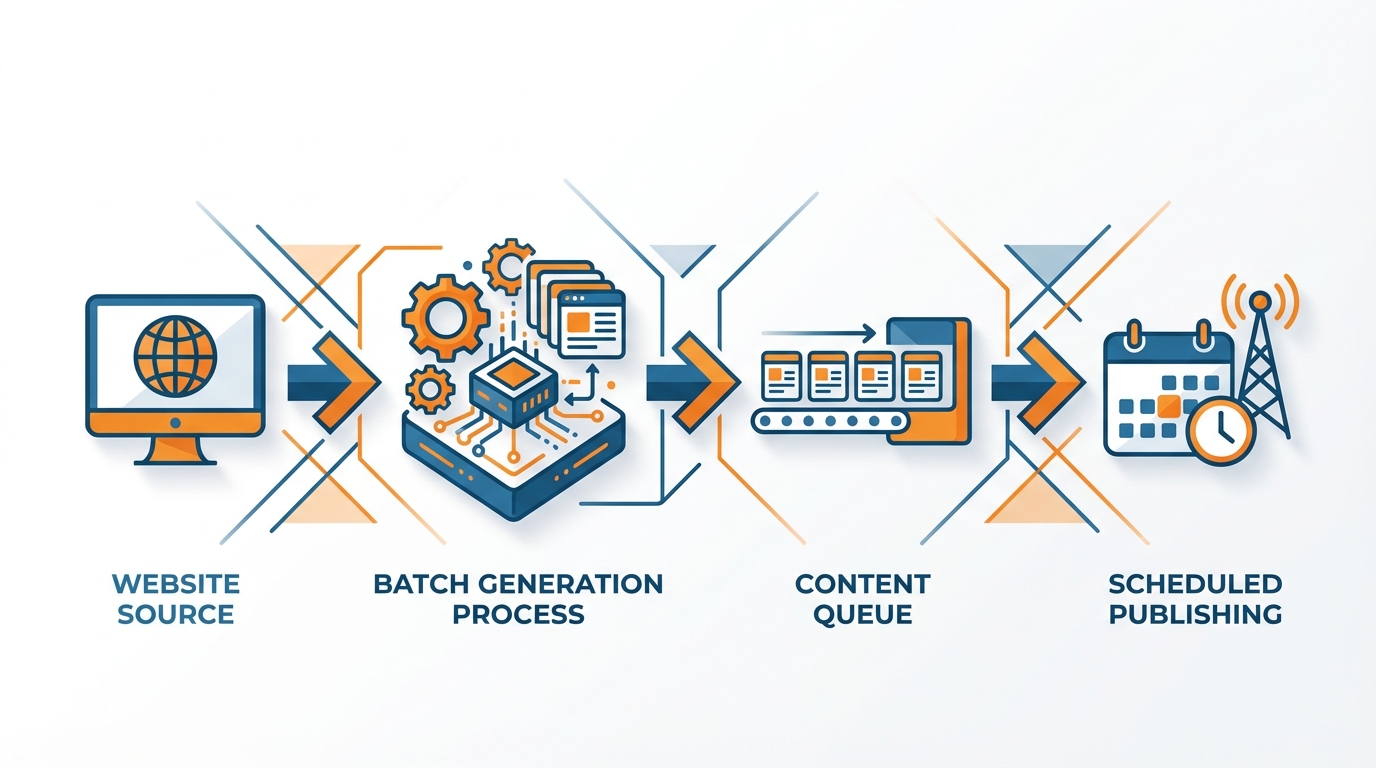
website input (preferably scalable, e.g. something that allows you to specify selection rules or upload a sitemap, so you can include money pages and exclude thin pages like tags or boilerplate.
Then it should generate batches: if you put in 10 pages, it should give you 50+ unique drafts back, not 10 summaries, and each should be tied to a specific claim, proof point, FAQ, or objection from the page.
In my impression from experimentation is that volume is less important than coverage: if what you get out doesn’t reliably cover problem, solution, proof, and next step for each of the pages you input, your calendar will be full, but you won’t be converting.
Second, you need an actual queue, not a drafts folder.
You need to be able to schedule based on intent (e.g. educational posts at the beginning of the week, proof & case-style posts in the middle of the week, offer-driven posts toward the end of the week), and also automatically stagger similar topics so that you don’t compete for the same eyeballs.
The rule of thumb can be done with some simple consistency math: a small business that posts five days a week needs ~20 posts a month; if you can get five genuinely compelling content angles from each core page on your site, then you only need four really strong URLs to get you through an entire month, and you can reboot the process every quarter as your site grows and changes.
Last, the publishing phase should be automated, and distribution included as part of the pipeline to avoid having to recreate the same content in seven different forms.
That’s where a platform like WoopSocial can come in handy, as it’s designed to extract your brand voice from your website, produce a month of ready-to-publish content quickly, and enable distribution from a single interface across the key channels. If you want the “one interface” part specifically, a social media AI manager supports that kind of workflow.
That’s a useful combination if you’re short on consistency, but not content ideas.
The bonus is time, but also the elimination of daily decisions to clear the way for your website to be converted to social posts even when you have a busy week.
Separately, repurposing is also a cost-efficiency move: a survey covered by Marketing-Interactive reported 84% of marketers planned to reduce inefficiencies and save costs by repurposing existing content on owned channels (why teams repurpose content to save costs).
Guarding against misrepresentation of your brand’s voice and values
Factual accuracy, proper credit, and hallucinations
If you’re automating blog posts from my website, trust is the name of the game.
You need features that ensure every blog post stays grounded in the facts of your website, rather than the creative universe of a model.
This means the tool should be drawing language from the source, it should be showing you which section of the page it used, and it should be making it easy to attribute the original page by linking back to the correct URL by default.
A practical way to evaluate this is to spend five minutes to run one of your product or service pages through the tool, then go through the generated draft to see whether each statement can be linked back to a sentence on the page or a table.
If you can’t find where something came from, you can’t trust it.
On money pages, this is a dealbreaker, because even tiny inaccuracies have compounding consequences: a misstated price, an old deadline, an overstated benefit, or a promised feature you don’t actually have can mean that one single post turns into a week of follow-up support emails and uncomfortable backpedaling.
You need to see enforceable mechanisms in place, like “quote-first” drafting modes, fact checking against the content on the page, and a warning system that flags when the tool can’t find evidence for something a sentence says.
When I review a new draft, I do it as a mini compliance audit: every data point, promise, and comparison has to trace back to its original in the source, or else it needs to be rewritten or removed.
The attribution is not just a citation - it’s a trust signal.
The tool should show you the context window that it used, so you can verify that it didn’t pluck a sentence from an FAQ and attribute it to a pricing statement, or that it didn’t combine two sentences that describe different service levels.
A good process might be to curate the quotes it pulls first, then use only those quotes to generate additional copies.
Adding that one small hurdle reduces the risk of hallucination radically, because the AI can no longer fabricate text, and your articles will sound less like social media copy and more like authoritative overviews of your website.
There is also experimental evidence that AI-generated short-form text and metadata can lift engagement: one large-scale field experiment found that providing AI-generated titles increased valid watches by 1.6% and watch duration by 0.9%, and when producers adopted AI titles, valid watches were +7.1% and watch duration +4.1% (large-scale field evidence on AI-generated titles).
Last but not least, ensure your brand voice is preserved, so the content is still in your voice even at scale.
This means you should be able to lock your tone rules that would be consistent with your writing today (for me, that would mean direct, specific, somewhat opinionated, and allergic to vague hype), and to preserve consistent branding in any pre-made images so the result doesn’t look like a template factory.
When something like WoopSocial scrapes your website to match your voice, and ensure consistent branding in the images, that’s not a cosmetic nicety, it’s a trust signal: people will recognize your brand faster, and the posts will feel like they’re coming from your company, not from a bot trying to guess what you’re selling. That level of adoption is also reflected in creator workflows: Adobe reported 86% of global creators use creative generative AI, and 81% say it helps them create content they otherwise couldn’t have made (how creators use generative AI).
Conclusão
Em conclusão, A tool to generate social media posts from your website is only interesting if it considers your website to be the source of truth, creates authentic multiformat social media posts, and operates on a flow you can actually scale: batch creation, a review queue, and posting that continues to execute consistently even when your week gets busy.
This is what distinguishes between flaky posting and a repeatable, monthly process for a small business, where you don’t have to recreate the process, write the same things over and over, or unwittingly wander from what you offer.
Focus on inputs that let you ditch human labor and maintain precision; this means sitemaps and RSS for automation, and URLs for one-off money pages and campaign pages.
Then demand outputs that match how platforms reward attention: a series of hooks for every idea, thread-style expansions, copy for carousel slides, and one point single post blasts.
I’m starting to view hooks like little experiments.
If you can produce 8 to 10 opening lines for a single services page, you’re no longer having to guess what might perform well and you’re now discovering how your audience responds to your positioning, and you’re getting it based on your own copy instead of AI nonsense.
You want the process to be tangible enough to execute over a calendar too.
Think it through: 5 posts a week means 20 posts a month, and if you can consistently get 5 different angles from each base page you only need 4 top-tier links a month to keep things diversified.
I recommend mixing up the pages by intent so you do not repeat yourself: educate on Mondays, prove by Wednesdays, sell by Fridays, and always keep the posts connected to the same promises and questions as on your website to avoid generating additional customer service from avoidable mistakes.
Next, pick depending on your publishing style.
If you want a thin repurposer, pick one that ingests easily and exports in formats you will actually use without requiring tons of editing.
If you want a full-stack generator that can take your website and generate a month of content in one go, and still sound just like you, find a tool like WoopSocial that will ingest your website, match your tone, and generate native drafts in quantity, so your website stops being a digital calling card and starts working like your best content generator.
Related reads
5/8/2026
The 7 best Blotato alternatives for developers - cheaper pricing, better API and feature comparison
Blotato is an AI-powered platform that allows you to create content and distribute it to different social media platforms. It also works as a unified social media API, which means you can run it with your AI agents to automatically post to social media.
5/7/2026
The 8 Best Bundle.Social Alternatives - Faster, Cheaper and Better Social Media APIs
Bundle.social offers a single endpoint to post to multiple social media platforms. It is also known as a unified social media API or a social posting API.
5/6/2026
The 7 Best Outstand Alternatives In 2026 - Cheaper, Reliable and Faster Social Media APIs
Outstand is a unified social media API that allows you to post to many social media networks through a single endpoint. Instead of having to build integrations for each of these platforms, you can now just build a single one and get started much quicker.