Small Business Competitor Benchmarking: Automate in 90 Minutes
Master competitor benchmarking for your small business. This guide teaches a 90-minute automated process to gain insights, identify market needs, and get actionable steps.
Competitor Benchmarking for Small Businesses: A 90-Minute Process You Can Automate
Benchmarking your competition is only valuable if it leads to quicker decisions that drive your business forward. No, not if it results in a super-whiz-bang, super-cool looking spreadsheet that does nothing different.
In this scenario where you have to balance sales, fulfillment and cash flow, you have to have a method that acknowledges that you have limited time, limited resources, irregular data and competitors that aren’t going to give you nice, neat numbers.
In this guide you will learn a simple and repeatable method to benchmark your competitors based on publicly available data and a few relatively simple assumptions. You’ll leave with a one page scorecard, a short list of KPIs that matter for your business model, and a prioritized list of steps to take this week.
The aim is not to replicate what others are doing. What you’re aiming for is to identify potential market needs, test your assumptions, and then take the next best step with conviction. I’ll share the steps I go through whenever I need to get insight fast: defining the relevant set of competitors, getting decision quality data, from benchmarks to hypothesis to experiments you can perform today.
No tool overload, no theoretical nonsense, and no unnecessary analysis, just competitive benchmarking that’s worth every minute. If you want to systematize the publishing side while you do this, you can also explore Woopsocial as a simple way to keep your cadence consistent.
Monthly small business competitor analysis: 90-minute process that I can automate
The reason that competitor benchmarking for small businesses doesn’t have to be an exercise in foreverness is that you can define done.
You want to be able to walk out of this 90-minute exercise with 3 things in your hands: a small set of competitors with a 1-sentence description each, a 1-page scorecard of the few metrics that matter most to your business, and 3 prioritized opportunities you can act on this month.
Anything else I treat as optional because the point is decision-quality signal, not precision.
When I run through this exercise myself, I’m brutal about ranges vs. precision: a competitor has 120-200 reviews, not 163; a lead magnet is strong or weak, not sliced and diced to death.
First, choose types of competitors. This is to avoid the pitfall of focusing on copies of your company.
- 2-3 direct competitors that sell the same thing to the same customer.
- 1-2 indirect competitors that solve the same problem another way.
- 1-2 attention competitors that compete for the same attention, even if they don’t sell the same category.
So for a local service company, my attention competitors might be the local Facebook group admins and the most popular channel in that niche on YouTube.
For ecommerce, it might be marketplaces, creators, or a brand with similar aesthetics that absolutely owns short-form.
Limit it to 6 max, so it’s enough to dive in and gain insight, but small enough that you can come back to it on a monthly basis and not have it become a hobby. Time-boxing is the system.
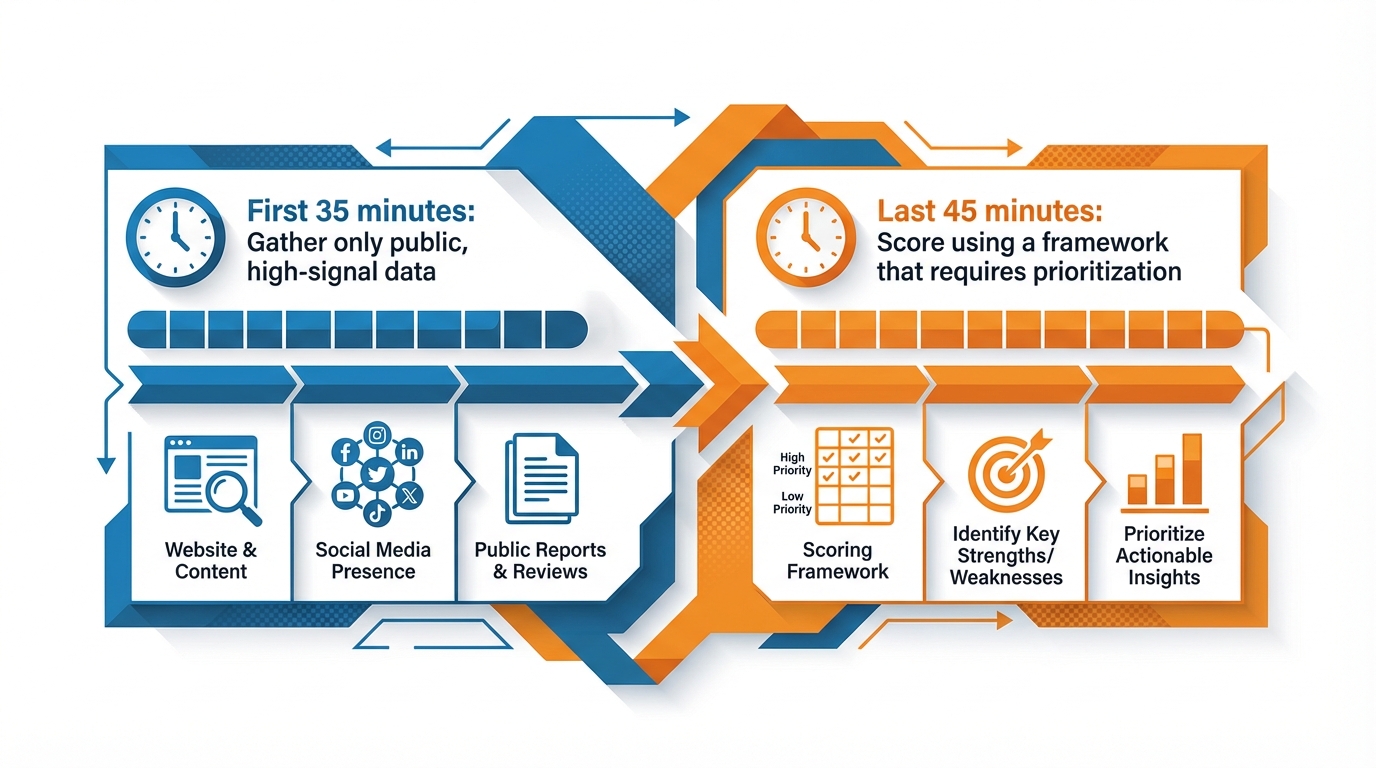
First 35 minutes: Gather only public, high-signal data
- Offering, pricing:
- Evidence, trust:
- Channels:
- CTA:
If you’re also tightening your publishing workflow while you gather this, a social media content calendar guide can help keep the monthly cadence practical.
Last 45 minutes: Score using a framework that requires prioritization
- Select 6 to 8 attributes:
- Rank 1 to 5:
- 1 line on why you ranked it this way:
Last 10 minutes: Convert scores to 3 opportunities using the following filter
- Biggest impact on customers:
- Easiest to implement:
- Quickest to test:
If you cannot state the opportunity as a change that you can test in less than 2 weeks, then it’s not an opportunity, it’s a research project. The frequency is what prevents this from getting in the way.
Every week: a 10-minute quick check on the two signals that most tell you about your market’s direction, whether that’s review rate and pricing or content type and frequency of publishing based on your niche.
Every month: a 90-minute analysis of the full stack to understand the change in your KPIs, not the absolute numbers, as the most valuable data point is always who’s moving the fastest in what ways.
Every quarter: a strategy re-set to update your competitive cohort and your benchmarking rubric, because markets change, yesterday’s direct competitor becomes today’s bit player while some other silent thug of a relevance competitor has been eating your lunch, and you need to re-understand the market’s conditions.
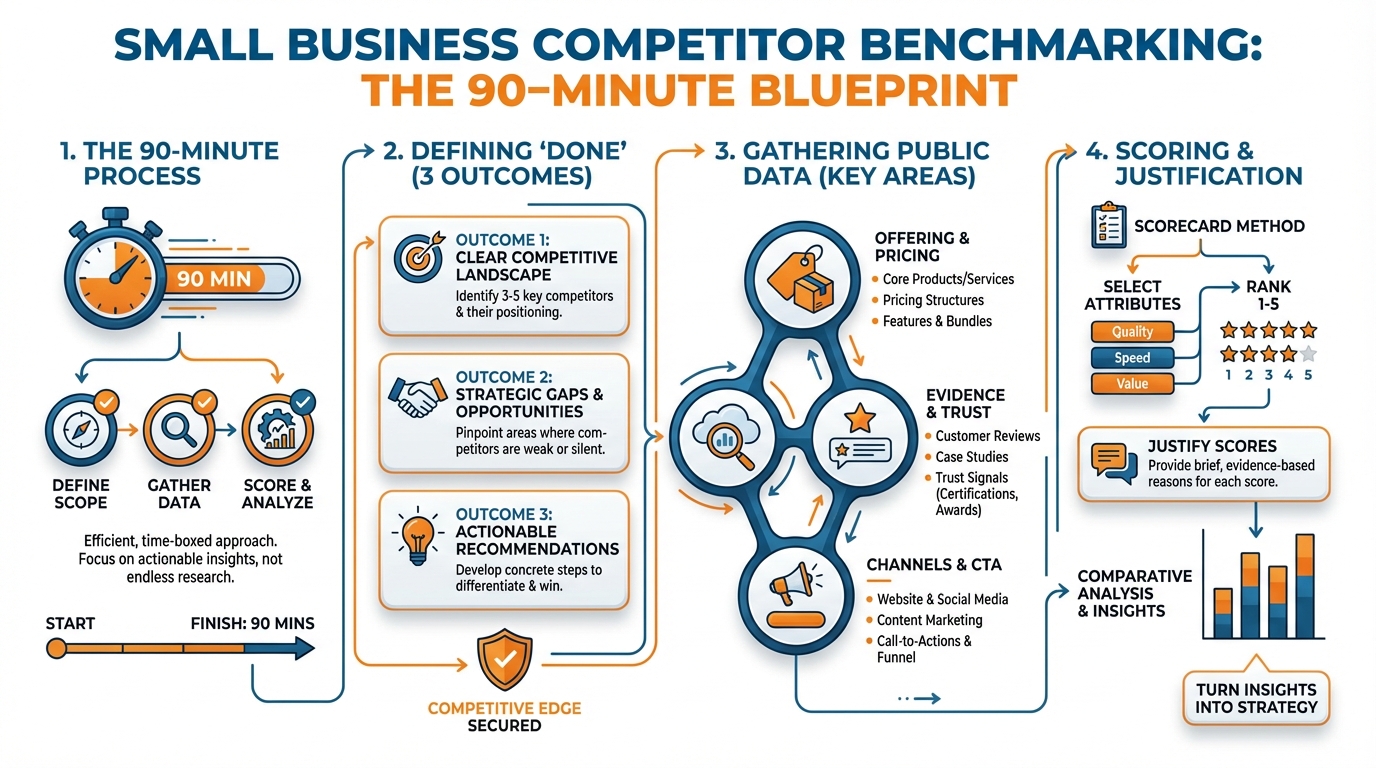
The core rule that keeps me on the right path here is simple: If I can’t trace a benchmark back to a decision I’m going to make this month, I don’t track it.
Competitor benchmarking for small businesses: which metrics to use (KPI menus by business model)
In a small business, competitor benchmarking works when you track the few leading indicators (leading signals) and the few lagging indicators (lagging signals) and dismiss all vanity metrics that look good. If you want a deeper read on why that matters, this piece on vanity metrics aligns with the same idea.
On just about any model, I benchmark the funnel through 4 stages: awareness (are you being seen), conversion (does a stranger turn into a lead or customer), retention (do they come back and share) and unit economics metrics (does growth generate positive or negative revenue).
The key is to think of every metric as a dial: leading indicators are dials you can turn now (the way you explain your offer, speed to lead, number of reviews, email capture rate) and lagging indicators are dials that tell you if the turn had an impact (revenue, churn, lifetime value).
If a metric doesn’t determine a next action, then it is a vanity metric by definition, regardless of its veracity. Here are the KPI shortlists that actually align to your small business revenue models.
If you run a local service business, track GMB visibility metrics such as: average ranking coverage of your top 5 service keywords in your service area, review velocity (new reviews per month, not total reviews), response rate and response time, and the conversion metrics that drive phone calls: call-to-appointment rate, quote-to-close rate, and speed-to-lead (in minutes).
If you run ecommerce, track product demand capture and product merchandising: share of search on your money keywords, email or SMS capture rate, add-to-cart rate, checkout completion rate, return rate, and contribution margin after shipping and ads (because top line growth with negative margin is a trap).
If you run SaaS, track activation and retention first, not just signups: trial-to-activated rate, time-to-value, weekly active usage per account, logo churn, net revenue retention, payback period; I also track pricing packaging and plan gates because small differences there can lead to huge ARPA differences without any traffic changes.
If you run a B2B service or agency, track pipeline quality over reach: lead-to-call rate, qualified-to-proposal rate, proposal win rate, sales cycle length, average retainer, gross margin, and utilization; you can also track proof density on key pages (case studies, specific outcomes, named niches) because that tends to correlate with win rate more than content volume.
When it comes to channels, you need a little different framework for benchmarking, as the same metric has different implications depending on the channel.
For organic, you need to look at the quality of demand and intent: the number of top-3 keyword rankings for buyer intent keywords, the percentage of site pages driving traffic, and the number of competitor pages ranking for the same intent keywords you are (for local, that’s service/location pages; for e-commerce, that’s category and comparison pages; for SaaS, that’s alternative and integration pages). It is important to track your rankings long term to understand how you are scoring against your competitors.
For paid, benchmark the efficiency and strength of the offer: the number of distinct ad creatives, the balance of promise vs proof on the landing page, and an estimated CPL (cost per lead) and conversion rate or customer profitability, since a low CPC is worthless if the traffic is unqualified.
For social, benchmark the mechanics of distribution, not the size of an audience: posting frequency, repeatable formats, hook construction, and engagement rate as a proxy for message-market fit; I discount spikes in virality unless it drives leads, signups or email capture consistently. If you’re measuring engagement as part of this, an engagement calculator can help keep your estimates consistent.
For partnerships, benchmark the ecosystem: the number of legitimate co-marketing partners, frequency of joint content creation, and whether the partnership yields a clear next step (referral link, co-branded webinar, bundling), since the number of partners means nothing without activation.
So here’s the “good KPIs” filter that lets me keep only the ones that drive choices:
- If a 20 percent fluctuation doesn’t cause you to do anything different this month, cut that metric.
- If it moves up and you do the same thing anyway, cut that metric.
- If it moves down and you can only cry about it, cut that metric.
You want 6 to 8 KPIs on your scorecard, balanced between leading and lagging, and you want each of them tied to a specific lever that you can control, such as offer, proof, channel focus, conversion step, retention mechanism, and pricing.
That’s how competitor benchmarking for SMBs stays fun: you’re not tracking metrics, you’re picking up signals that point you to the next unfair advantage.
The following resources are where I get my data (where it’s free or low-cost, and where good enough is, well, good enough)
When it comes to small business competitor research, I begin with the most direct data your customers touch: your Google Business Profile and reviews.
You can glean valuable insights by monitoring the number of reviews and, crucially, the number of new reviews per month, as well as any recurring themes within the last 10 to 20 reviews of your competitors.
You aren't just interested in the sentiment; you're also interested in the operational commitments that your customers are voluntarily bringing up: prompt replies, tidy work, transparent pricing, timely completion, friendly staff, durable solutions.
If one of your competitors is consistently getting new reviews and others aren't, it's often an early sign that their service or review request process is effective, and you can react swiftly by improving your review process. This matters even more in markets where competition is rising; the U.S. Chamber’s SBI report notes that 36% of small businesses say competition has increased compared to six months ago (Q2 2023).
Second, I outline where they sell and how they present themselves in public: marketplaces, directories, and their own site.
On their site, you can benchmark pricing and packaging (what is included, what is excluded, what the upsells are), offers (guarantees, bundles, entry offers), and trust signals (case studies, before-after, certifications, named customers, response times, turnaround times, delivery windows).
Then you can follow their conversion path like a customer: submit a lead form, request a quote, or start checkout and just observe what happens next.
This allows you to benchmark speed-to-lead, qualification questions, whether they use deposits, and how hard they push to a call versus letting you buy or book directly.
Stay ethical here: only use public pages and your own test submissions, do not scrape gated systems, do not misrepresent who you are, and do not attempt to access anything private or behind employee logins.
When I need to approximate the work of a keyword tool in the absence of budget, I start with a combination of ad copy and a cross-section of search results: pull the ad copy of your closest competitors and look for patterns - what strengths do they play up, what do they emphasize as key differentiators, and which landing pages are they willing to spend money on?
Then, check who appears in the top non-paid search results for your most important intent-based terms.
You don’t need full SEO tool access to draw conclusions: choose 5-10 of your most important keywords, take a look at the top search results, note the types of pages you see (landing pages, comparison pages, alternative pages, location pages, etc.), and write down what each promises above the fold. If you want to turn keyword lists into clearer traffic expectations, SEO forecasting is likely the best way to go nowadays. This is especially relevant given that the Service Direct search marketing survey reports 72% of small businesses do some amount of search marketing.
If you see a particular ad with a regular basis, that’s one thing.
But if you see a competitor regularly ranking for pages that answer a particular objection or comparison, you’ll know you have an opportunity to build a better page, not a bigger one.
Lastly, I measure social, community, and partnership footprints as distribution signals, not vanity metrics.
On social media, you can examine recent posts for formats to repeat, the ratio of views to comments, and frequency of next steps (link clicks, DM prompts, booking flows), and you can examine community indicators like event frequency, comment density, and the presence of real customers. If you want to generate variations quickly while you test formats, an AI social media content generator can support that without changing the benchmarking method.
On partnerships and influencers, I look for co-marketing patterns to repeat: tagged partners, guest appearances, affiliate codes, bundled offers, shared webinars, podcast rounds, or resellers. This lines up with the reality that 57% of deals are competitive, according to Kompyte’s competitive sales benchmark study.
When exact numbers are not available, use rough estimates: work in ranges (50 to 80 reviews, not 63), use proxy metrics (comment-to-like ratio as an engagement quality proxy), sample consistently (same day of the month, same keywords, same 10 recent posts), and measure direction more than absolute.
In small business benchmarking, whoever has the most accurate data does not win, whoever can detect the signal in time to act does.
5. Competitor benchmarking for small businesses: turning benchmarks into strategy (diagnose → hypothesize → test)
I also use benchmarking as a small business - but I approach it as an exploration tool rather than a grading tool.
I try to understand what is happening in the market by spotting patterns in four areas: 1) holes in the market where nobody satisfies some combination of product offering, use case, or urgency level; 2) positioning differences where the narrative around the company shifts from features to benefits to outcomes; 3) distribution where one company is consistently present in places that I am not; 4) credibility and trust differences where one company appears more trustworthy or safe to buy from in 5 seconds; and 5) velocity differences where one company seems to launch new pages, new products, or new partnerships more quickly than anyone else.
When I see a pattern emerge across multiple competitors and multiple touch points, I take it as signal.
If I see it once, I take it as noise until it happens again.
From there, you derive testable hypotheses.
So if you notice a proof-based advantage, your hypothesis might be that we will get a better lead-to-call rate from adding evidence near the CTA than we could from adding more traffic.
If you notice a distribution-based advantage, your hypothesis might be that a single partnership channel will perform better than a month of content creation because it has borrowed authority.
If you notice a positioning advantage, your hypothesis might be that the market is no longer buying the category, it is buying a result by a certain time, and our positioning needs to start with that.
I try to condense every benchmark into a sentence that begins with if we change X, then Y will improve, because Z is what the market is currently rewarding.
Small teams succeed by focusing on highest-leverage activities and doing the smallest meaningful tests first so you learn as fast as possible and build momentum.
Do compound interest tests: test your landing page headline to nail the value proposition and eliminate an objection, test an offer/package change that accelerates your ideal customers’ purchasing decisions, build a review funnel that accelerates review flow and compounds credibility month-over-month, test a content distribution deal that opens a new channel to a qualified audience overnight, and automate a community when it eliminates rote management and speeds responses while retaining a personal touch. If you’re leaning into automation here, a broader overview of social media automation fits this same execution-first approach.
I often like 2-week tests, because they’re long enough to provide some indication of direction but short enough that you’re not stuck committed to a bad idea that reality has long since trumped.
One of the quickest ways to turn benchmarking into a waste of time for SMBs is to get caught in one of the benchmarking traps.
Don’t copy a tactic without copying the parameters that made it succeed (budget, brand, audience, time of year).
Don’t target averages because the average is the homogenization of all things differentiating and you don’t care about the middle of the curve; you care about the tails that predict why a customer would choose someone, not the meaningless middle that can’t predict anything.
And don’t react to noisy signals like a one-week spike in traffic or a single piece of content going viral, as you need at least a few samples and you need to see it reflected in leading indicators like more leads, a higher conversion rate, shorter sales cycles or lower churn.
Benchmarking isn’t about being the same; it’s about being able to read the market well enough to make better decisions than your competition can make this month. That’s increasingly true as competitive intelligence tooling grows; Mordor Intelligence’s competitive intelligence tools market report notes cloud deployment captured 78.04% share in 2024.
Em conclusão,
At the SMB level, benchmarking is a much more effective tool when it’s more of a practice and less of a project.
You want to keep the cycle tight and keep it to a monthly cadence, because it’s only through the cadence that you really get the benefit, which is that after 3-6 months you start moving beyond being a pundit to having your own internal guidance on what’s valued, what isn’t, and what’s changing before it’s clear.
At that point, benchmarking becomes less about research and more about an edge, since you’re measuring trends and not events.
Take your next monthly pass to measure your competitors’ pace, not their totals.
In small business niches, subtle indications of changes in competition almost never manifest in scale but in velocity: a competitor grows from 2 to 6 new reviews a month, their above-the-fold shifts from describing features to delivering results, their offer now touts a faster turnaround, or their content starts repeating a format that consistently generates a lot of comments and leads.
By tuning your eye to measure these rates of change, you’ll spot shifts in positioning when they first occur - and before the cost to react effectively becomes high.
Next, you turn each observation into a single experiment you can test within 2 weeks.
You don’t need 10 different “actions”, you need 1 that flips a dial: proof nearby the CTA, a package that eliminates a hesitator, a response time guarantee that you can fulfill, a single new distribution channel that piggy-backs authority, a landing page copy that uses the language the market uses, etc.
I do this exact same exercise: 1 hypothesis, 1 leading metric, and 1 decision at the end to keep, kill, or iterate.
That’s the reward: you’re competing on execution and positioning, not just on your guesses.
If you continue a monthly cadence of competitive benchmarking for small business you’ll be the team that adapts faster than the market.
And you’ll build a playbook that your competitors can’t replicate because it’s based on your observations, your experiments and your results over time.
Related reads
5/8/2026
The 7 best Blotato alternatives for developers - cheaper pricing, better API and feature comparison
Blotato is an AI-powered platform that allows you to create content and distribute it to different social media platforms. It also works as a unified social media API, which means you can run it with your AI agents to automatically post to social media.
5/7/2026
The 8 Best Bundle.Social Alternatives - Faster, Cheaper and Better Social Media APIs
Bundle.social offers a single endpoint to post to multiple social media platforms. It is also known as a unified social media API or a social posting API.
5/6/2026
The 7 Best Outstand Alternatives In 2026 - Cheaper, Reliable and Faster Social Media APIs
Outstand is a unified social media API that allows you to post to many social media networks through a single endpoint. Instead of having to build integrations for each of these platforms, you can now just build a single one and get started much quicker.