Automate B2B Social Media: Post Better, Not More
Discover how to automate B2B social media posting effectively. Prioritize quality and consistency over quantity to drive pipeline influence, sales enablement, and partner engagement.

Automate your B2B social media posting by posting better, not more.
Want to automate social media posting for b2b? Quit trying to publish faster and start trying to publish better. In B2B, automation is not a trick to publish faster, because your content has business risk: one mistaken assertion could confuse prospects, raise compliance issues, or undermine your credibility in the eyes of diligent prospects and customers. The upside is having a reliable publishing engine that takes all of your business news, including product releases, customer successes, webinars, thought leadership, and partner announcements, and turns it into consistent social media content that continues even when you are too busy to run the business. If you want a practical starting point for social media automation, see social media automation.
Here is the mindset shift you need to make: You’re not in the game for more content, you’re in it for the consistent signal. You need to have the right signal appear over and over in the timelines of the right accounts, with the right amount of oversight and curation, and with metrics that tie it back to business results. In my experience, the teams who nail it use automation as an engine with dials: A defined process for content entering the system, a lightweight approval for anything that involves claims or sensitivities, and a standard method for spinning one piece of content into a dozen unique messages that don’t sound canned. When you do it this way, you end up measuring success with pipeline influence, sales enablement, and partner engagement, not just likes and views. You can tell it’s working when sales starts incorporating your content into sequences, when you don’t have to sweat as hard to get webinar signups, and when prospects quote your point of view before you even get on the phone.
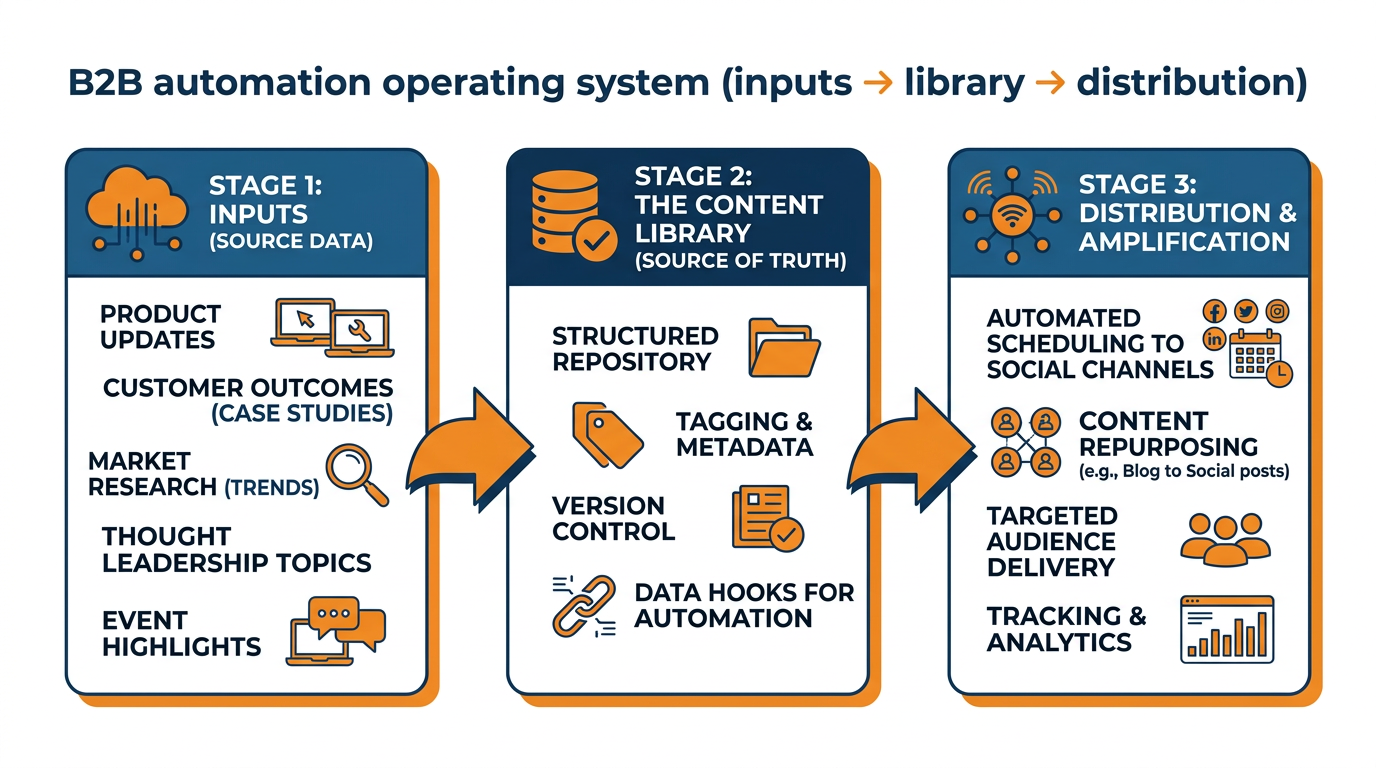
Develop the B2B automation operating system (inputs → library → distribution)
Want to run b2b social media posting on autopilot without building a house of cards? You need to architect an operating system: inputs, a content library, and distribution.
Inputs: decide what’s permitted (and formatted)
First, decide what is permitted into your system and how it’s formatted.
You want inputs that correspond with actual purchasing decisions, not bright ideas:
- product updates
- customer outcomes
- webinar topics
- partner news
- weekly sales objections
- category perspectives you can support
Create a basic intake protocol: every input must have one proof point (metric, screen grab, quote, artifact), one target persona, and one next-step destination on your website.
I do this because it prevents the two most costly issues in small teams: 1) publishing non-converting, fluff content and 2) panicking for context when it’s time to repurpose.
Library: source of truth (not drafts)
Finally, use the content library as a source of truth, not a repository of drafts.
Each item should be stored once, with hooks for the data that will allow it to be reused, e.g. positioning context, ICP, stage, approved claims, canonical URL.
This will help you fight content drift, where over time your messaging creeps from your category story, because people reword it in different ways.
A simple hack here is to require a small positioning block like who it’s for, what problem you solve, and why you win for every asset, and to have every social post be forced to inherit that block from the asset it’s derived from.
When you do this, your social presence will compound over time; when you fail, you will end up with disjointed stories which confound prospects who are evaluating you over 3-9 months.
Workflow: long-form → social-native
So then you need a workflow to go from long-form to social-native, because people don't consume timelines like they consume blog content.
So you have a single anchor asset, like a case study or webinar, and then you have to create a lot of different formats out of it.
You have to create:
- a contrarian insight post
- a how-to post
- a mistake post
- a short story post
- a proof post with some actual numbers
You need to decide the channel rules going in.
Like if you're going to be LinkedIn-first, you're going to write for skim-speed, you're going to write for a really strong opening line, you're going to write for one idea per post. If you want a tighter system for planning, review social media content calendar.
And if you're going multi-platform, you're going to write the hook and the structure for the platform, so you don't copy and paste.
And we've seen small B2B teams get more engagement, and higher quality engagement by posting less often, and rotating through formats, because it's the repetition of the same core message in a different format that actually gets the committee buying process to remember it. This matches broader usage data in the 2022 B2B content marketing benchmarks PDF, where Organic (nonpaid) social platforms used by B2B content marketers in the last 12 months include LinkedIn 96%, Facebook 76%, Twitter 70%, YouTube 65%, Instagram 57%, TikTok 9%.
Distribution: boring, reliable, and designed for failure modes
Last, make distribution boring and reliable by designing for failure modes.
You need deduplication so the same post does not publish twice when you re-run an automation; the simplest rule is a unique post ID tied to the library record and a check that it has not been published to that channel already.
You need link integrity checks so broken URLs do not leak credibility; use one canonical link per asset and validate it before publishing, plus add UTMs consistently so you can see which themes influence traffic. If you want to standardize tagging, use a UTM generator.
You need timezone control so posts hit business hours for your market; lock a default timezone per account and convert all scheduled times to it.

And you need a cadence that fits B2B reality: plan in weekly themes, publish consistently, and expect impact to show up as repeat exposure and sales enablement over months, not overnight virality.
Systems like WoopSocial fit neatly here because they can generate on-brand variations fast and keep your visuals consistent, but the real win comes from the operating system you run underneath it.
Automate what can be automated. Safeguard what can’t (governance + human-in-the-loop).
If you want to automate social media posting for b2b without having it blow up your feed, you need automation rules.
Automate what is repetitive in nature. Automate what is relatively low risk.
Automate things like… idea creation related to ICP pain points… drafting multiple on-brand variants of the same core message. Automating theme days for the week. Automating the circulation of evergreen content such as, key statistics from a case study, key learnings from a webinar, key responses to common objections. If you need help generating drafts, an AI social media post generator can speed up those first-pass variations.
I have watched small teams get outsized outcomes from automation by treating each content piece as a battery to generate as many new, but related pieces as possible.
Because, at the end of the day, b2b buyers don’t need to be surprised and delighted with new content. They need to be circled back to the same content again and again.
Depending on your sales cycle, it can take anywhere from 3-9 months for your b2b buyers to make a purchasing decision.
What should remain human?
What should remain human? Everything that carries potential downside risk.
You leave replies and DMs to humans, because tone/context/intent can evolve rapidly, and a single misfired response can erode the trust of a prospect who’s already on the fence.
Similarly, sensitive announcements, pricing, legal/performance promises, crisis response, and customer-specific messaging remain human-led, since a single misplaced nuance can compromise confidentiality or fray a relationship.
A simple test for this? If it’s a message that could be screenshotted, sent to a CFO/regulator/important customer, and cause an awkward conversation, it shouldn’t be fully automated.
Governance: defined, not heavy
Governance does not need to be heavy, but it does need to be defined.
Define triggers that automatically cause content to be sent to a gate.
Any content with a number, a comparison, a customer logo, a promise, a security claim, a partner reference, etc. goes to the gate.
Any content that is educational and remains within your approved messaging should go around it.
Create a brand gate that checks that the content is consistent with the positioning block.
Create a legal-common sense gate that checks whether a claimed statement could be backed up with an internal asset.
Create an escalation procedure so that you do not find yourself arguing about it in real time.
Any content that involves a contract term, regulated terminology, or a customer permission should be escalated to an owner who can say yes or no in a defined amount of time.
Minimum audit trail
Last but not least, keep the minimum audit trail that protects you in regulated or enterprise-heavy contexts without holding you back.
You need a basic record of what was posted, when, by whom, from which source asset, with which claim or proof, and approved by whom (if approval was necessary).
That trail turns automation from reputational Russian roulette into a managed risk, and it makes it simple to quickly amend or retract if the context shifts.
As a practical matter, I find that generating rapid, on-brand drafts in WoopSocial and then putting anything that hits your triggers through this lightweight review is a great way to maintain speed where it’s safe and humans where it counts.
Let automation fit your B2B motion (ICP, ABM, sales, partners)
If you want to automate social media posting for B2B and still generate revenue, every automation decision has to hook to your go-to-market motion.
A PLG SaaS motion works by scaling category education and quick proof that removes friction, so you automate high-signal how-to themes, product moments, and customer outcomes with tight loops to the exact page that converts.
An enterprise ABM motion works by precision and repetition inside a small list of accounts, so you automate fewer posts, but each one is built to land with a buying committee: finance-safe ROI angles, security and risk language, implementation realities, and a consistent point of view that shows up week after week. This aligns with the Outlook for 2024 B2B research, where Channels used to distribute content (B2B): 90% use organic social media platforms (highest listed), and when asked which organic social platform delivers the best value, B2B marketers chose LinkedIn most often (84%).
A services business needs credibility and fit, so you automate before-and-after stories, process breakdowns, and the hard lessons learned that pre-qualify; I have seen small teams cut wasted sales calls fast when their automation consistently filters for the right budget and urgency.
Your ICP should be your engine for content topics, frequency, and channel, not a slide in a presentation.
You should label every social media-ready statement in your repository with the associated persona and funnel stage, and then establish a frequency that’s relevant to attention span in your market; ABM may favor a slower more consistent drumbeat, while partner and services may allow more rapid social proof pulses as each new partnership or win comes online.
A rough guideline that I apply is to target 60 to 70 percent problem and perspective content, 20 to 30 percent proof points like data, images, mini success stories, and 10 percent pure product or offer because B2B buyers will require many impressions over a long journey and credibility multiplies faster than novelty.
Second, I tailor automation to sales execution, not just marketing hygiene.
I use automation to generate post variants that speak to the top three objections we get, the top three things that drive urgency, and the top three things customers are willing to pay for.
This way, my posts are a pipeline of pre-sold copy blocks sales teams can grab off the shelf to copy-paste into emails without having to rewrite, and we don’t incur all that silent waste where marketing talks too smart and sales can’t use it.
I do this by making sure that every high performing post is a content asset that’s approved for the claims it makes and the persona it speaks to, so it can appear as a founder post, company post, and partner post without slipping off-positioning.
Last but not least, approach distribution as more peer-to-peer than one-to-many, by exploiting peer-to-peer collaboration as a scalability lever.
You should create a revolving chain of partners, clients and respected influencers in your industry, and automate content bundling: jointly branded images, customized introductory text for each partner, and staggered posting dates to give the impression that similar content is spreading across different streams, rather than sinking in one.
Here’s where small outperforms big, because your community responds to you faster than the competition’s bureaucracy, and I’ve created a micro-influencer list in the past that saw the same post reach more people, not because the content was being posted at greater volume, but because it was being posted in unison from many micro-influencer accounts.
WoopSocial is useful in this scenario because it can rapidly generate custom graphics, and automatically brand them, thus making it feasible to maintain your branding even as you spread your content across multiple channels.
Make automation responsible. Metrics that matter to leadership (beyond vanity metrics)
If you’d like to automate social posting for B2B and have your executives believe in the results, then you need some measurement that’s real, not mystical.
So first, make sure you’re using UTM parameters on every link, and they should only reflect the four things that you’re actually deciding: channel, theme, content type, and funnel stage.
Keep the number of values small enough that you’ll actually use them for an entire year: it’s better to be consistent than comprehensive.
And then stop driving traffic to your homepage.
Instead, each theme should be going to a custom landing page that fulfills the promise of the social post, with a clear primary CTA and secondary CTA.
And when you do this, you’ll notice a pattern that’s both surprising and consistent: posts that are in the middle of the pack for social engagement will frequently perform way above average on-site, while posts with a ton of likes will frequently tank on the landing page because they drove curiosity rather than intent.
Then create a clean funnel from content-to-meeting so social signals can convert to a conversation without pretending that attribution is fully accurate.
You should have two paths based on buyer intent: a short funnel for highly intent content like book a call, pricing, security, or implementation, and a long funnel like a brief guide page, case study, or webinar summary before the meeting link makes contextual sense.
I like to follow the rule that if the blog post is proof-based, it should get a meeting link, but if the blog post is perspective-based, it should get a funnel page that educates before offering the meeting.
It prevents over-asking that erodes trust, and it creates a measurable signal since you can track who consumed awareness stage content and considered review pages before they reached out.
Now, report KPIs by funnel stage so you can speak in business terms, not vanity metrics:
For awareness, you should be measuring reach quality signals that predict pipeline, such as profile clicks, non-follower reach, saves, and repeat visitors from social in your analytics; in small B2B, 1 to 3 percent of social landing-page sessions should result in a next-step action; that’s healthy, even if your likes are flat.
For consideration, you should be measuring actions that signal evaluation, like case study views, time on key pages, webinar signups, and contact-page views.
For conversion intent, you should be measuring demo requests, meeting bookings, inbound replies mentioning a post, and assisted conversions where social was an earlier touch.
You don’t need perfect attribution; you just need directional accuracy to double down on what generates meetings and revenue. This matters even more as budgets tighten: the Gartner 2024 marketing budget update noted that marketing budgets have dropped to 7.7% of overall company revenue in 2024, and that digital channels account for 57.1% of paid media budgets in 2024.
Last but not least, make it a circle, not a document.
You should go through the last 10 sales calls and customer conversations and gather the words people actually use for pains, objections and triggers, and then input them back into topic themes and landing pages.
At enterprise scale, it pays to widen that loop beyond call notes: a voice of the customer platform (VOC) can unify surveys, reviews, support tickets, chats, and social feedback so marketing and CX align on the same prioritized drivers of retention, NPS, and pipeline—instead of juggling disconnected exports.
Each month, you should decide what to recycle, rewrite and retire based on results: recycle posts that generate consideration actions even if the engagement is low, rewrite posts that get clicks but no consideration actions because the promise and landing page don’t match, and retire anything that reliably brings the wrong ICP into the conversation.
If I need to run this fast and not have content drift off-brand, I use high volume variations in WoopSocial, and then I hold the system accountable with UTMs, dedicated landing pages, and a monthly prune-and-improve cycle that increases the proportion of posts that generate a sales conversation. This also fits the operational case for GenAI: the Deloitte Digital GenAI content production report found that in both 2023 and 2024, GenAI saved the average employee 11 hours of work per week, and 41% said GenAI reduced costs of content production (compared to 32% in 2023).
The easiest way to get started, without creating a Zap rat’s nest
If you’re looking to automate your B2B social media posting without ending up with a house of cards, begin with less than you think you can handle: choose one channel to master, one type of content to leverage, and one day per month to batch it all. If your team struggles with inconsistency, see inconsistent social media posting.
For the vast majority of small B2B brands, that channel should be LinkedIn, as it’s where committees are most likely to see you and where positioning trumps volume.
In your first month, we’re not going for intricate, we’re going for proof.
Proof that you can deliver the same fundamental message in different ways without losing the thread.
First, make sure the content source is something you can logically defend, as opposed to just something you believe.
Next, identify one asset type you have and can comfortably create on an ongoing basis, such as blog posts, webinars, or case studies, and create a monthly practice that looks like this: a single session, to identify 12-20 blog post ideas per asset, and assign each idea to a persona and to a stage of the journey.
I say this because it enforces a practice many small businesses avoid: every blog post has a proof point and a purpose, which means you’re not just filling a channel, you’re teaching the market to trust you around a specific issue and a specific solution.
Keep the process simple enough to make it through your most hectic month: create, edit, schedule, and be done with it.
The key insight is that the real driver of consistency is less motivation and more the elimination of choices.
With one medium and one content type, you’ll reduce the mental overhead by 80 percent, and the quality will be better because you’re refining the same content instead of trying to create new content.
This is the key to avoiding the classic small-business error of over-automating distribution while under-investing in content, which is the surest way to get noise and no pipeline.
Technology certainly has a place in making generating on-brand ideas and batch scheduling steps faster, particularly if you need to expand a single anchor asset into a month of assets as quickly as possible.
I’ve leveraged tools like WoopSocial to get a month’s worth of post drafts created and prepped for scheduling in a single pop, which is a game-changer when time is your most constrained resource.
Make sure governance and performance review steps remain human.
You should remain in control of what claims are supported, what remains out of bounds, and what’s renewed, repurposed, or replaced, based on what’s working in the real world, like consideration actions and sales conversations. Safeguard what can’t.
Related reads
4/23/2026
Ayrshare Alternatives - Which social media APIs are better, cheaper and more reliable?
Finding the right Ayrshare alternative can be challenging, so we put all available APIs up to the test per different use case on pricing, coverage, limits and developer ease of use. Find the right fit in less than 2 minutes.
4/22/2026
Social Media MCP: How To Set It Up With WoopSocial.
Posting automatically to Facebook, Instagram, Pinterest, LinkedIn, TikTok, YouTube and X/Twitter was always manual work. But with the new MCP by WoopSocial, you can set it all up without having to do all the manual work.
2/27/2026
The best way to auto schedule tweets for small businesses
The best way to auto schedule tweets for small businesses isn’t a set-and-forget solution. It’s a simple system for consistent posting, improved visibility, and a strong brand voice, reducing your time commitment significantly.