An Indie Bookstore Marketing Calendar That Actually Keeps You Visible All Year
An Indie Bookstore Marketing Calendar That Actually Keeps You Visible All Year An indie bookstore marketing calendar isn't a list of holidays. It's...
An Indie Bookstore Marketing Calendar That Actually Keeps You Visible All Year
An indie bookstore marketing calendar isn't a list of holidays. It's not simply an events listing. If it were a holiday list, you'd know what everyone else is talking about; and if it were just an events listing, you'd know what's going on in your store. Neither of these helps the indie bookstore meet its day-to-day challenge of getting eyes on its inventory with the expectation that you'll keep the bookstore open year-round. And the reality is, you're going to be open even when nothing special is happening, no big event or viral title or extra time in the day to pull it off. You're going to be open even when you're not sure what people want, because they can only want what you give them. That means curation, community, and discovery, but these only get you so far if you don't have a marketing calendar that can actually keep customers in your door consistently, and not just on days that happen to have something 'special' happening.
The actual problem I am solving for you is keeping you visible all year, with a small staff, limited time and constantly changing book selections. New releases come out in waves, reorders are delayed, an author tour is announced last minute, or staff favorites sell out in a day. If your calendar is based around holidays, you will just post whatever, or you'll miss what can drive real traffic and book sales. A featured staff pick is more likely to drive people in the door than just a generic holiday card. A featured local partnership. A featured series that trains customers to come in and check out the books weekly.
By the end of this article, you will take away a working Content calendar framework that an indie bookstore can genuinely pull off, including: the ability to map themes out in arcs around bookish seasonality, the know-how to pick your channels to match the story and repurpose one great idea into multiple opportunities for community interaction, and an understanding of what you need to measure to know how to grow your store visits, event turnout, and sales, not just engagement metrics. I will share my thinking around creating repeatable series of content, leveraging community to help with content distribution, and performing easy, simple checks to make sure your calendar remains realistic, flexible, and profitable. If you want a broader foundation on the same idea, this fits closely with social media content systems.
Building an Actual Content Calendar System for Independent Bookstores, Instead of Just Dates
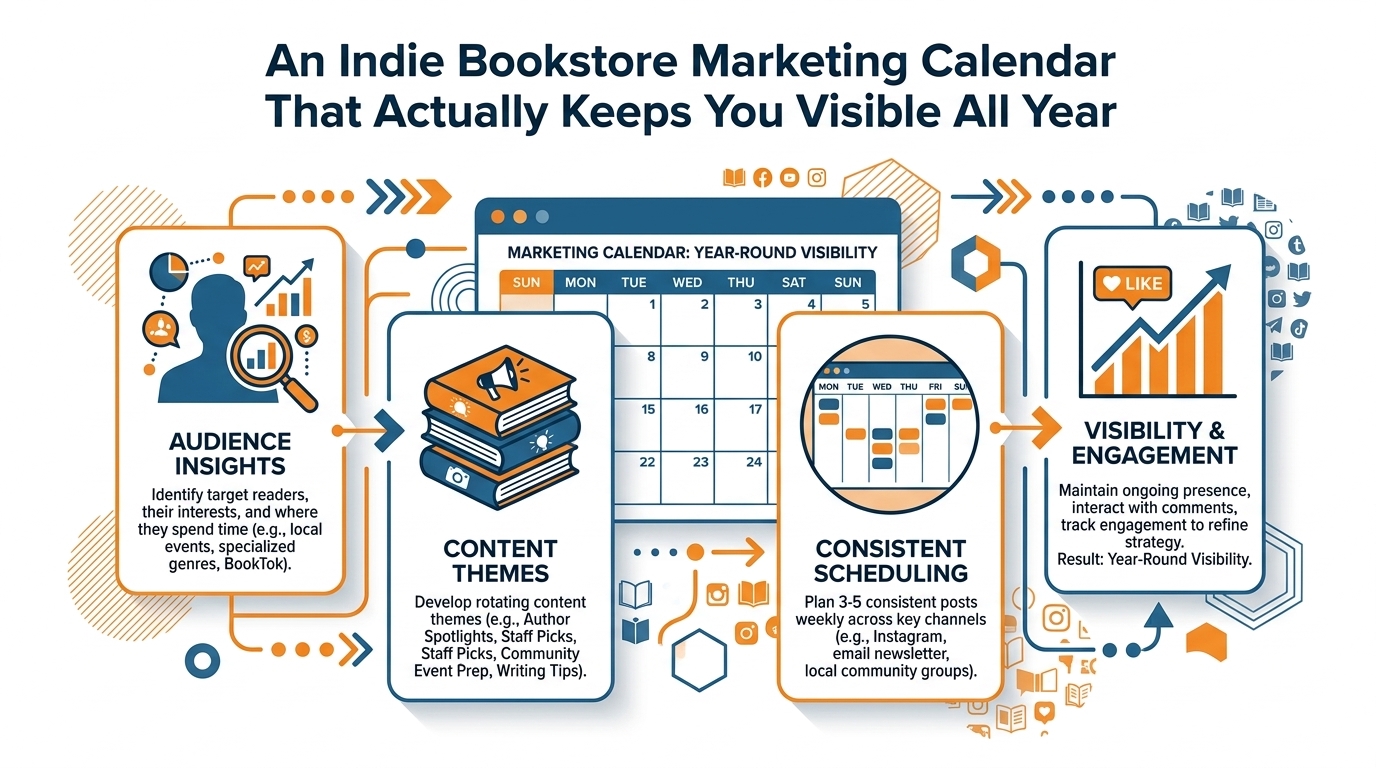
A Content Calendar for independent bookstores needs to start with knowing what content means in your context, after all, your customers don't only see your posts on Instagram.
In your world, content means social posts, email newsletter, website updates, Google Business Profile posts, in-store signage scripts and event promotion materials; that's how your business operates across channels.
The way those content pieces work varies: social drives discovery, email encourages repeat visits, Google captures high-intent shoppers looking nearby, the website answers what, when and where, and signage moves browsers into buyers.
And the best thing about this Content Calendar system is that each weekly theme you choose will translate to one idea that can be expressed in at least three of your channels (so it's no more work than it was before). If you want help making that kind of system repeatable, Woopsocial is built around planning and publishing across channels.
For example, when I have a staff picks feature planned in my Content Calendar, I treat the concept one time for one purpose across five channels:
- Shelf Talker script (1 of 80 staff picks)
- social post (1 of 5 for the week)
- Google post (for local visibility and SEO)
- Email newsletter
- Website mention or feature, if relevant to an event or preorder
After that, make outcomes non-negotiable and define what content type you can produce to reach those outcomes.
Pick 2 to 3 primary outcomes per month from the following: preorders, event RSVPs, walk-ins, email list growth, sidelines or gift sales, community partnerships.
Assign a measurable content job for every outcome:
- Preorders: Need early visibility and repetition. So you plan two mentions prior to pub week and a third on release week.
- Event RSVPs: Need clarity and social proof. So you run a short-form post, a reminder, and a day-of post with logistical info.
- Walk-ins: Are driven by what’s in the store now. So you build fast-paced inventory-led posts with a direct call to action.
- Email list growth: Need an online and IRL moment. So you make it a habit to mention the newsletter at the register weekly and share at least one email-only perk, thinking of early access to scarce items or limited ticketed events, on digital channels weekly.
A good rule of thumb I follow: a single promotion of an event typically yields only a fraction of the response rate you’d expect; a multi-channel promotion yields a higher response rate because it takes more than a single exposure to reach your audience.
To avoid your calendar running empty, anchor it to evergreen bookstore content buckets: inventory-led, staff-led, community-led, and event-led.
Inventory-led includes what just came in, what’s replenished, what is scarce, what works for a given season, and what’s available for pre-order.
Staff-led is about taste, expertise, and human connection: brief reviews, curated displays, what we’re reading now, or a short note on why this book matters.
Community-led taps into local pull: schools, libraries, charities, reading groups, and area businesses.
Event-led covers in-store programming and its follow-up, such as a memorable line, a question from the audience, autograph piles, and pictures from the event.
On any given week, adjust the mix according to circumstance rather than aspiration: when event volume is high, let events lead and support them with inventory; when events are quiet, emphasize inventory and staff recommendations; and when you want to increase foot traffic, pivot to community-based projects that draw on other people’s networks.
Finally, you keep the engine going with repeatable weekly series and a tiny-team workflow that sidesteps decision fatigue.
Create two or three regular series for customers to get familiar with, like a new release spotlight day, a staff pick slot, and a weekend whats-on-the-front-table check-in; the idea is to make sure the spine of your calendar remains even if the rest of it changes.
Hand off ownership that can weather busy shifts: one person owns photos on the floor as they happen, another person owns copy, another owns publishing, and everyone gets one rule for speed, like if something affects timing, price, availability, or accessibility, it gets updated immediately.
You want fewer handoffs and quicker approvals overall; I stick to one pass of editing for recurring series and only take more time to produce posts that might be high-stakes like big partnerships or tricky subjects.
You've got a system on your calendar when it's dependable and agile and centered on the practices that actually help an independent bookstore survive and flourish year-round.
How to Create a Content Calendar for an Independent Bookstore
What’s effective about a bookstore-specific content calendar is when it’s tied to the real book events rather than simply tying content to all events.
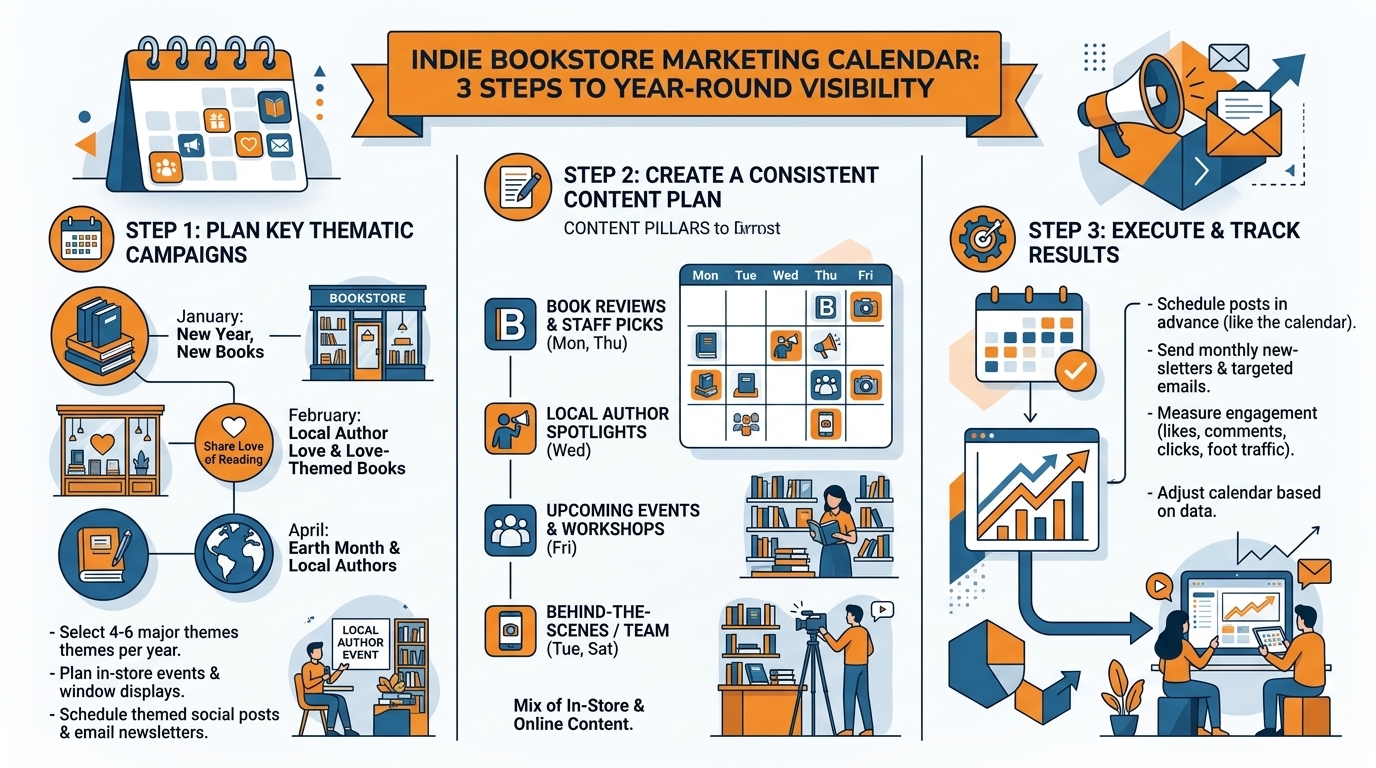
My plan will revolve around Independent Bookstore Day and Banned Books Week, as they’re great opportunities for promotion and they’ve been effective over time. For a real tentpole benchmark, Independent Bookstore Day 2025 saw more than 1,600 independent bookstores nationwide participate, and Chicagoland had 55 indies participating in an organized crawl.
I will plan these events out with one runway, a lot during the week of the actual event, and some post-game events that lead people to what book to buy, what books to bundle and what to do in the store. If you're looking for a concrete mechanic to plug into the runway and post-game, the 2023 coverage of passport promos notes that passport stamps unlocked 20% discounts valid from May 1 through Sept. 30, which is a built-in multi-month promotional window.
However, those events shouldn’t be the only things that you’re doing on that content calendar and the other weeks, you need to make sure your content series are running, your front tables are changing and your customers know there’s a lot going on every week even if there aren’t any major national events happening.
The most real your calendar will ever be in your store is to make it reflect your selling rhythm across months.
In Summer months you are all about discovery and momentum so your store focuses on beach reads, road-trip audiobooks, kids stuff, local tourism peaks, etc.
In most towns foot traffic can jump dramatically on certain festival weekends and your best content for that is a real snapshot of what you have in your store on that day.
In Back-to-School months you are all about utility and identity so your store is going to focus on teacher gifts, study-break stuff, display reading-challenges and things that sell when school resumes.
During Holiday gifting months your store is doing all of the above but you should start earlier with giftable price points and then shift to urgency and convenience as shipping and calendars tighten. If you want the “why timing matters” data to support this kind of planning, the ABA survey coverage reports 66.3% said 2025 holiday-season sales were higher than 2024 among 382 respondents.
During Winter months your store should be about protecting margins so it is about bookclub stuff, staff read for comfort, preorders for Spring stuff, add-ons at lower price points that increase average transaction value when the footfall of the store is lower.
The rhythms of the publishing industry provide a sense of built-in immediacy, even at the busiest times for your local events calendar.
There's enough regularity of 'new release' moments to anchor a weekly rhythm and it blends well with award season cycles.
Longlists and shortlists are prime opportunities for read-alikes as customers often ask, 'I loved that book, what's next on your shelves?'
When I see an award list come out, I immediately shift my messaging from just talking about the list to sharing on my shelves now what is similar in theme, mood, or author comparison because this is what actually drives sales.
Author tours and events also follow a cycle, and you can plan around the announcement, the hype, the day of and the aftermath.
You can feature different products and titles at each stage, from the author's headliner to their backlist to signed stock.
Every observance should be reframed in a bookstore-specific way; otherwise, it’s the same as posting on the internet.
Instead of simply announcing a “day,” explain what’s currently being displayed on your store shelves, what books are on your front table, what the staff is reading and why, and what bundles you can curate to save your customers from decision fatigue.
Build the calendar with evergreen fillers so it doesn’t crumble when life happens.
I always leave room in the calendar for a few themes that can work anytime, such as staff mini-reviews, restock announcements, shelving updates by category, or three-book bundles for common needs.
You can never predict if you’ll have to close due to the weather, if shipments won’t arrive on time, or if you end up carrying a viral book that everyone is talking about.
Be resilient: make the plan bend, but not break, so you can be visible, relevant, and still sell during the chaos.
Content Calendar Strategies to Keep in Mind
Here are some content calendar strategies for independent booksellers to keep in mind:
Keep your content formats easy to produce and easy to reuse. A content calendar only works for independent bookstores if you actually do it when you live the day: you are on the floor, answering questions, handselling, receiving boxes, fixing a display that’s been picked over in an hour, and you need a simple way to capture content while you’re doing that.
Build a realistic capture routine inside the store, not a production plan.
Just allow yourself to create the content that’s going on the screen at that moment: give yourself permission to take the 10-second video while opening the arrival box, give yourself permission to make a quick 2-sentence staff pick while you’re shelving it, or do a before/after on the front table, or take a picture of the signed books stacked high, or take a picture of a packed storytime corner.
I do this in tiny bursts between customers, because I want consistency, and you can’t get consistency if you have to find an empty afternoon you do not have. If consistency is the bottleneck, this aligns with inconsistent social media posting.
Instead of viewing your social media as one individual post at a time, treat your content as a bundle of opportunities.
One simple moment can create a multi-channel campaign that continues to sell long after your chairs have been packed away.
If you’re a small business, you have an opportunity to record a short video during Q&A or setup, as well as a few images of the audience and book stack, that moment alone can become a short-form video for discovery purposes, carousel post for depth of content, newsletter call-out driving sales, web post optimized for author + local town keyword search (think 'author + city'), copy for an in-store poster directing people to signed copies, a Google Business Profile listing, and so much more to a high-intent, local shopper.
The key opportunity here is efficiency because one capturing moment can easily feed at least 5-7 touch-points and that matters because most people require multiple exposures before making a decision and small businesses are often at a disadvantage when it comes to repeated visibility so this creates an opportunity to get in front of an audience multiple times without multiplying your work.
Balance your calendar based on formats' strengths, not on their relative popularity; short video is for top-of-funnel acquisition, so it is the right spot to capture attention from people who did not plan to think about your store today.
Carousels and photo posts are for context and credibility, so they are the right spot to explain the subject and audience for a title and what other products would go with it.
Email is for sales, so it is the right spot for people who already like you who need an additional cue to come by the store or reply with an order.
The website is for evergreen search queries and information, so that is where your hours, event details, preorder pages, and product categories should be, so the site continues to pay dividends months later.
In-store signage is for immediate conversion, so use those spots for the customer in-store who already has their pick for what to read next and encourage them to add one more book or pick a higher-margin item.
A good way to make this repeatable is to build a shot list as a reflection of the day-to-day, and let that fill the calendar.
As you go through the week, there are so many content prompts: new arrivals, staff handselling, window dressing, storytime, restocks, sidelines, and those little proof points that say 'we're a place. We're real. We have good taste.'
(If you don't have a mix in the content, it just becomes announcements; and then it quietly trains people not to listen to you unless you're doing something.)
Make sure, week after week, you have:
- discovery content for new followers
- trust content that demonstrates your taste and curation
- direct selling, which should communicate the who/what/how, the why now, and what to do on-site when they get in the store
How Independent Bookstores Should Plan a Content Calendar: Distribute, Partner and Measure the Way Local Media Brands Do
The secret to an easy calendar for your independent bookstore is letting go of the idea that you always have to earn every single pair of eyes.
Build your calendar out of a consistent, local partner network so each and every month connects you to another audience: one school, one library, one coffee shop, one nonprofit, one festival, one book club.
You don't need a massive roster; you only need structure and clear categories.
If you select two categories per quarter, you can rotate without having to reinvent your content calendar each time: educational partners during the week, cafes on the weekends, nonprofits on purpose-driven nights, festivals at high-traffic seasons.
I run it like a short-term strategy, and think of my bookstore as a local media brand, because local brands thrive on appearing consistently in the same places with their audience, rather than relying on one viral hit.
For cross-promotion to function, the other party must have a strong reason for why it would make sense to repost you back.
This is done by posting your content first, featuring something visual in the store with them, co-hosting a 'moment of proof,' and tagging intelligently so that the right account and the right people see it.
For example, if you were co-hosting a children's storytime with a librarian, you would make sure to give them three things in a week that are easily repostable to their audience: a picture of the setup of the reading corner with the librarian's name on the sign, a video of the audience reaction, and a simple slide showing the next date plus a library card callout.
By doing this, you have made it mutually beneficial, and now you can easily say something to that librarian that sounds natural along the lines of 'Hey, I'm so thankful for you and your awesome community; can we please repost each other's content next time we have an event like this?'
In a similar vein, you should also be planning content and angles in a way that can be easily posted when partnering up as part of an event in your calendar, such as a staff pick shelf that is 'partnering with this store' or a bundle tied to their mission, or a behind-the-scenes photo or video with proper credit to the partner.
Plan distribution as part of the process, not after posting.
Make sure you have a plan for every entry in your calendar: who do you reach out to, where is the content posted, and who amplifies it (partners, collaborators, or community groups)?
Sure, you post on your own channels, but also map out your second ring of distribution: local parent groups, neighborhood associations, university pages, festival social accounts, and partner newsletters.
Don't send the same thing to all of them: you tailor the hook to each group's reason for being.
I also map out a simple partner notification flow so it doesn't fall through the cracks: 48 hours before the event, partner gets the image and caption they need (easy share); the day of the event, you send a short reminder message with the location and start time; and the day after, one great recap image they can post as community proof.
Your calendar becomes less about your reach (your number of followers) and more about a multiplier effect (every partnership is a distribution channel).
Measure like a bookstore, not like a creator.
Track a few key performance indicators that link your content back to revenue and day-to-day choices: show up rates compared to RSVPs, how many books are pre-ordered by specific title after a particular mention, how many people click an email that leads to a single page, how much traffic hits your website and event/preorder pages, and how many in-store redemption prompts tied to your posts or newsletters you actually get. If you need a companion concept for keeping measurement grounded, this overlaps with vanity metrics.
That last piece of attribution, which you control in a small business, is the big one: assign each month a single in-store prompt such as say you saw this post at the register for a free bookmark, and then keep tally of which ones you get redeemed on a weekly basis.
This will show you which posts make people walk through your doors, not just which generate likes.
And then, once a month, build in a 30-minute feedback loop that looks at your top three most successful pieces of content, not in terms of how far they spread, but in terms of whether they produced an outcome.
Ask yourself which topics and formats were responsible, then tweak the focus, themes, and frequency of your content going forward, but don’t throw away next month’s posting schedule entirely to do so.
You’re not aiming for perfection; you’re aiming to compound whatever actually gets people to come, preorder, and come back again.
Fim
The secret sauce of a content calendar for independent bookstores is making it light enough to run on even your busiest week.
Think of this as a lean operating system that combines the consistency of weekly recurring series, the relevance of timely planning, the leverage of content repurposing, and the amplified reach of cross-promotion.
When you structure a calendar like that, you don't have to depend on the capriciousness of your good days to deliver good results.
You build in an input system that produces an output system, all while you are scrambling to deal with inventory or a suddenly scheduled book event.
Posting less is the goal.
Instead, aim for consistent, trackable momentum that sells copies, draws people to events, and keeps you in the top of mind in your community year-round.
For your store, that means evaluating your content calendar for signals your team can control; what kind of posts result in preorders within 24-72 hours, what event copy gets more people through the door (versus just RSVPing), what kinds of events generate word-of-mouth, and which recurring titles have a reliable draw.
I’ve had success with independent stores taking a similar approach to their social: treating your feed as another extension of your storefront, consistent, reliable, and driving a real-world, immediate action.
Here’s a concrete thing you can start doing now: Pick your channels, pick your weekly series, and commit to just one seasonal theme and one business objective for the next 30 days before you begin planning out the whole year.
Think in terms of a narrow loop that you can actually pull off. One theme that connects to what people already want to consume. One goal that is measurable in real time, so you can change based on proof, not feelings.
Stay light, stay repeatable, stay tied to outcomes.
After your first 30 days are planned and executed, you'll have real insights into what resonates with your community, which partnerships make the biggest impact, and which series belong in your independent bookstore Content calendar going forward.
That's when your calendar transforms from a static plan into a powerful engine.
Related reads
4/18/2026
Can AI Replace a Social Media Manager in 2026?
Can AI Replace a Social Media Manager in 2026? By 2026, AI will become an imperative part of social media, not an accessory. It’s baked into cre...
4/14/2026
Streamline Your Social Media With a Simple Operating System
Streamline Your Social Media With a Simple Operating System If you are looking for ways to streamline your social media, you probably aren't short...
4/13/2026
The Best Time to Post Instagram Reels for US Startups
The Best Time to Post Instagram Reels for US Startups There's no one-size-fits-all posting window for US startups that will automatically boost you...