Understanding the LinkedIn Algorithm in 2026 (Without Roulette)
Stop the LinkedIn algorithm roulette. Discover how to gain consistent reach, leads, and authority in 2026 by building trust and relevance.
Understanding the LinkedIn Algorithm in 2026 (Without Roulette)
The reach of LinkedIn at the start of 2026 has been a pendulum. You post one week and are rewarded with the full view of the market. You post the following week with an even better post, and a hot take or regurgitated thought is given precedence. If you’re a small business owner, you don’t have the luxury of allowing your leads, hiring process, or reputation to be dictated by roulette. I am writing this to you today because you deserve a consistently reliable theory of the universe upon which you can act, regardless of the mood LinkedIn is in.
In this article, Understanding the 2026 LinkedIn algorithm does not mean another list of post hacks. It means distinguishing verified signals from likely signals, and then applying that to what you can do today. I will make clear what is clearly verified by platform activity, and what is still an educated guess, and I will root it in what I have repeatedly seen work at scale, across multiple geographies and industries, particularly for businesses that need impact without unlimited spend.
It’s written for founders, consultants, marketers, job candidates, and recruiters because we are all playing different games. You might be chasing qualified inbound leads, shortlist calls, investor interest, qualified candidates, responses from recruiters, or established authority in a niche.
I’ll keep it practical by connecting each mechanism back to a win condition, so you’ll know which knobs and dials are relevant for what you care about, and which are irrelevant.
The basic theme you’ll see here is this: The 2026 algorithm is all about rewarding trust, relevance, and authority. Across your entire profile, all your content, and every single thing you do. Not one-off hacks. To get steady reach, you need to be a known entity in the feed as a trusted, authoritative voice in your niche. And you need everything you do to prove it every day. I’m going to walk you through how to set that system up. So LinkedIn becomes a reliable growth engine. Instead of a roulette wheel. If you want a related system for consistency, see this guide on a social media content calendar.
The truth about the LinkedIn algorithm in 2026 - facts and fiction
With that mindset, LinkedIn’s 2026 algorithm is a lot simpler.
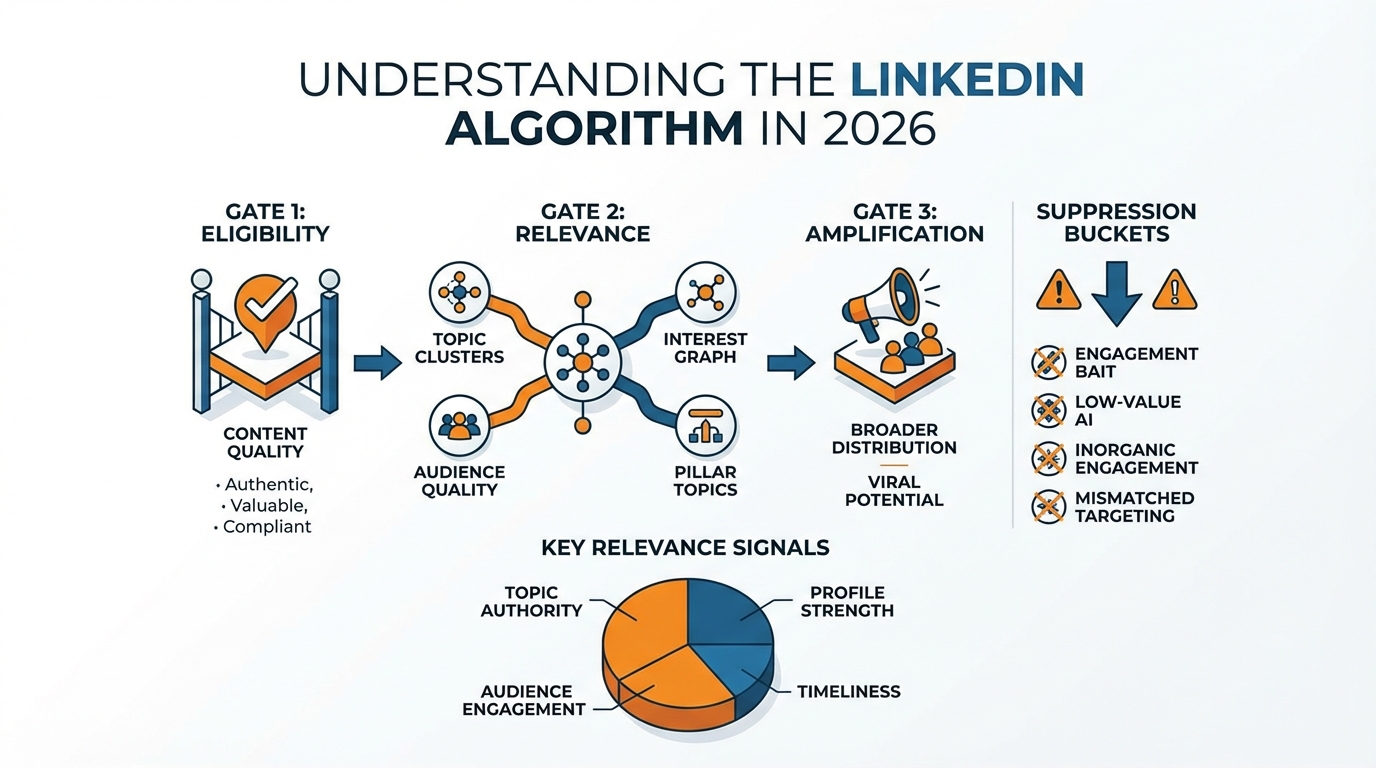
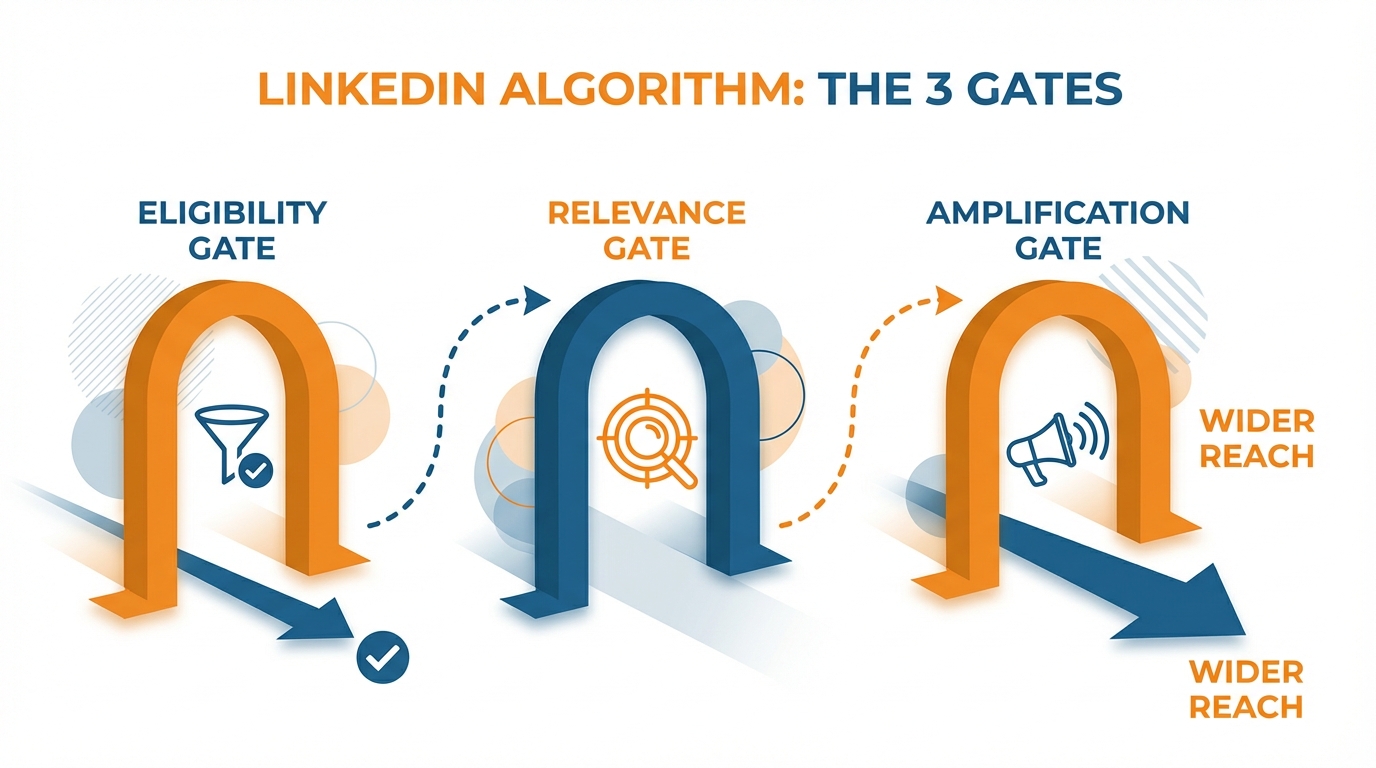
When I post something on the feed, it goes through 3 gates:
- Eligibility (is it a high-quality, not spammy, not a policy risk post?)
- Relevance (who are the most relevant people to show it to first?)
- Amplification (the more people who actually found it valuable, the more I will show it to others)
As a SMB marketer, this is what you need to do:
- write a post targeting a buyer or candidate persona
- make it clear in the first 2 sentences of the post what the post is about
- make the rest of the post digestible, engaging, and worth commenting on or saving for later
I do this by distinguishing between what’s measurable and knowable to LinkedIn, versus what’s merely a post-hoc hypothesis by the creator.
They can measure whether you held onto someone’s attention, if they clicked “see more,” if they clicked through to your profile, if they left a “meaningful” comment, if they clicked the “I don’t want to see this” button, and whether the same few accounts always seem to engage in the same way. LinkedIn has written about this in a feed-ranking dwell-time explainer, including that the P(skip) model increased AUC by as much as 10% over multiple trainings (offline), in this dwell-time ranking breakdown.
Creators mostly guess about the impact of A on B, when in reality the impact of A was negligible and B was actually caused by C.
Your move is to track leading indicators you can actually influence: do you consistently earn profile visits from the right roles, saves from people who match your market, and comment threads that stay on-topic instead of generic praise. If you need a repeatable cadence to support that, this weekly social media system is relevant.
The most important thing from 2025 is that you can’t rely on recency as much of a hack and that it matters even more to have topical coherence (i.e. topical relevance) over time, as LinkedIn becomes more and more sophisticated at identifying topic and creator. Social benchmarks also show the environment is tighter: according to fresh LinkedIn benchmark data, LinkedIn engagement decreased by 8.3% in the first half of 2025, while multi-image posts average engagement rate is 6.60%.
That’s what people mean when they say that the algorithm considers the user, not just the post.
If you post 3 different topics to 3 different groups, it becomes harder for LinkedIn to figure out who will engage, so your distribution is noisier and you grow less predictably.
If you demonstrate topical coherence, if you establish a history with a certain type of audience, and if you maintain engagement behaviors that appear organic, you become easier to serve in the feed.
For you, that means to pick one lane and stick with it for at least 30 to 60 days, to use the same terms that your customer uses, and to allow your comment behavior to affirmatively signal that lane, rather than undermine it.
Suppression buckets and common confusion
The suppression buckets in 2026 are also more transparent in effect, even if LinkedIn doesn’t tag them explicitly:
- engagement bait that demands reactions
- low-value AI repetition that’s indistinguishable from a thousand other posts
- inorganic engagement that appears coordinated
- mismatched targeting where the wrong people are engaging first
This is why people get confused by false claims.
External links aren’t penalized in themselves, but they tend to shorten on-platform session time, so the result depends on whether your audience still engages strongly before or after the click.
Hashtags don’t have a special button, but they can aid in certain kinds of classification, so they succeed when they’re tied to how your audience is searching and they fail when they’re generic.
Polls can jump your reach because they’re frictionless, but they also attract low-intent engagement that will train your distribution to the wrong audience.
Whenever I share a link, I make sure the post itself is worth engaging with: you can do the same, and earn the engagement before you make the click optional rather than the only reward.
Relevance in 2026: topic clusters, interest graph, and audience quality
What is the LinkedIn algorithm 2026 and how does it assign relevance (through topic clusters, interest graph and audience quality).
Now I said that there are 4 key components to this new algorithm, but there is actually one more, which is that your posts also need to match up with your pillar topics.
But here’s the thing.
Most people don’t understand what the new 2026 LinkedIn algorithm is actually looking for with these “pillar topics”.
Most people are using very general terms like “sales” or “leadership”, but that’s way too broad and that’s where things get wonky.
There’s just too much overlap and not enough clarity in your posting, so the algorithm doesn’t know exactly how to categorize you, and so the system is just “spraying and praying” that it’s getting it somewhat right.
What you actually want are specific clusters of topics that the algorithm can recognize, and that can be traced back to you repeatedly over time.
Like a specific type of business owner you work with, a specific type of problem you solve, a specific tool you use, or a specific industry you work in.
Instead of just “I post about marketing”, it’s more like “I help HVAC business owners fix lead flow using local landing pages and Google reviews”, and you want to keep repeating those entities in your posts so that your topical signature starts to look very clear and predictable.
So, the thing you should actually be doing is picking 2-3 topic clusters and using the same topical signature consistently for 30-60 days, because it’s the consistency that actually allows the algorithm to know that your one really good post isn’t a fluke, but a pattern that it can trust and use to route content.
The other factor controlling the Relevance score in 2026 is who you get to engage first, because LinkedIn will use that to determine whom the post is intended for.
It’s not just how many people like it, it’s their job titles and levels, their company, and whether they’ve interacted with you before.
If the first 10 people to like a post are other contractors who live in your area, then LinkedIn learns that this is a contractors-to-contractors post even if you intended it for CFOs.
If the first 10 engagers are practitioners at companies you sell into, then you get a clean signal and distribution will flow through that network.
Your to-do item is to craft the first two sentences so that the target reader self-selects out of the gate, and then populate the rest of the body with some specific, relevant examples, choices, metrics, and tradeoffs so the right readers leave valuable comments, not just a thumbs up and “Nice one!”
That’s why audience quality is king, not content views: 10 comments from the right people is worth 100 from your peers, because it will help the algorithmic guess at who should see it next.
In reality, quality engagement usually results in longer comment threads, more profile visits from desired roles, and greater re-exposure to the same kinds of decision makers over time.
I’ve seen posts with lower absolute views generate more leads because they were engaging to buyer-roles and adjacent influencers in the space, while posts with higher absolute views were mostly engaging to a broad creator audience that taught the algorithm to show it to non-customers.
For you, the heuristic is simple: decide if this will be a broad-reach or quality-reach post before you hit publish, and craft it that way.
Broad-reach content speaks more universally, and the story broader.
Quality-reach content targets harder at specific roles, includes more tactical details, and makes a more focused promise that only your customer would be interested in.
Minimizing classification uncertainty and actually winning distribution outside pods is all about providing the placement mechanics that helps LinkedIn do its job, while cultivating a distribution network that appears organic.
This means making sure your profile headline, About, and Featured section match the topics you actually write about so the system knows your profile and your content say the same thing, then cultivating your network through means that look natural like quality connections from a variety of partners, customers, vendors, and other relevant micro-influencers that appear to share your same target audience, as well as engaging with their work in the comments and partnering on topics that serve both communities. For practical guidance on staying consistent instead of drifting, read inconsistent social media posting.
If done correctly, you’ll find that your early views and engagement often come from the right graph, that your topic clusters get developed more quickly, and that the algorithm begins to see your content as a known quantity that matches a particular type of audience rather than a dice roll.
The engagement types that actually increase reach
Now that we have that covered, let’s dive into the 2026 LinkedIn algorithm and the types of engagement that will actually help increase your post’s reach (hint: it’s comments, saves, shares, and dwell):
- Comments.
- Saves.
- Shares.
- Dwell.
Now before we deep dive into the 2026 LinkedIn algorithm, let’s cover the types of engagement that lead to the highest sustained exposure, not just in 24 hours.
The highest ROI types of engagement that I’ve observed include: Comments (particularly high signal ones that keep the conversation on topic) because they make your content stay in the commenters’ feed and keep the conversation going.
Shares, because shares generate new conversations in new networks of the sharers.
Saves are usually a more silent sign of success, but very telling in the long-term for those in smaller or niche industries (it leads to more distribution in the long-term) because they’re a key indicator of the value in your content and can generate return traffic to your profile.
Reactions, because they help with the initial virality of your post.
However, likes are usually a short-term indicator and not a good indicator of success in themselves.
You want to avoid the trap of seeking engagement that’s easy to generate (even if it’s high quantity) but leads to exposure to the wrong people.
Ultimately, we measure the success of posts based on not just the traffic the post received, but the types of engagement and who engaged. LinkedIn’s own feed team has also shown how passive consumption matters; their 2024 engineering write-up includes a distribution chart where a “significant portion” of LinkedIn Weekly Active Users are passive consumers, in this member feed dwell-time analysis.
Comments: optimize for high-signal, not applause
If you want comments that have distribution value, you have to optimize for high-signal comments, not applause.
A high-signal comment is one that provides some knowledge that aids the next reader: a bit of context from their discipline, a counterpoint that strengthens the argument, an illustrative data point, or a framework that can be used within 5 minutes.
When I comment, I don’t say something generic and positive, because that doesn’t give LinkedIn any information about the topic; I pin it to the problem and the tradeoffs.
You can do the same, by closing your post with a specific decision model that demands substance: which of these constraints do you really think is relevant: time, money, risk, or talent.
This sort of question almost always results in comments that include nouns, verbs, and scenarios.
And that’s the sort of signal that LinkedIn can use to determine what your post is actually about, and who to distribute it to.
Match format to the engagement you want
But the most important thing is just to marry the format of the post with the desired engagement.
Want saves? Write a list or a checklist or a playbook or a rule of thumb that people are going to need again next week.
Want comments? Formulate an actual choice or a valid debate, and then put enough meat on the bone that the reader can actually make a decision without having to send you 5 follow-up questions.
Want shares? Create something that’s easily shareable within teams (makes the reader look good to share it). Example: Here’s a brief explanation of an expensive mistake, and a sign to detect early.
Want profile clicks? Leave a hook hanging that makes your credibility come into play. Example: “Here’s what I’ve done. I solved for this constraint.” And then don’t tell the whole story in the post.
The curiosity flows to your headline and Featured section.
In 2026, dwell and completion are the silent killers, and they play out in different ways by format.
For carousels, the key to completion is to merit each subsequent slide, not to commit to an arbitrary number of slides. The first slide should identify a problem, the middle slides should carry the proof and the tradeoffs, and the last slide should resolve with a decision someone can make today.
For text posts, you win on dwell by making the first three lines un-skimmable, then using short paragraphs that each introduce a new piece of information so the reader keeps investing attention.
For short-form video, you win by getting to the point fast and structuring it like a mini case: what happened, what changed, and what you would do if you had to repeat the result.
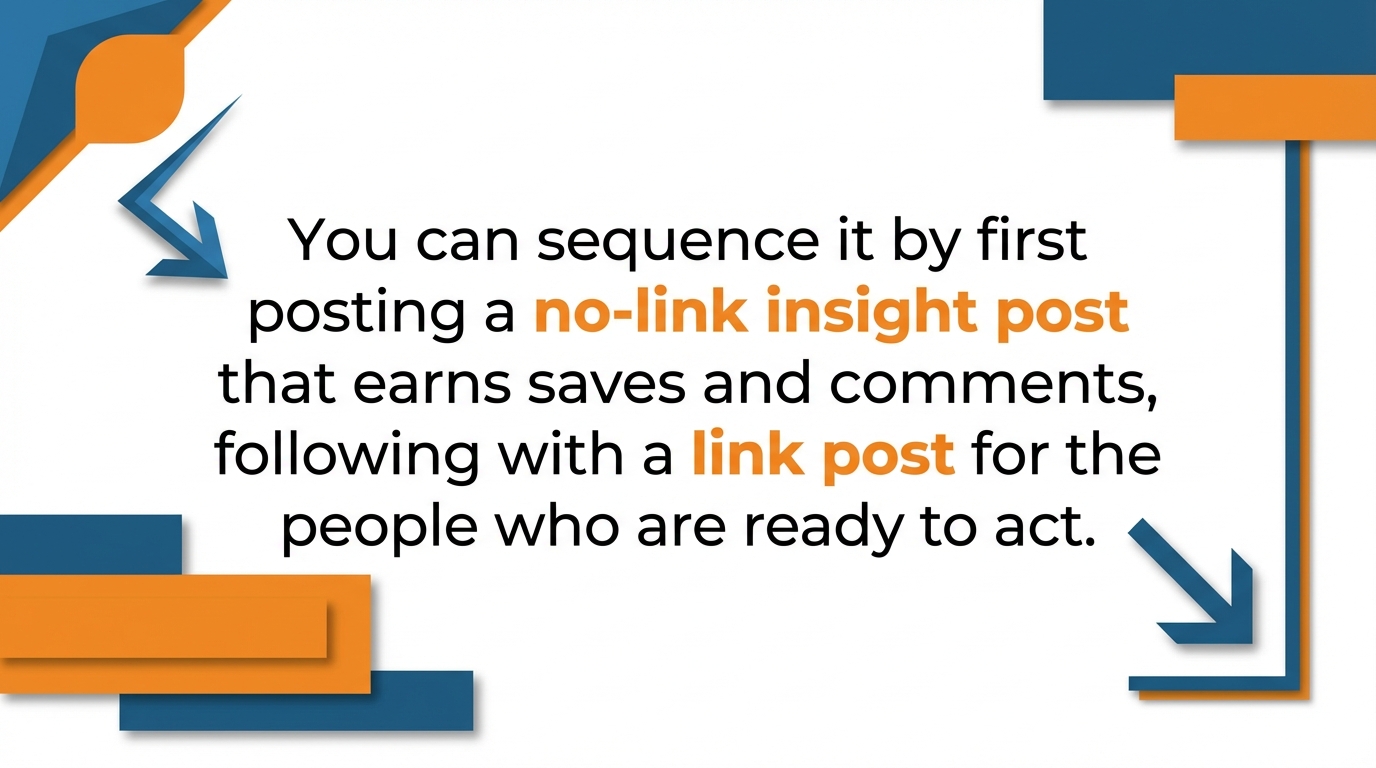
For links, the truth is simple: external clicks can reduce on-platform session time, so I only lead with a link when intent matters more than reach. You can sequence it by first posting a no-link insight post that earns saves and comments, then following with a link post for the people who are ready to act.
Last, keep your engagement patterns looking human: vary timing, avoid repetitive phrasing, and do not let the same small group be the only early engagers every time, because that predictability is a signal you are gaming the feed instead of meriting it.
Measuring, testing, and scaling without intuition
If you want to master the LinkedIn algorithm 2026, you first need to learn how to measure, test and scale content without relying on intuition:
After posting to LinkedIn in 2026, you should measure and analyze metrics that tell you what the platform is likely to ultimately reward.
For most users, that’s impression and like count.
But the early indicators of distribution are saves, follows, profile views, and DM starts, segmented by the topic cluster and format you used.
You need to have a little scorecard for each post that says this problem, this format, this action, by these people.
As you do this, you’ll start to notice that, for example, the post with fewer likes that generated 2-3x the amount of profile views from buyer job titles, is the post that’s going to guide future distribution in the right direction.
To escape the realm of guessing, you need to do clean enough experiments that you actually believe the results.
One thing at a time, or you know nothing: try hooks, then try format, then try CTA, then try timing, then try target.
Do each long enough to outrun the random number generator; it usually takes me 6-10 posts per version to see a real winner, because one anomalous hit can give you a false positive.
If you’re testing hooks, hold topic consistent for 2-3 weeks and try changing up the hook, then compare saves/1000 views and views/1000 views, not just reach.
That’s how you figure out what LinkedIn has labeled you as, and whether the people that respond are people you can sell things to or get hired by.
Pacing should reflect your identity, not a pro-blogger schedule.
If you are a founder, you typically can’t go wrong with less content, at a higher signal, that delivers value and sparks conversations, because your constraint is sales, not content.
If you are a job hunter, consistency is more important, because you want to be surfaced frequently to hiring managers and recruiters, so you should emphasize formats that are easy to repeat, and demonstrate ability through example and result.
If you are a recruiter, your cadence should often be tied to your pipeline, because posting about roles brings the right nodes in your network to you quickly, and orients the algorithm to your target candidates.
If you are an executive, you can post in bursts on one theme at a time per month, because thematic consistency is what retains your reach when you don’t post every day.
Responsible scaling isn’t a creative issue, it’s a scale issue.
Do the planning when you’re creative.
Get your thinking done in batches when you’re fresh, then touch in the small ways daily: respond in the first hour, do a few high-signal comments in your niche, DM if and only if they’ve earned it through interaction.
Stay free of platform risk and auto-pilot risk: alternate your times, don’t copy and paste responses, don’t let the same mini-bubble always bump you first.
For amplification, keep a list of relevant amplifiers to bring online based on who adds substantial comments, shares to relevant places, and has adjacent customers, and engage them via collaborative content that makes them look good for sharing.
Lastly, link each post to a stage of the funnel.
Awareness posts bump reach.
Trust posts bump saves and follows.
Conversation posts bump profile clicks and DMs.
So if you win at the algorithm, you win at business rather than just taking a screenshot. If you want more on operationalizing this, this article on smart social media automation fits this exact point.
Em conclusão,
This is the main thing you should remember for Understanding LinkedIn's 2026 algorithm: LinkedIn is rewarding you for consistency, not tricks.
Consistently clear themes, a consistently clear audience, and consistently clear value will outperform a consistently clever post format, a consistently fortunate posting time, and a consistently on-trend post template.
By using the same words in your profile as in your post-intro as in your comments, by focusing on consistently the same few topics, you're making it easier to know what you do, increasing the chances that your immediate engagement is from the right folks, and more evenly distributing your reach rather than hitting it in a spike.
If I were optimizing your approach this week, I’d optimize first for positioning clarity, meaning a stranger can tell who you serve, what you help them accomplish, and what your proof is.
Then you’d get more disciplined on topic clusters, choosing 2 to 3 and committing to hit the same terms and entities for 30 to 60 days since that repetition is what influences the interest graph.
Last, you’d focus on optimizing engagement for high-signal activities like writing conclusions that create tough decisions, responding with specifics that keep the conversation on track, and striving for saves and profile views from people in buyer roles rather than going for likes. LinkedIn has also published research on personalization systems that reported measurable lifts, including a 0.10% lift in weekly active users (WAU) and a 0.62% improvement in click-through rate (CTR), in this personalized-notification GNN paper.
If you want to do one clean experiment, change one thing for 6 to 10 posts and then assess with a metric like saves per 1,000 views and profile views per 1,000 views rather than just measuring pure reach.
Think of distribution as a quality control process, not a random drawing.
You’re aiming for an outcome where the initial engagement is mainly coming from the people you sell to, since those initial job titles inform who the platform attempts to draw next.
I have seen SMBs get more value from a smaller post that drew the right operators into the conversation and drove repeat profile visits, and I have seen high-view posts mysteriously ruin future distribution when the initial engagers were largely peers, other creators, or friends who are not in-market.
What I would not pay attention to going forward is any so-called rule that seems absolute, and definitely general algorithm hacks that are not aligned with your purpose and audience quality objectives.
In 2026, the quickest way to kill your momentum is to chase engagement tactics that are easy, but that teach the algorithm the wrong audience; and the quickest way to build compounding momentum is to make your expertise unmistakable, your targeting obvious in the first two lines, and your engagement behavior useful to the precise niche you want to own. If you want a broader framework that connects this to systems and compounding results, this post on social media automation is closely related.
Related reads
3/7/2026
TikTok to Reels Crossposting Workflow 2026: The Ultimate Guide
Learn the 2026 TikTok to Reels crossposting workflow. Optimize for speed, views, and Instagram-native quality to beat algorithms & grow.
3/2/2026
Threads for business: How to get started in 2026
Discover how small businesses can leverage Threads in 2026 for conversation-led growth. Learn to test offers, build a routine, and convert attention to action within the Meta ecosystem.
2/21/2026
How to Market a Law Firm on LinkedIn
Market your law firm effectively on LinkedIn. Learn a system that leverages individual lawyer profiles to build trust, relationships, and attract ideal clients.